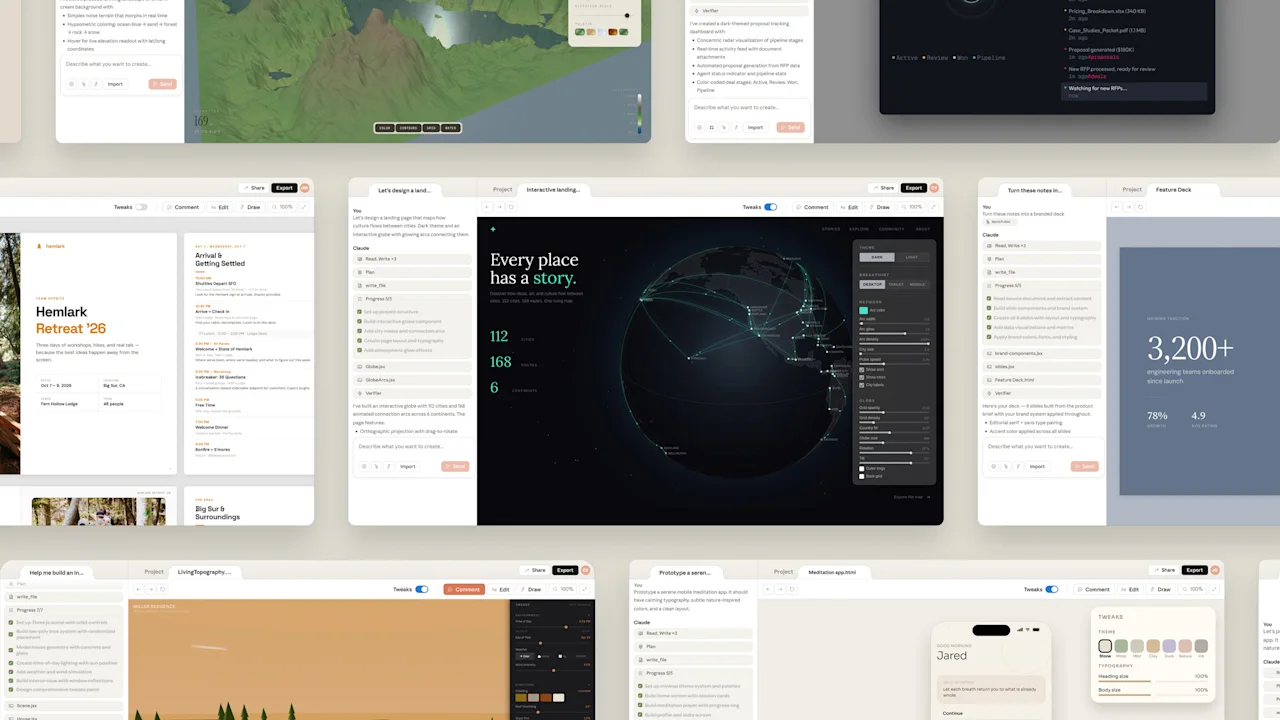
Anthropic has introduced Claude Design, a new interface for its flagship AI model that signals a significant expansion from text-based assistance into the realm of visual production. Powered by the recently released Opus 4.7 model, the tool allows users to generate prototypes, slide decks, and one-pagers through natural language prompts. By positioning the product as a bridge between high-level concepts and functional mockups, Anthropic is moving to challenge the established territories of Canva, Figma, and Adobe — companies that have spent years building dedicated design ecosystems.
The technical premise relies on Claude's ability to handle complex, multi-stage tasks and difficult coding prompts. Users can feed the model existing codebases, brand documents, or reference images to ground the AI's creative output in specific technical or aesthetic constraints. This creates a feedback loop where the AI acts as a digital intermediary, capable of translating design intent into something approaching a functional product.
From Language Model to Design Surface
The trajectory from text generation to visual production has been building for some time. Large language models first demonstrated competence in writing code, then in reasoning about spatial layouts and component hierarchies. Claude Design represents a logical next step: collapsing the distance between describing what a product should look like and producing an artifact that can be tested, shared, or handed to an engineering team.
The competitive implications are worth parsing carefully. Figma has built its dominance on collaborative, browser-based design workflows that serve professional teams. Adobe's suite remains the standard for high-fidelity visual production. Canva carved out a market among non-designers who need polished output without specialized training. Claude Design does not replicate any of these tools exactly. Instead, it operates at a different layer of abstraction — one where the input is intent, expressed in natural language, and the output is a working prototype rather than a static composition. The question is whether that layer of abstraction is sufficient for professional use or whether it will primarily serve as a rapid ideation tool that still requires refinement in traditional software.
This distinction matters because design tools have historically been defined by their precision. A Figma file carries exact spacing, type scales, and component states. A prototype generated from a text prompt may capture the spirit of a layout without matching the rigor that production workflows demand. If Claude Design can close that gap — particularly by ingesting existing brand systems and codebases as constraints — it could shift from a novelty to a genuine workflow component.
The Disappearing Interface
This launch reflects a broader industry convergence. As general-purpose large language models gain visual and structural capabilities, the distinction between a chatbot and a dedicated design suite is eroding. For professional designers, the value proposition lies in rapid iteration — moving from concept to testable artifact in minutes rather than hours. For non-specialists, it offers a lower barrier to entry for visual communication, much as Canva did a decade ago but with an even more accessible input mechanism.
The pattern echoes what has already occurred in software development, where AI coding assistants have not replaced engineers but have compressed the cycle between idea and working code. Design may follow a similar path: AI-generated prototypes serve as a starting point, refined by human judgment and domain expertise. The risk for incumbents is not immediate displacement but gradual erosion of the early-stage workflow — the sketching, wireframing, and low-fidelity prototyping that currently happens inside their platforms.
The result is a design landscape where the tool itself becomes increasingly invisible, replaced by an interface that prioritizes intent over manual execution. Whether that shift empowers designers or commoditizes their craft depends on where the ceiling of AI-generated output settles — and whether the companies whose territory is being encroached upon can absorb the same capabilities into their own products before the workflow migrates elsewhere.
With reporting from Fast Company Design.
Source · Fast Company Design