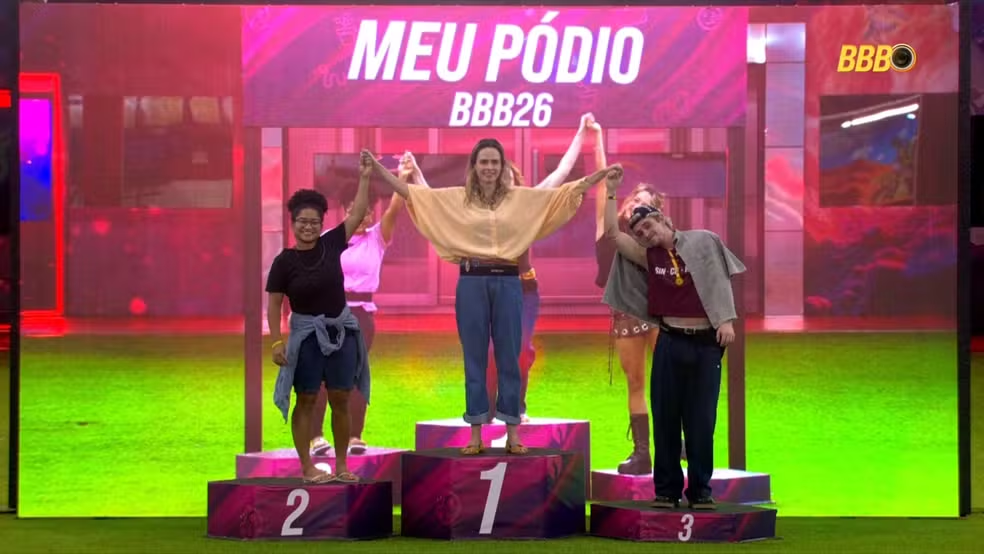
The "ideal podium" has become a cornerstone of the *Big Brother Brasil* (BBB) social experiment—a public declaration of loyalty that serves as both a strategic anchor and a potential liability. In the show’s 26th season, the ritual of selecting a final three revealed the inevitable friction between early-game optimism and the cold pragmatism required to survive the competition’s final weeks.
Initial predictions made on January 19 offered a snapshot of the house’s nascent social architecture. At that stage, alliances were often built on immediate rapport rather than proven reliability. However, by the time the finalists were asked to revise their choices on April 6, the landscape had been fundamentally reshaped by months of isolation, strategic eliminations, and the natural erosion of trust inherent in a high-stakes environment.
The discrepancies between those early forecasts and the final reality underscore the volatility of human connection within a closed system. For some, the final podium represents a rare consistency in a game defined by flux; for others, the shift in choices reflects a calculated pivot toward the path of least resistance. Ultimately, the exercise serves as a post-mortem on the social contracts formed—and broken—under the constant pressure of the cameras.
With reporting from [Exame Inovação].
Source · Exame Inovação