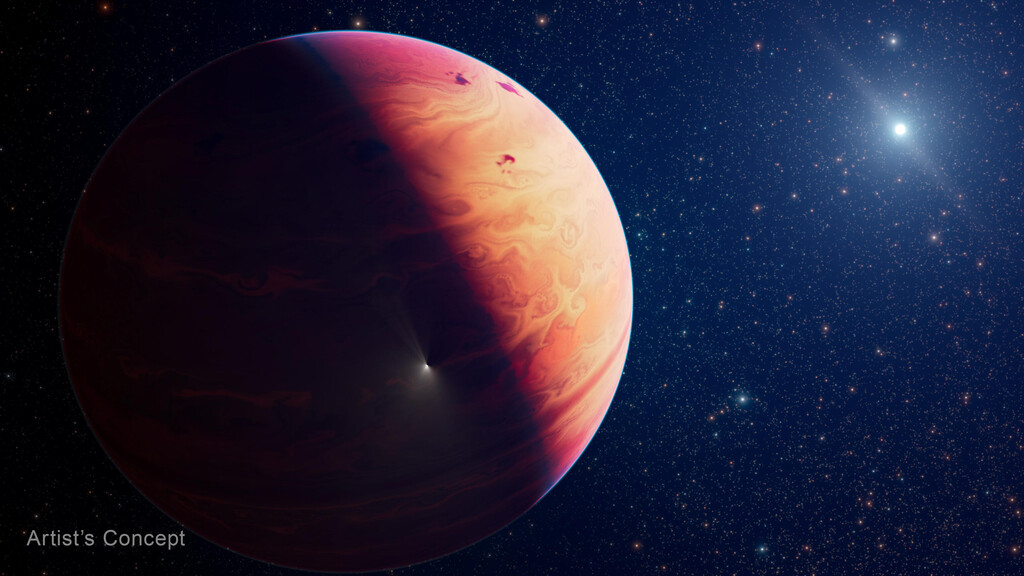
The celestial object 29 Cygni b has consistently posed a challenge to traditional astronomical classifications. With a mass equivalent to 15 times that of Jupiter, it occupies the gray area between a giant planet and a brown dwarf—a type of "failed star." Recently, a team of astronomers utilized the James Webb Space Telescope to investigate whether this giant formed "bottom-up," like planets, or "top-down," like stars. The answer emerged through the NIRCam instrument, which facilitated a detailed spectroscopic analysis of the object's atmosphere. The data revealed that 29 Cygni b possesses a remarkable concentration of metals, equivalent to 150 times Earth's mass. This metallic enrichment is significantly higher than that of the star it orbits, a strong indication that its formation occurred through the accretion of solids within a protoplanetary disk. This discovery confirms that, despite its colossal mass, 29 Cygni b is genuinely a planet. While stars form via the gravitational collapse of gas clouds (top-down), this object grew from the gradual accumulation of dust and rock (bottom-up), challenging the perceived maximum size a planet can attain. The study not only resolves the identity of a distant cosmic neighbor but also refines models of planetary formation. By demonstrating that metallicity serves as the "fingerprint" distinguishing massive planets from small stars, the James Webb paves the way for a more sophisticated understanding of the architecture of solar systems beyond our own. With information from Xataka.
Source · Xataka