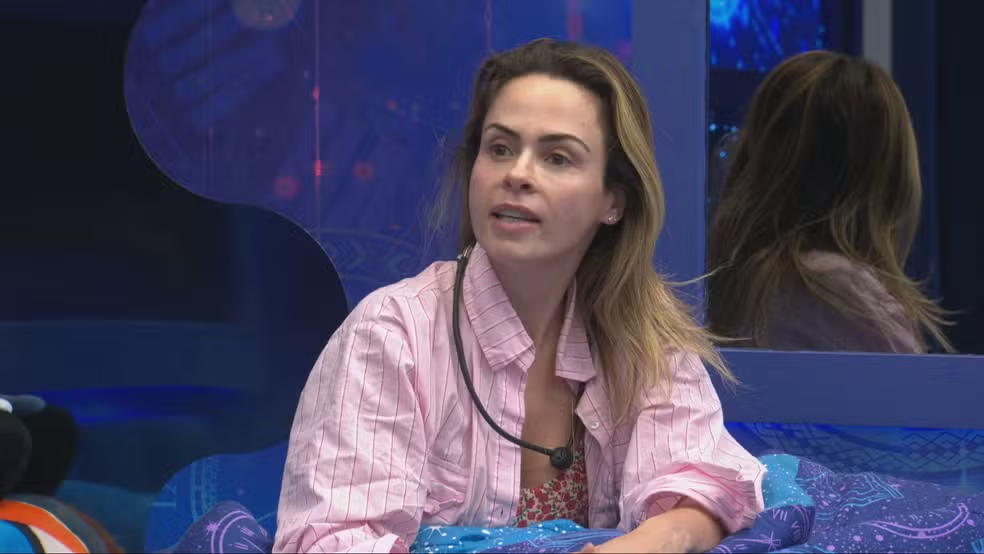
The marathon of Big Brother Brasil 26 reached its final hours on Tuesday, marking the conclusion of a season that once again dominated the national conversation. As the public prepared to cast its final votes, the social and emotional infrastructure surrounding the contestants moved into the spotlight. On the morning talk show *Encontro*, hosted by Patrícia Poeta, the inner circles of the finalists gathered to reflect on a journey that is as much a test of endurance for families as it is for the participants themselves.
The finalists—Juliano Floss, Ana Paula Renault, and Milena—represent the latest iteration of the show’s ability to turn digital influence and personality into a high-stakes social experiment. For those watching from the outside, the finale is a spectacle of entertainment; for those within the contestants’ immediate orbits, the experience is more fraught. A close friend of Ana Paula Renault described the closing day as a "mixture of pain and joy," capturing the exhaustion of a months-long campaign and the relief of an impending return to reality.
This emotional duality is a hallmark of the Big Brother phenomenon, where the boundary between private life and public performance is systematically dissolved. As the season ends, the focus shifts from the internal dynamics of the house to the broader cultural impact of the winners. In the ecosystem of Brazilian media, the finale is less of an ending and more of a transition, as these individuals move from the controlled environment of the reality set into the unpredictable machinery of modern celebrity.
With reporting from Exame Inovação.
Source · Exame Inovação