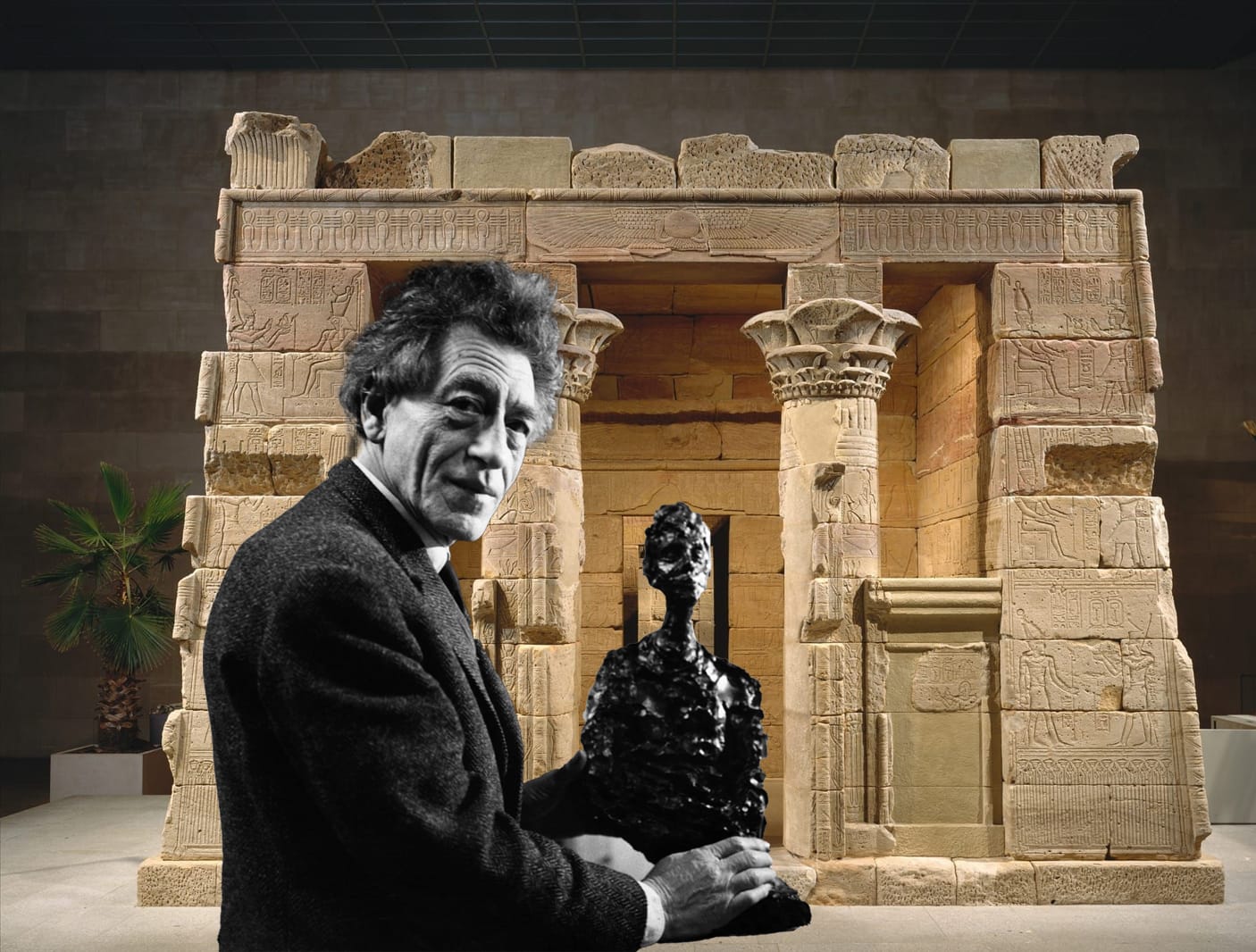
The Temple of Dendur, a first-century BCE sandstone monument dedicated to the goddess Isis, has long served as a sanctuary of stillness within the Metropolitan Museum of Art. This summer, that stillness will be punctuated by the arrival of Alberto Giacometti’s gaunt, elongated figures. In a collaboration with the Paris-based Fondation Giacometti, the museum will install 17 of the Swiss sculptor’s works within and around the temple, creating a visual dialogue between modern existentialism and ancient ritual.
The pairing is less anachronistic than it first appears. Giacometti was a lifelong student of Egyptian art, drawn to its unique blend of naturalism and symbolic power. The exhibition, \"Giacometti in the Temple of Dendur,\" highlights this kinship through works like the 1932 bronze \"Femme qui marche I\" (Woman walking) and the 1956 \"Femme de Venise I\" (Woman of Venice). These figures, ranging from mere inches to over eight feet tall, mirror the lean, hieratic proportions of the figures etched into the temple’s walls.
By placing these mid-century silhouettes in a space built to honor motherhood and magic, the Met invites a meditation on the human form as a constant across deep time. As Emilie Bouvard, curator of the Fondation Giacometti, notes, the sculptor sought a \"monumentality\" that did not sacrifice humanity. In the shadow of the Temple of Dendur, Giacometti’s sculptures suggest that the search for the essential human spirit remains unchanged, whether carved in stone for an Egyptian goddess or cast in bronze for a post-war world.
With reporting from Hyperallergic.
Source · Hyperallergic