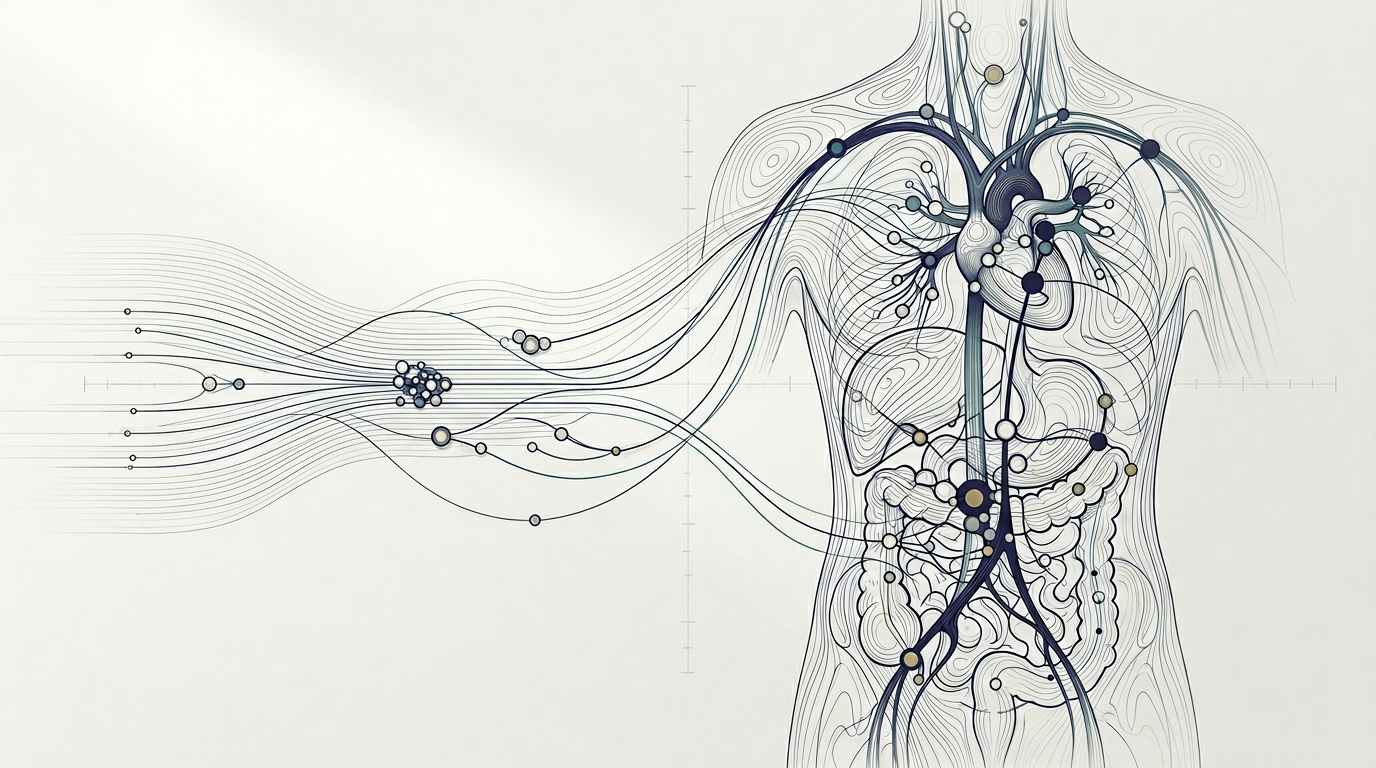
Stanford University professor James Zou is seeking to raise capital at a roughly $1 billion valuation for a startup that would build artificial intelligence models designed to improve research about the human body, according to Bloomberg reporting. The company would focus on AI-for-physiology — an emerging niche that applies foundation-model techniques to biological and physiological data rather than text or images.
The fundraising effort, if successful at that valuation, would place the startup among a growing cohort of AI companies that have reached unicorn status before shipping a commercial product. More importantly, it marks a conceptual shift: the thesis that the most consequential AI breakthroughs may not come from ever-larger general-purpose language models, but from domain-specific systems trained on the particular complexity of human biology.
From Language Models to Body Models
The past three years of AI investment have been dominated by a relatively narrow template — large language models (LLMs) trained on internet-scale text, then fine-tuned for tasks ranging from coding to customer service. The economics of that paradigm have been extraordinary, but the architecture is increasingly being transplanted into domains where text is not the native medium. Protein-folding, drug discovery, and genomics have each attracted their own foundation-model efforts, with companies like Recursion Pharmaceuticals and Isomorphic Labs building dedicated AI stacks for molecular biology.
Zou's reported venture extends this logic to physiology more broadly — the study of how the body's systems function in health and disease. The distinction matters. While much of AI-for-biology has concentrated on molecular or cellular scales, physiology encompasses organ-level and whole-body dynamics: cardiovascular function, metabolic regulation, neural signaling. If the startup succeeds in building models that capture these higher-order interactions, it could complement molecular-level AI tools and open new avenues for clinical research. The $1 billion target valuation, however, also reflects the degree to which investor appetite for anything labeled "AI + bio" has outpaced demonstrated clinical utility.
The Valuation Question in Frontier Bio-AI
A billion-dollar pre-product valuation is no longer unusual in generative AI, but it carries particular tensions in the biomedical space. Unlike a chatbot or a coding assistant, whose value can be tested in weeks, biological AI models face long validation cycles. The data they require — physiological measurements, longitudinal health records, multi-organ interaction data — is fragmented, often proprietary, and subject to strict regulatory and ethical constraints. Building a defensible dataset is itself a multi-year endeavor.
Zou's academic credentials lend credibility to the effort. As a professor at Stanford — an institution whose AI lab has been a talent pipeline for some of the industry's most valuable companies — he brings both research depth and proximity to the networks that fund frontier ventures. Yet the history of AI-for-healthcare startups is littered with companies that attracted large valuations on the strength of academic pedigree and a compelling thesis, only to struggle when translating research prototypes into products that hospitals, pharmaceutical firms, or regulators would adopt. The gap between a promising model and a validated clinical tool remains one of the widest in the technology landscape.
The broader pattern is nonetheless significant. Capital is flowing not just into bigger general-purpose models but into specialized systems designed for specific scientific domains. If this trend holds, the AI industry's center of gravity could gradually shift from consumer-facing applications toward research infrastructure — tools that accelerate discovery rather than automate existing workflows. For the biotech and pharmaceutical sectors, the implications are substantial: AI models that faithfully represent human physiology could compress research timelines, reduce reliance on animal models, and surface drug targets that traditional methods miss.
As the boundaries between AI research and biomedical science continue to blur, the question is not whether domain-specific models will attract capital — they clearly will — but whether the validation frameworks and data ecosystems exist to justify the valuations being assigned. Zou's startup will be one test case among many, and the answer is unlikely to arrive quickly.
With reporting from Bloomberg — Technology
Source · Bloomberg — Technology