In the forests of Grödinge, south of Stockholm, the European spruce bark beetle has become one of the most visible agents of ecological disruption. The insect bores into weakened or drought-stressed spruce trees, severing the cambium layer that carries nutrients between roots and canopy. The bark loosens, the tree dies, and what remains is a standing column of exposed wood surrounded by curling sheets of detached bark. Across Scandinavia, successive warm summers have accelerated beetle outbreaks, leaving vast tracts of dead spruce in their wake. It is precisely this material—bark stripped by infestation—that Ulf Mejergren Architects (UMA) has gathered to construct the Spruce Bark Hut, a small shelter that treats forest decay not as waste but as a building resource.
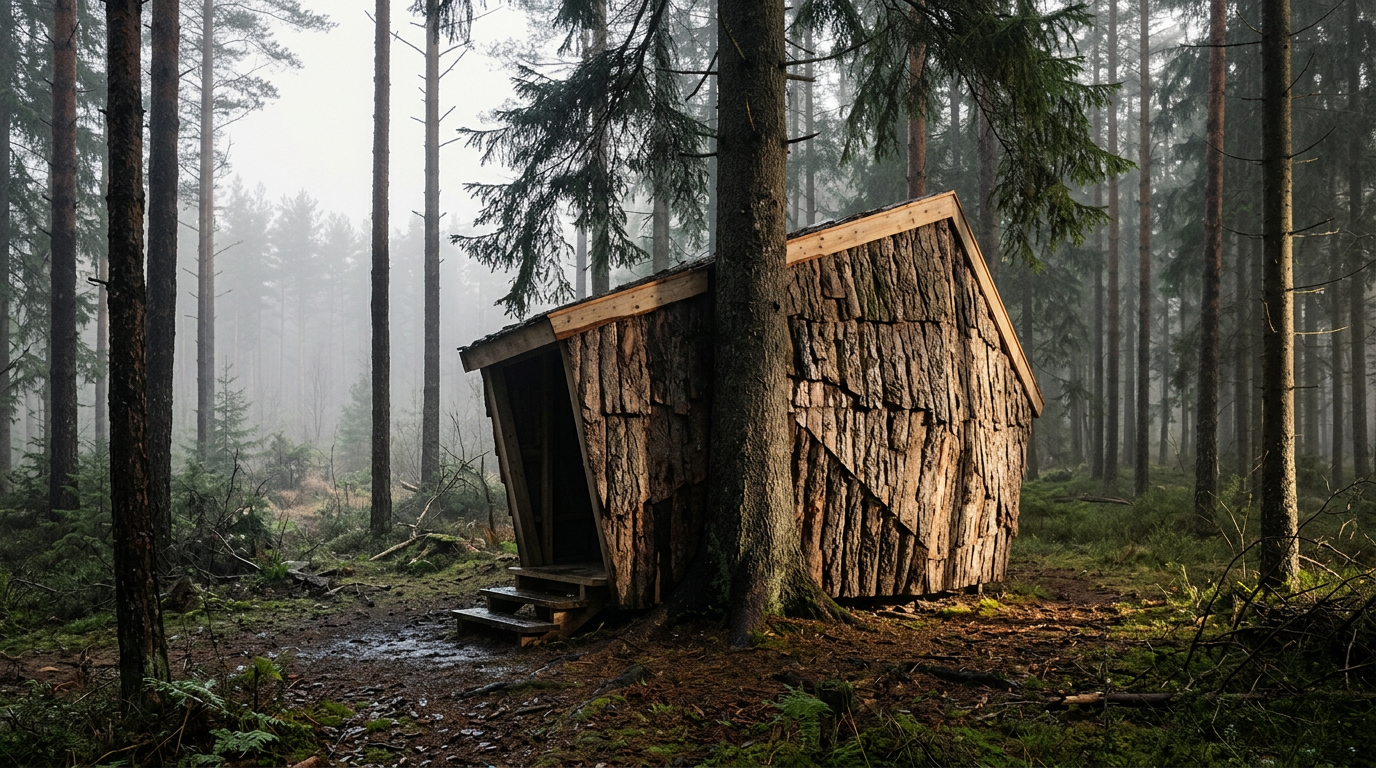
The hut sits in the Grödinge woodland, built around a living spruce tree whose trunk serves as a central structural pillar. A lightweight frame of timber and masonite provides a secondary skeleton, onto which sheets of salvaged bark are layered, folded, and stapled in overlapping courses. The result is a primitive enclosure whose form draws explicitly from the architecture of anthills—mound-like structures that use the verticality of a tree as an anchor and organize material in concentric, additive layers.
Between Beetle and Ant: Two Biological Logics
The conceptual framework of the project rests on a deliberate pairing of two insect behaviors. The bark beetle is the demolition agent: it provides the raw material by killing trees and separating bark from trunk. The ant is the construction model: its hill-building logic—accretive, vertical, organized around a central axis—supplies the formal and structural language. UMA positions the architect as a mediator between these two processes, harvesting what one organism discards and assembling it according to the spatial intelligence of another.
This is not an entirely new impulse in design. The broader field of bio-based architecture has, over the past decade, explored materials derived from living systems—mycelium composites, hempcrete, bacterial cellulose—as alternatives to carbon-intensive building products. What distinguishes the Spruce Bark Hut is the directness of its material chain. There is no industrial processing, no laboratory cultivation. The bark is collected from dead trees and applied almost as-is, functioning less like conventional timber cladding and more like a textile. It is thin, pliable, and paper-like, qualities that allow it to be wrapped and shaped rather than cut and joined. The resulting envelope is weather-resistant in the short term, though it will inevitably continue to decompose—a fact the project appears to accept rather than resist.
Architecture Within the Cycle, Not Against It
The Spruce Bark Hut belongs to a lineage of experimental structures that treat impermanence as a design parameter rather than a flaw. Temporary pavilions, land art installations, and vernacular shelters built from foraged materials share a willingness to let a building age, erode, and eventually return to its site. The difference here is the specificity of the ecological context. The beetle epidemic is not a neutral backdrop; it is a consequence of rising temperatures and shifting forest management practices across Northern Europe. By building with the byproduct of that epidemic, UMA frames architecture as something that can operate within cycles of environmental stress rather than in opposition to them.
The question the project leaves open is one of scalability and intent. As a one-off installation in a Swedish forest, the Spruce Bark Hut functions as a provocation—a demonstration that discarded organic matter can enclose space and shelter bodies. Whether the logic extends beyond the poetic prototype into repeatable building practice depends on factors the hut itself does not address: the economics of bark harvesting at scale, the durability limits of untreated organic cladding, and the regulatory frameworks that govern building materials in Northern Europe. The tension between the project's elegance as a concept and its fragility as a structure is precisely what makes it worth watching. It asks whether architecture can be an act of metabolic participation in a landscape rather than an imposition upon it—and leaves the answer to the forest.
With reporting from Designboom.
Source · Designboom