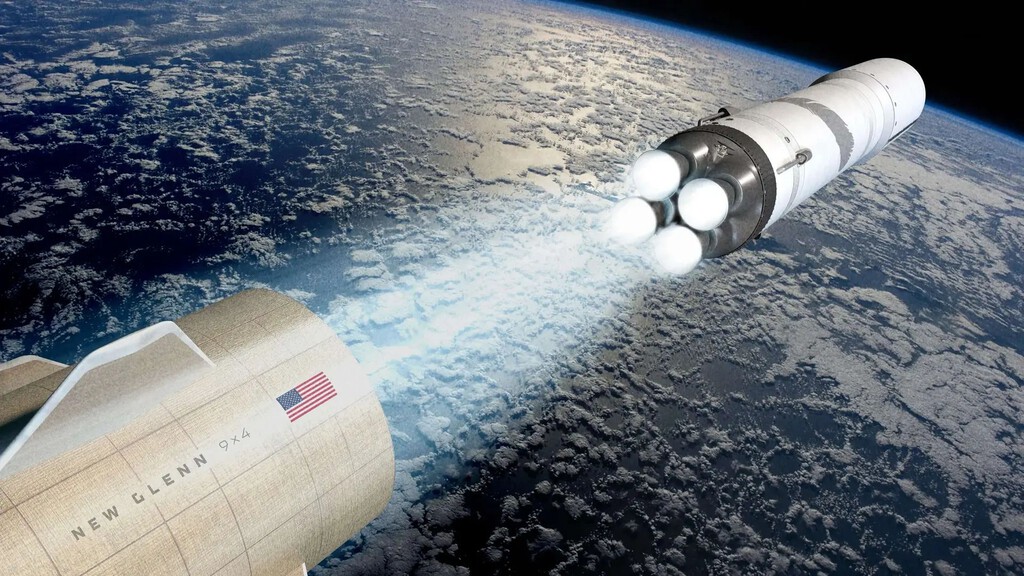
For years, the narrative of the private space race has been one of a widening chasm between SpaceX and its competitors. While Elon Musk’s firm turned rocket reuse into a routine industrial process, Jeff Bezos’s Blue Origin remained largely confined to suborbital hops with the smaller New Shepard. That dynamic shifted this week when Blue Origin successfully launched and recovered a previously flown New Glenn booster, matching a technical feat that has, until now, been the exclusive domain of SpaceX.
The achievement marks a significant maturation for the New Glenn program. Unlike the New Shepard, which is designed for brief tourist flights to the edge of space, the New Glenn is a heavy-lift orbital workhorse designed to compete for lucrative satellite contracts and NASA missions. Reusing its first-stage booster is a prerequisite for the economic viability Bezos has long promised, signaling that the company has finally mastered the complex thermal and structural stresses of atmospheric reentry at orbital scales.
However, the milestone was marred by a critical failure in the mission’s primary objective. While the booster returned to Earth as intended, the satellite payload was deployed into an incorrect orbit. In the exacting world of aerospace, a successful landing is a secondary triumph if the customer’s hardware is misplaced. The error serves as a sobering reminder that while Blue Origin is closing the engineering gap on hardware recovery, it still lacks the operational consistency that has made SpaceX the de facto utility of the modern space age.
The duality of the mission—a breakthrough in sustainability coupled with a failure in delivery—captures the current state of the "billionaire space race." Blue Origin is no longer a mere spectator in the heavy-lift market, but it remains in a period of high-stakes refinement. For Bezos, the path to the moon and beyond requires not just rockets that can come back, but rockets that can reliably put their cargo exactly where it belongs.
With reporting from [Xataka].
Source · Xataka