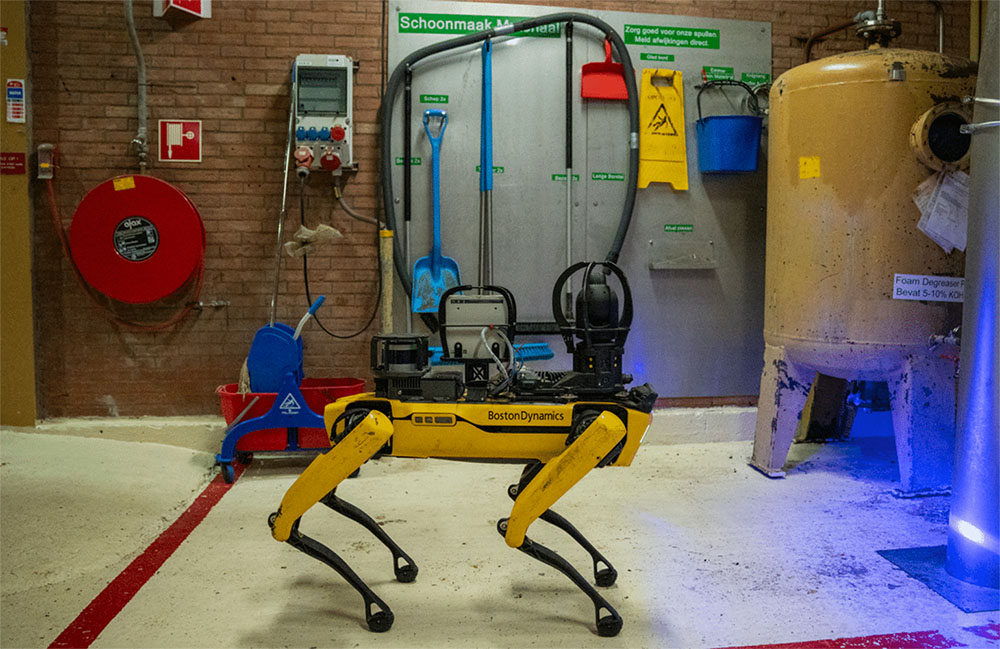
For years, the progress of mobile robotics has been measured by physical agility — how well a machine might navigate a cluttered floor or climb a flight of stairs. Boston Dynamics' Spot quadruped has long been the benchmark for such mobility, deployed across oil rigs, construction sites, and power plants to perform inspection tasks that would be tedious or hazardous for human workers. But the next frontier for these machines is not movement. It is cognition. In a new partnership with Google DeepMind and Google Cloud, Boston Dynamics is integrating the Gemini large language model into its fleet, aiming to bridge the gap between raw perception and structured reasoning.
The integration centers on Gemini Robotics ER 1.6, a specialized version of Google's multimodal AI designed for what the companies describe as "reasoning-first" applications. By embedding this capability into the Orbit AIVI-Learning system — the software layer that governs Spot's autonomous inspection workflows — the robot moves beyond simple object recognition. Instead of merely identifying a valve or a gauge, Spot can now interpret the state of an industrial facility with greater nuance, drawing on multi-view understanding and task planning to navigate complex, high-stakes environments.
From sensor platform to industrial agent
The distinction matters more than it might appear at first glance. In its current commercial deployments, Spot typically follows pre-programmed routes, captures images or thermal readings at designated waypoints, and flags anomalies for human review. The robot sees, but it does not reason about what it sees. A leaking pipe is a visual anomaly; whether it represents an urgent safety risk or a routine maintenance item remains a judgment call left to operators reviewing the data after the fact.
Integrating a large language model with multimodal capabilities changes the architecture of that workflow. Gemini allows the hardware to call upon external tools — including Google Search and various vision-language-action models — to resolve ambiguities in real time. If Spot encounters a piece of equipment in an unexpected state, the system can cross-reference visual data against operational context, equipment manuals, or historical inspection records to generate a more informed assessment. The robot does not simply report; it begins to interpret.
This trajectory mirrors a broader pattern across industrial robotics. The physical hardware for inspection and monitoring has matured considerably over the past decade. Quadrupeds, drones, and wheeled platforms can reliably traverse most industrial environments. The bottleneck has shifted upstream, toward the intelligence layer — the ability to make sense of what sensors capture without requiring a human in the loop for every decision. Companies across the sector have been experimenting with foundation models to address precisely this constraint, though few have announced integrations at the scale of a Boston Dynamics–DeepMind collaboration.
The tension between autonomy and trust
The promise of a reasoning robot, however, carries its own set of complications. Industrial environments are governed by strict safety protocols, regulatory frameworks, and liability structures that assume human judgment at critical decision points. A robot that merely captures data and defers to operators fits neatly into existing workflows. A robot that interprets conditions and recommends — or eventually initiates — responses introduces questions about accountability that the industry has not fully resolved.
There is also the matter of reliability. Large language models, including Gemini, are known to produce confident but incorrect outputs — a characteristic sometimes called hallucination. In a consumer application, a wrong answer is an inconvenience. In a petrochemical facility or a nuclear plant, it could be something else entirely. How Boston Dynamics and DeepMind calibrate the system's confidence thresholds, and how much autonomy operators are willing to grant, will likely determine whether this integration becomes a genuine operational shift or remains a sophisticated demonstration.
The partnership positions Spot at an interesting inflection point: physically capable enough to operate in demanding environments, and now potentially intelligent enough to reason about them. Whether the industries that rely on these machines are ready to let them do so is a separate question — one shaped less by technology than by regulation, organizational culture, and the slow accumulation of operational trust.
With reporting from The Robot Report.
Source · The Robot Report