The fundamental divide between living systems and engineered devices is one of texture and medium. Biological life is soft, wet, and communicates through the movement of ions — charged molecules such as potassium and sodium that carry signals across cell membranes and along nerve fibers. Electronics, by contrast, are rigid architectures of silicon and copper, driven by the flow of electrons through solid-state circuits. For decades, that mismatch has imposed hard limits on how intimately machines can interact with the body.
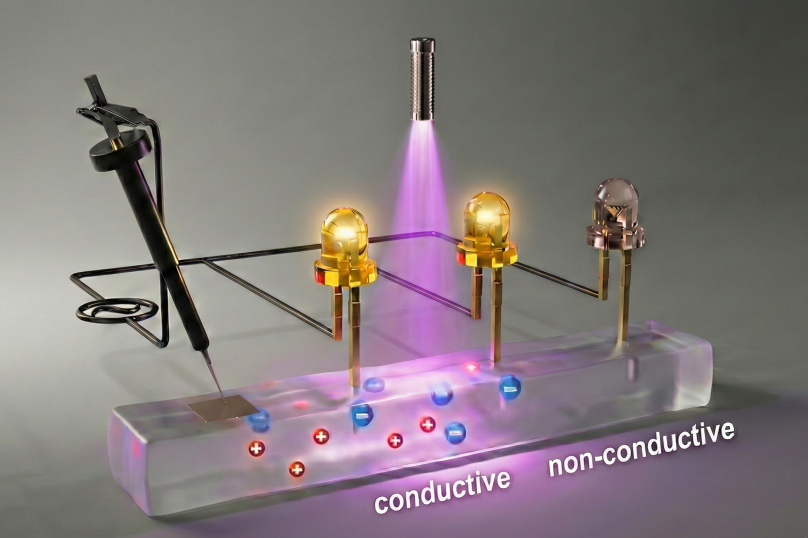
Researchers at MIT have introduced a material designed to narrow that gap: a flexible, biocompatible gel whose ionic conductivity changes dramatically when exposed to light. By manipulating the local ion population within the material, the engineers can dynamically control how signals move through the soft substrate. The work sits within a growing field known as ionotronics — the effort to build devices that process information using ions rather than electrons, effectively translating the language of biology into the logic of hardware.
From passive conduit to active interface
What distinguishes the MIT gel from earlier ionic materials is the degree of control it offers. Rather than serving as a static bridge between a sensor and a circuit, the gel functions as a self-adaptive system. Light exposure alters the material's internal ion distribution, enabling engineers to tune conductivity in real time without physical contact. That property opens a design space that has been difficult to reach with conventional approaches, where adjusting ion flow typically requires changes in voltage, temperature, or chemical composition — interventions that can be slow, energy-intensive, or incompatible with living tissue.
The concept of using light as a control signal is not new in materials science. Optogenetics, for instance, has demonstrated the power of light-responsive proteins to activate or silence neurons in laboratory settings. Photoresponsive polymers have likewise been explored for drug delivery and shape-morphing structures. The MIT work extends that logic into the domain of ionic transport in soft matter, a combination that could prove relevant wherever electronics must conform to — and communicate with — biological surfaces.
Soft robotics is one obvious application area. Current soft actuators and grippers often rely on pneumatic pressure or electrochemical stimulation, both of which impose constraints on speed, precision, or biocompatibility. A material that modulates ion flow optically could enable softer, lighter actuators with faster response times and fewer rigid components. Wearable health monitors represent another potential use case: devices that sit against the skin must contend with sweat, motion, and the mechanical mismatch between hard circuit boards and compliant tissue. An ionic gel that adapts its conductivity to ambient conditions could reduce signal noise at the body-device boundary.
The harder question of scale
Materials that perform well in a laboratory setting do not always survive the transition to manufactured products. Ionic gels must maintain their photoresponsive properties over thousands of activation cycles, across a range of temperatures and humidity levels, and at scales compatible with existing fabrication processes. Biocompatibility, too, is a spectrum rather than a binary: a material that passes initial cytotoxicity screening may still provoke immune responses over weeks or months of continuous skin contact.
There is also the question of where ionotronic devices fit within the broader electronics ecosystem. Ions move more slowly than electrons, which means ionic circuits are unlikely to compete with silicon for raw computational speed. Their value lies elsewhere — in the ability to interface with biological tissue on its own chemical and mechanical terms. That positions ionotronics less as a replacement for conventional electronics and more as a complementary layer, one that handles the messy, wet boundary between body and device while traditional chips handle processing and communication.
The MIT gel, then, is best understood not as a finished product but as a proof of principle for a design philosophy: that the next generation of human-machine interfaces may depend less on making biology compatible with electronics and more on making electronics compatible with biology. Whether that philosophy scales from bench to bedside will depend on durability data, manufacturing economics, and the willingness of device makers to rethink interface architectures that have relied on rigid substrates for half a century. The tension between what is scientifically elegant and what is industrially viable remains the defining constraint.
With reporting from MIT News.
Source · MIT News