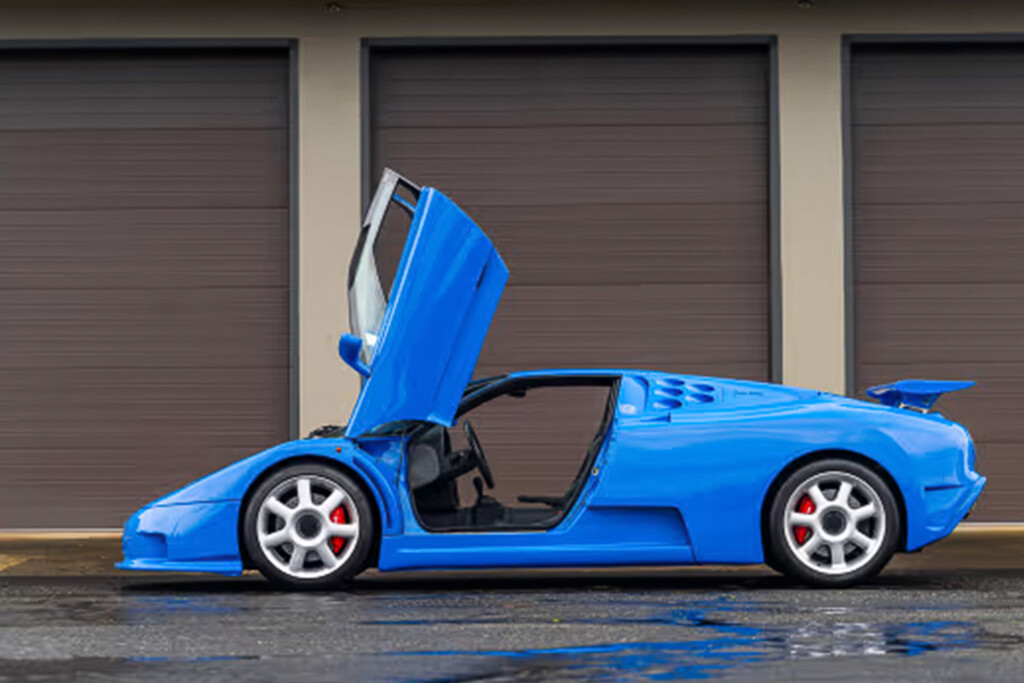
The 1995 bankruptcy of Bugatti Automobili SpA was more than a financial failure; it was the abrupt end of an era of industrial romanticism. Under the leadership of Romano Artioli, the brand had established a state-of-the-art factory in Campogalliano, Italy, aiming to reclaim the pinnacle of automotive engineering. But as creditors moved in to dismantle the estate, a curious discrepancy emerged: chassis number 021—a newly completed EB110 Super Sport finished in the brand’s signature Blu Bugatti—simply vanished from the inventory.
The EB110 was a rare specimen of 1990s excess and precision, with only 139 units ever produced. Of those, the Super Sport variant was the most coveted, representing a limited run of just 30 cars. Its cultural footprint was cemented by owners like Michael Schumacher, who purchased chassis 020 just as his Formula 1 career was taking flight. While Schumacher’s yellow Super Sport became a public icon, its successor on the assembly line, number 021, became a ghost, absent from the bank ledgers meant to settle Artioli’s debts.
For twenty-four years, the car remained a legend among collectors—a "lost" Bugatti that existed in production logs but not in the physical world of auctions or private collections. Its recent surfacing marks the end of a decades-long mystery, providing a final postscript to the collapse of the Campogalliano factory. The reappearance of chassis 021 serves as a bridge to a turbulent chapter in the history of high-performance engineering, reminding us that even in the precise world of automotive manufacturing, things can still slip through the cracks.
With reporting from Xataka.
Source · Xataka