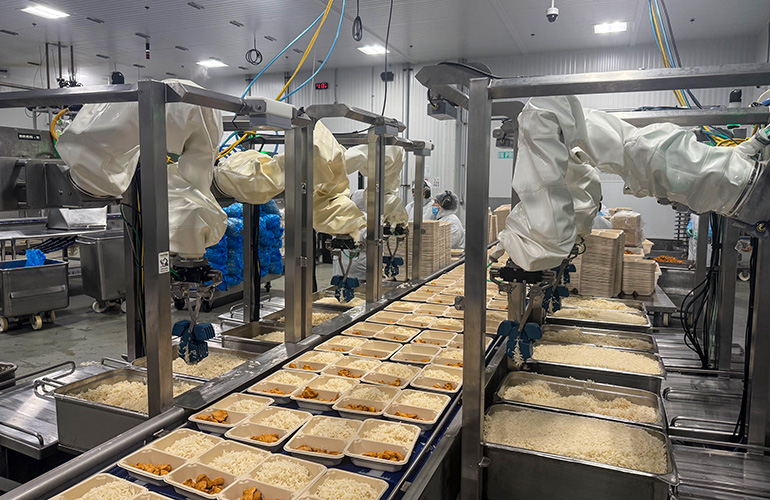
The automation of the kitchen has long been a pursuit of mechanical efficiency, but Chef Robotics is making the case that the real bottleneck was never hardware — it was data. The San Francisco-based startup recently announced it has surpassed 100 million meal servings assembled by its robotic systems across more than a dozen facilities in North America and Europe. The milestone, reached roughly a year after a $43 million Series A funding round in early 2025, positions the company as one of the more visible examples of physical AI moving from controlled laboratory settings into messy, high-throughput production environments.
The achievement is less a celebration of culinary art than a measure of industrial scale. In modern food manufacturing, portioning and assembly lines run at volumes where even marginal gains in consistency and uptime translate into significant economic value. Chef Robotics claims its systems now operate with a reliability that human labor markets — strained by chronic shortages across the food sector — can no longer consistently match.
The data problem behind deformable materials
Most industrial robotics was built for the rigid world: metal parts, plastic housings, components with predictable geometries. Food is a fundamentally different domain. Sauces flow. Grains scatter. Proteins vary in shape, moisture, and texture from one batch to the next. In robotics terminology, these are "deformable materials" — objects whose physical properties change under force, making them far harder to grasp, portion, and place with precision.
This is the class of problem that has historically kept robots out of food assembly. Traditional automation requires extensive programming for each new product configuration, making it economically viable only for long, unchanging production runs. Food manufacturers, by contrast, often operate in high-mix environments, switching between dozens of recipes and ingredient combinations within a single shift.
Chef Robotics has attacked this problem through data accumulation at scale. The company claims to have built the world's largest dataset for real-world food manipulation — a corpus of sensor readings, visual inputs, and force-feedback signals gathered from its deployed systems. Each serving assembled feeds back into the training pipeline, refining the models that govern how the robot handles a new sauce viscosity or an unfamiliar grain size. The approach mirrors the flywheel logic familiar from software AI: more deployment generates more data, which improves the model, which enables more deployment.
The parallel to large language models is instructive but imperfect. Where language models train on text scraped from the internet, physical AI systems require embodied interaction with the real world — a far slower and more expensive data-collection process. That Chef Robotics has reached the scale it has suggests the unit economics of food manufacturing may be among the first domains where this feedback loop becomes self-sustaining.
Labor economics as structural tailwind
The food manufacturing sector has faced persistent labor shortages for years. The work is physically demanding, repetitive, and often conducted in cold or otherwise uncomfortable environments. Turnover rates in food production have historically exceeded those in manufacturing broadly, and demographic trends in major markets show little sign of reversing the pressure.
This structural reality has shifted the calculus for food manufacturers. Automation in this context is less a matter of competitive advantage and more a prerequisite for maintaining output. Chef Robotics has positioned itself squarely in this gap, targeting high-volume, lower-complexity tasks — the portioning and assembly work that constitutes the backbone of prepared meal production.
The company's expansion across more than a dozen facilities suggests that early deployments have cleared the threshold of operational viability. In food manufacturing, where margins are thin and downtime is costly, sustained adoption is a stronger signal than any single pilot program.
What remains to be seen is how far the data-driven approach can stretch. High-mix food environments grow more complex as product lines diversify, and the gap between portioning rice and assembling a multi-component entrée with garnish is nontrivial. The competitive landscape is also shifting: established industrial automation firms are investing in flexible robotics, and other startups are pursuing adjacent segments of the food supply chain. Whether Chef Robotics' dataset advantage compounds faster than rivals can close the gap is the central tension shaping the next phase of this market.
With reporting from The Robot Report.
Source · The Robot Report