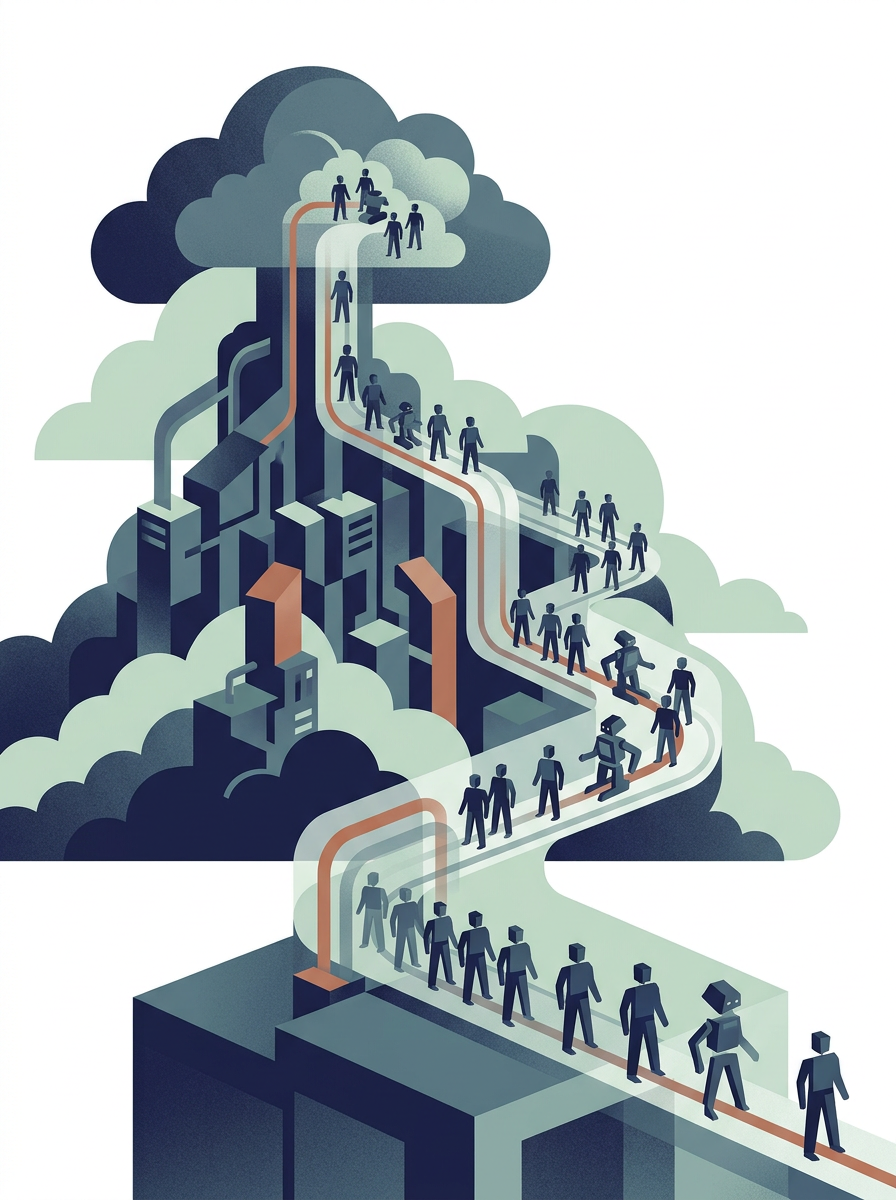
The transition from large language models as conversational novelties to functional autonomous agents is accelerating. Cloudflare has announced a deepening of its partnership with OpenAI, integrating GPT-5.4 and Codex into its Agent Cloud platform. The move is designed to provide enterprises with the infrastructure necessary to move beyond simple prompts and toward "agentic workflows"—sequences where AI can autonomously handle multi-step, real-world tasks without continuous human oversight.
By embedding these models directly into Cloudflare's global network, the partnership addresses two persistent hurdles of enterprise AI adoption: security and latency. Codex provides the underlying logic for automated software development and system management, while GPT-5.4 serves as the cognitive engine for higher-order decision-making. The arrangement allows companies to deploy agents that interact with existing data stores and APIs without the architectural friction typically associated with scaling experimental AI beyond a proof of concept.
From model to infrastructure
For much of the past three years, the AI industry's competitive energy has concentrated on model performance—parameter counts, benchmark scores, context windows. That phase is not over, but the Cloudflare-OpenAI integration illustrates a parallel race that is now commanding equal attention: the race to build reliable operating environments for AI agents.
The distinction matters. A model, however capable, remains inert without the infrastructure to route its outputs securely to the systems it needs to act upon. An agent tasked with updating a customer record, provisioning a cloud resource, or triaging a security alert must authenticate, call APIs, handle errors, and log its actions—all within latency constraints that enterprise users will tolerate. Cloudflare's edge network, which already handles a significant share of global web traffic, provides a natural substrate for this kind of distributed execution. The company has spent years building the routing, caching, and security layers that web applications depend on; repurposing that stack for AI agents is a logical extension.
The integration also reflects a broader pattern in which cloud and infrastructure providers position themselves as the indispensable middle layer between foundation model vendors and enterprise customers. Just as the cloud hyperscalers captured value by abstracting away server management a decade ago, companies like Cloudflare are now seeking to abstract away the complexity of deploying, securing, and monitoring autonomous AI. The model becomes a component; the platform becomes the product.
The trust problem at scale
Enterprise adoption of agentic AI hinges on a question that no benchmark can answer: can the organization trust an autonomous system to act on its behalf? The security dimension of the Cloudflare-OpenAI partnership speaks directly to this concern. Agents operating within Cloudflare's network inherit the platform's existing access controls, DDoS mitigation, and traffic inspection capabilities—features that would be costly and time-consuming for individual enterprises to replicate around a standalone model deployment.
But security is only one facet of trust. Reliability, auditability, and graceful failure handling are equally critical when an AI agent is executing multi-step workflows that touch production systems. The industry has yet to converge on standards for agent observability—how to log what an agent decided, why it decided it, and what it changed. Without those standards, scaling from a handful of pilot agents to hundreds operating across business units introduces risk that many organizations are not yet equipped to manage.
There is also the question of economic structure. If the value in enterprise AI shifts decisively from the model layer to the infrastructure layer, the competitive dynamics of the industry shift with it. Model providers face margin pressure as their outputs become commoditized inputs to platform services; infrastructure providers, conversely, gain leverage as the gatekeepers of secure, low-latency execution. Whether that dynamic holds—or whether model capabilities remain differentiated enough to command premium pricing—depends on how quickly the frontier of model performance continues to advance relative to the pace at which infrastructure providers can absorb and standardize new capabilities.
The Cloudflare-OpenAI announcement is less a product launch than a statement of architectural philosophy: that the next phase of enterprise AI will be defined not by what models can do in isolation, but by how reliably they can be made to act within the constraints of real organizations. The tension between autonomy and control, between speed of deployment and rigor of governance, will shape how quickly that philosophy translates into widespread adoption.
With reporting from OpenAI Blog.
Source · OpenAI Blog