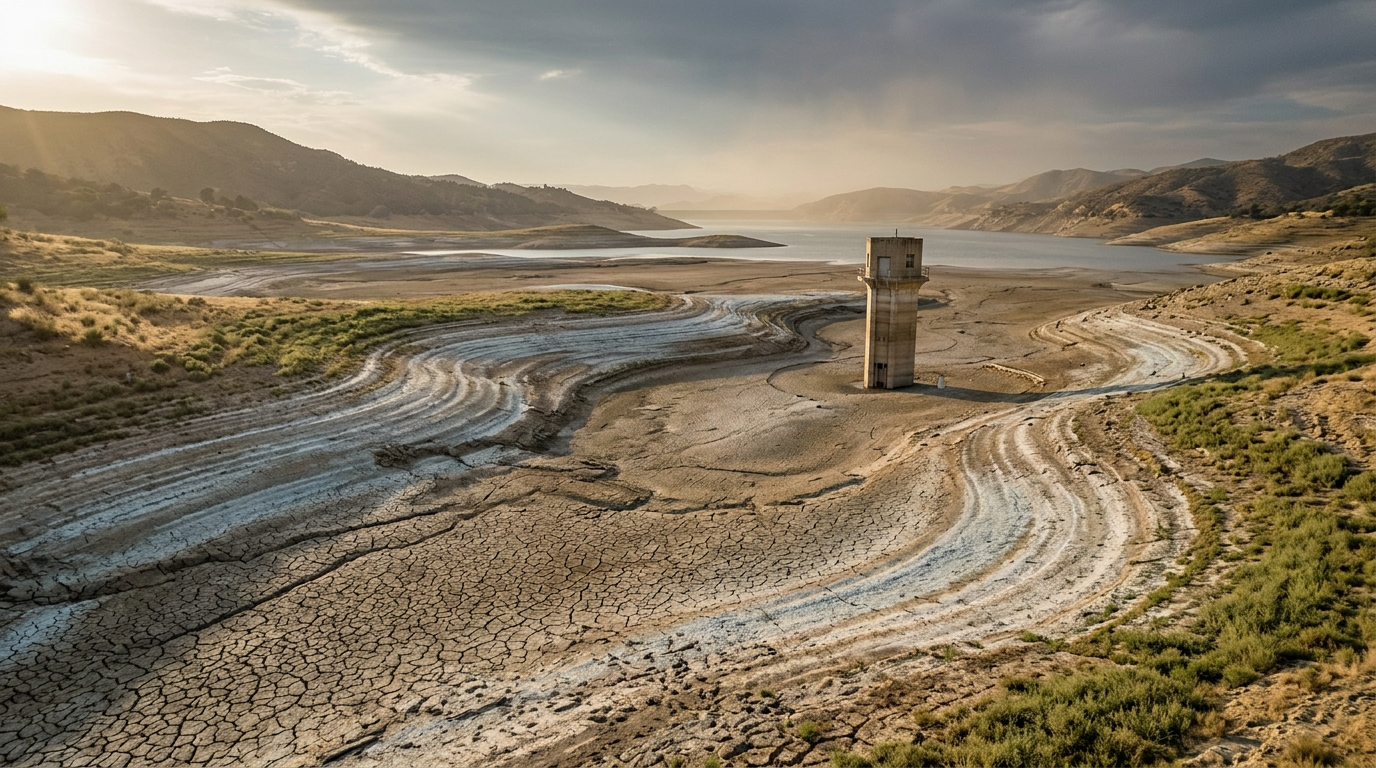
Corpus Christi, Texas, is preparing to declare a "water emergency" as its reservoirs head toward complete depletion — a scenario that, according to Inside Climate News reporting in partnership with the Texas Newsroom, would make it the first modern American city to run out of water. Absent a major rainfall event, the city's water supply is on track to dry up, forcing leaders to confront a crisis without precedent in the contemporary United States.
City officials intend to impose unprecedented cuts to water use beginning in September, though the specifics of those restrictions remain undefined. Meanwhile, critical institutions — schools and hospitals — have begun drilling for water independently, a signal that confidence in the municipal supply has already eroded. The situation raises a question that has long seemed theoretical for American cities: what happens when the taps actually stop?
A Crisis Built Over Decades
Corpus Christi sits on the Gulf Coast of South Texas, a region long familiar with drought but historically buffered by a system of reservoirs designed to sustain the city through dry spells. That buffer is now failing. The trajectory toward empty reservoirs reflects not a single catastrophic event but a compounding set of pressures: prolonged drought, rising demand, and infrastructure that was never designed for the climate conditions now materializing across much of the American South and Southwest.
The city's predicament is distinct from other high-profile water crises in recent U.S. history. Flint, Michigan, suffered from contamination, not scarcity. Cape Town, South Africa, famously approached "Day Zero" in 2018 but ultimately averted it through aggressive conservation and timely rains. Corpus Christi's challenge is more structurally stubborn — its reservoirs are finite, its alternatives limited, and its timeline compressed. The fact that hospitals and schools are already drilling private wells suggests that institutional actors are not waiting for city government to solve the problem. That kind of parallel infrastructure development, born of necessity, is typically associated with developing-world water crises, not cities in the world's largest economy.
The Political and Structural Test Ahead
Declaring a water emergency grants municipal authorities broader powers to restrict usage, but the practical mechanics of enforcing deep cuts in a city of more than 300,000 people are daunting. Corpus Christi's leaders have acknowledged they are still determining exactly how the restrictions will work — a candid admission that underscores how far outside normal governance this situation sits. Rationing water in an American city at this scale has no modern playbook.
The crisis also exposes a broader tension in Texas water policy. The state has long prioritized growth — population, industry, agriculture — while deferring hard decisions about long-term water supply. Corpus Christi is not the only Texas city facing stress on its water systems, but it is the most acute case. How the state and federal governments respond, or fail to respond, will set a precedent. If a city of this size can approach the brink of running dry, the implications extend well beyond South Texas. Other fast-growing, drought-prone regions — from the Rio Grande Valley to parts of Central Texas — will be watching closely to see whether Corpus Christi's emergency triggers systemic investment or remains treated as an isolated event.
The coming months will test not only Corpus Christi's capacity to manage an immediate shortage but also the willingness of state and federal institutions to treat urban water scarcity as a structural risk rather than a temporary anomaly. Whether September's planned restrictions prove sufficient — or whether the city becomes a cautionary case study for the rest of the country — depends on decisions that have yet to be made, and on rainfall that cannot be summoned by policy. The line between managed crisis and civic catastrophe may prove thinner than any American city has had to confront.
With reporting from Inside Climate News
Source · Inside Climate News