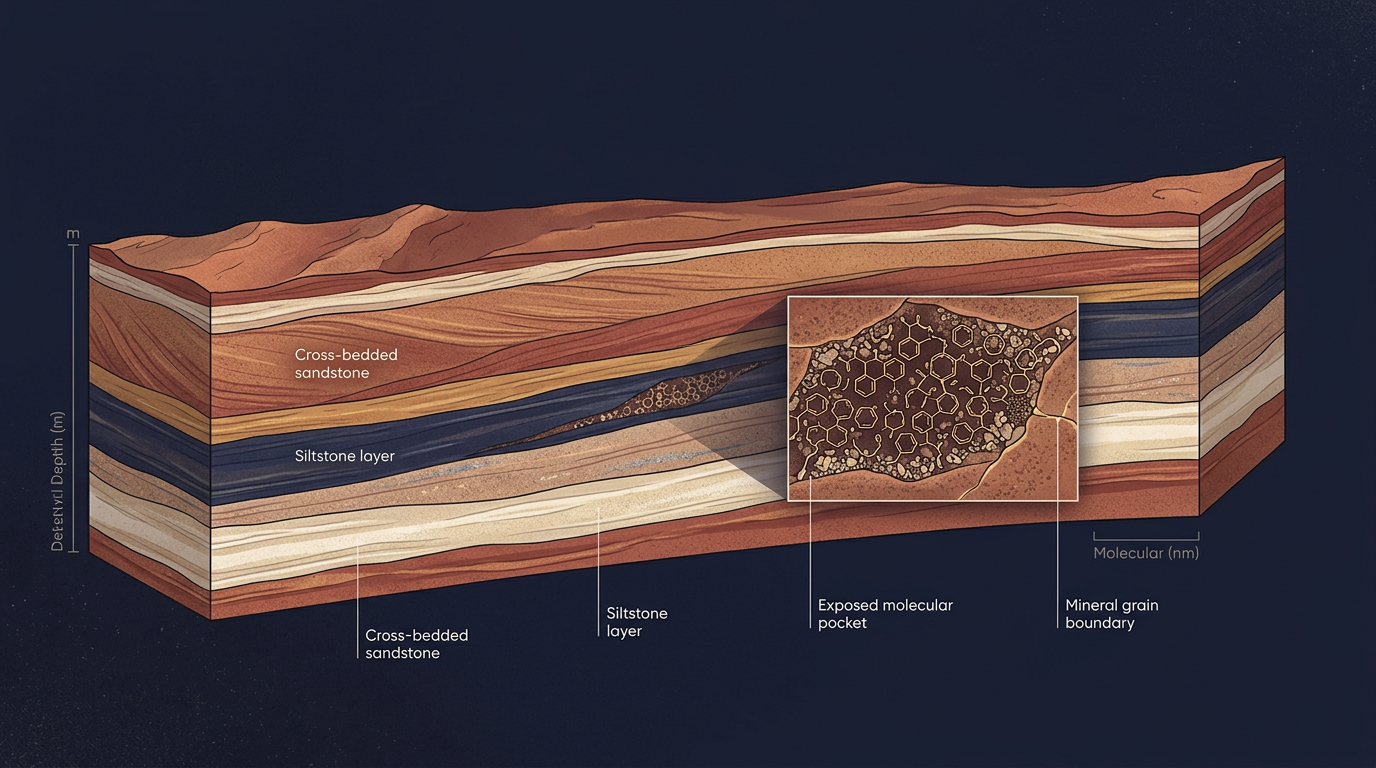
NASA's Curiosity rover, now in its fourteenth year of operations inside Mars's Gale Crater, has delivered what may rank among the most consequential geochemical findings of the mission. The agency reports the detection of a diverse array of organic molecules in Martian rock samples, including a nitrogenous compound whose structure bears a notable resemblance to the molecular precursors of DNA. The discovery does not constitute proof of past life. It does, however, indicate that the chemical environment of ancient Mars was considerably more complex — and more amenable to prebiotic chemistry — than prior data had established.
The finding arrives at a moment when NASA is simultaneously managing the twilight of its longest-running deep-space hardware and contending with a shifting terrestrial landscape in which artificial intelligence is reshaping both the tools and the politics of scientific inquiry.
Prebiotic chemistry and the narrowing gap
The significance of nitrogen-bearing organic compounds on Mars lies in what they imply about the planet's early chemistry. Nitrogen is a structural element in amino acids, nucleotides, and the base pairs that encode genetic information in all known life. Its presence in complex organic form inside Gale Crater sediments suggests that the chemical reactions necessary to assemble biological building blocks were at least plausible on early Mars — a planet that, geological evidence increasingly confirms, once hosted liquid water, a thicker atmosphere, and volcanic activity capable of cycling nutrients.
Curiosity's Sample Analysis at Mars (SAM) instrument suite has previously identified simpler organic molecules, including chlorobenzene and thiophene, in Gale Crater mudstones. Each successive detection has incrementally tightened the range of plausible explanations for Martian organic chemistry. The latest finding pushes the complexity threshold further. It does not eliminate abiotic origins — meteoritic delivery and UV-driven surface chemistry can produce nitrogen-bearing organics without biology — but it does narrow the gap between what Mars demonstrably had and what the simplest conceivable biology would require.
The distinction matters for mission planning. NASA's Perseverance rover, operating in Jezero Crater, is caching rock samples for eventual return to Earth, where laboratory instruments orders of magnitude more sensitive than anything deployable on Mars could resolve ambiguities that in-situ analysis cannot. The Curiosity finding strengthens the scientific case for that sample-return effort at a time when its budget and timeline face political scrutiny.
Legacy hardware, emerging tools
While Curiosity probes the deep past, NASA is also managing the finite future of Voyager 1. The agency recently deactivated a critical instrument aboard the spacecraft — a calculated sacrifice designed to extend the probe's dwindling power supply and keep it transmitting data from interstellar space, a region no other human-made object has reached. Launched in 1977, Voyager 1 operates on a radioisotope thermoelectric generator whose output declines steadily with the decay of its plutonium-238 fuel. Each instrument shutdown buys time, but the arithmetic is unforgiving. The mission's end is a question of when, not whether.
This balancing act — coaxing additional science from aging hardware — runs in parallel with rapid advances in the tools available on the ground. OpenAI has released an updated version of its image-generation capabilities within ChatGPT, further tightening the integration of text and visual synthesis. The refinement is incremental in isolation but cumulative in effect: generative AI is steadily becoming embedded in workflows across research, media, and governance.
That embedding carries political weight. Reports indicate that Donald Trump has entered discussions with Anthropic regarding a potential agreement, a development that underscores how foundational AI models have migrated from the domain of technology companies into the machinery of political and economic influence. The specifics of any such arrangement remain unclear, but the pattern is legible: access to frontier AI capability is becoming a strategic asset that governments and political figures seek to secure directly, rather than regulate at arm's length.
The convergence is worth watching. The same era that produces nitrogen-bearing organics on Mars and keeps a 47-year-old probe alive past the heliopause is also one in which the instruments of analysis — AI models capable of processing planetary data, generating imagery, and shaping public discourse — are themselves objects of geopolitical competition. Whether the institutions governing space exploration can adapt to that reality as deftly as they have managed aging spacecraft remains an open question.
With reporting from Olhar Digital.
Source · Olhar Digital