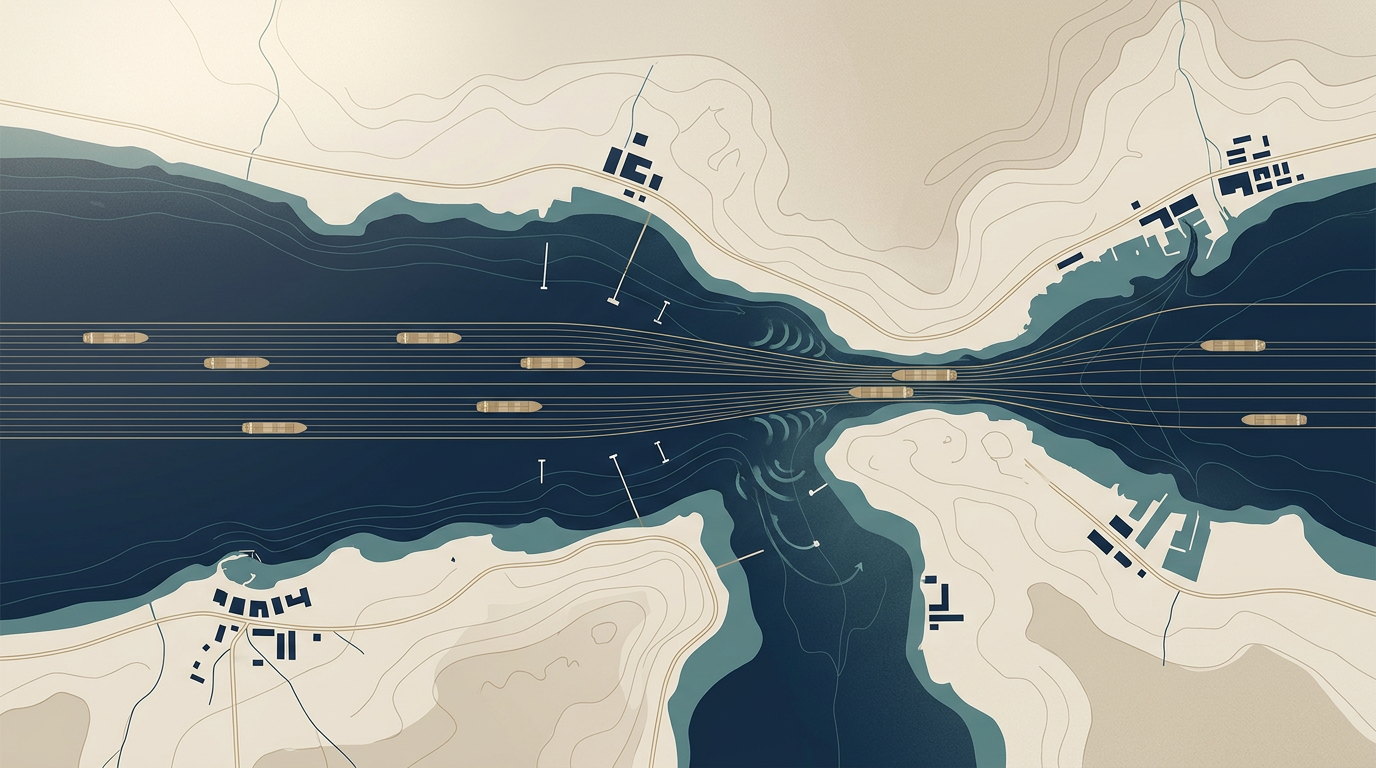
In 1988, the USS Samuel B. Roberts nearly sank in the Persian Gulf after striking an Iranian mine—a moment that underscored the disproportionate power of low-cost, "invisible" threats in narrow waterways. Decades later, the Strait of Hormuz remains the world's most sensitive energy chokepoint, but the architecture of its security is undergoing a quiet, tectonic shift. According to reports first detailed by the Wall Street Journal, European officials are drafting a post-conflict strategy to secure the strait—one that conspicuously omits the United States.
The plan centers on stabilizing maritime traffic once current regional hostilities subside. Its objectives are technical and economic rather than purely militaristic: a coordinated effort involving minesweepers and naval escorts designed to lower insurance premiums and restore the confidence of global shipping conglomerates. By leading a coalition of willing nations, Europe aims to bypass the traditional reliance on American naval hegemony in the region, prioritizing commercial continuity over military posture.
The strategic logic of exclusion
The decision to leave Washington out of the framework is not incidental—it is the framework's organizing principle. For more than four decades, the United States Navy's Fifth Fleet, headquartered in Bahrain, has served as the de facto guarantor of freedom of navigation in the Persian Gulf. American-led operations—from Operation Earnest Will in the late 1980s to the International Maritime Security Construct launched in 2019—have defined the security template for the strait. Removing the U.S. from the equation represents a deliberate departure from that template.
The rationale is diplomatic as much as operational. European planners reportedly envision a degree of coordination with Iran, a necessary partner for any long-term stability in the waterway through which roughly one-fifth of the world's petroleum passes daily. Washington's history of "maximum pressure" sanctions campaigns and direct confrontation with Tehran—including the 2020 strike that killed Iranian General Qasem Soleimani—makes American participation a potential liability in any initiative that requires Iranian acquiescence. By framing the mission as a neutral, commerce-first stabilization effort, European officials hope to sidestep the adversarial dynamics that have historically complicated Gulf security arrangements.
There is precedent, if imperfect, for European-led maritime security in contested waters. The European Union Naval Force's Operation Atalanta, launched in 2008 to combat piracy off the Horn of Africa, demonstrated that European navies could sustain a meaningful operational presence far from home waters over extended periods. That mission, however, operated in a permissive diplomatic environment with broad international consensus. The Strait of Hormuz presents a fundamentally different challenge: the threat is not stateless piracy but state-laid mines and state-directed naval assets, and the key interlocutor—Iran—has deep grievances with several of the nations likely to participate.
Commerce, risk, and the limits of autonomy
The commercial stakes are difficult to overstate. When tensions in the Gulf escalate, war-risk insurance premiums for tankers transiting Hormuz spike, shipping routes are rerouted, and energy prices ripple outward into every economy dependent on Gulf crude and liquefied natural gas. A credible de-mining and escort operation could, in theory, compress those risk premiums and signal to markets that the strait is open for business under a stable, multilateral arrangement.
Yet the plan's viability rests on assumptions that remain untested. Iran's willingness to cooperate with a European-led coalition—rather than view it as a softer extension of Western power projection—is far from guaranteed. Tehran has historically leveraged its geographic control over the strait as a strategic deterrent; voluntarily ceding that leverage to a foreign naval presence, however benign its stated intentions, would require a significant shift in Iranian strategic calculus. Equally uncertain is whether European navies possess the sustained mine-countermeasure and escort capacity to operate credibly without American logistical support, which has quietly underpinned most allied naval operations in the Gulf for decades.
The initiative is, at its core, a wager on strategic autonomy—the idea that Europe can act as an independent security provider in a theater where it has long been a junior partner. Whether that wager pays off depends less on the minesweepers deployed than on the diplomatic architecture built around them: whether Iran sees an off-ramp, whether Gulf states accept a non-American guarantor, and whether European capitals sustain the political will to back a mission that carries real operational risk with no American safety net underneath it.
With reporting from Xataka.
Source · Xataka