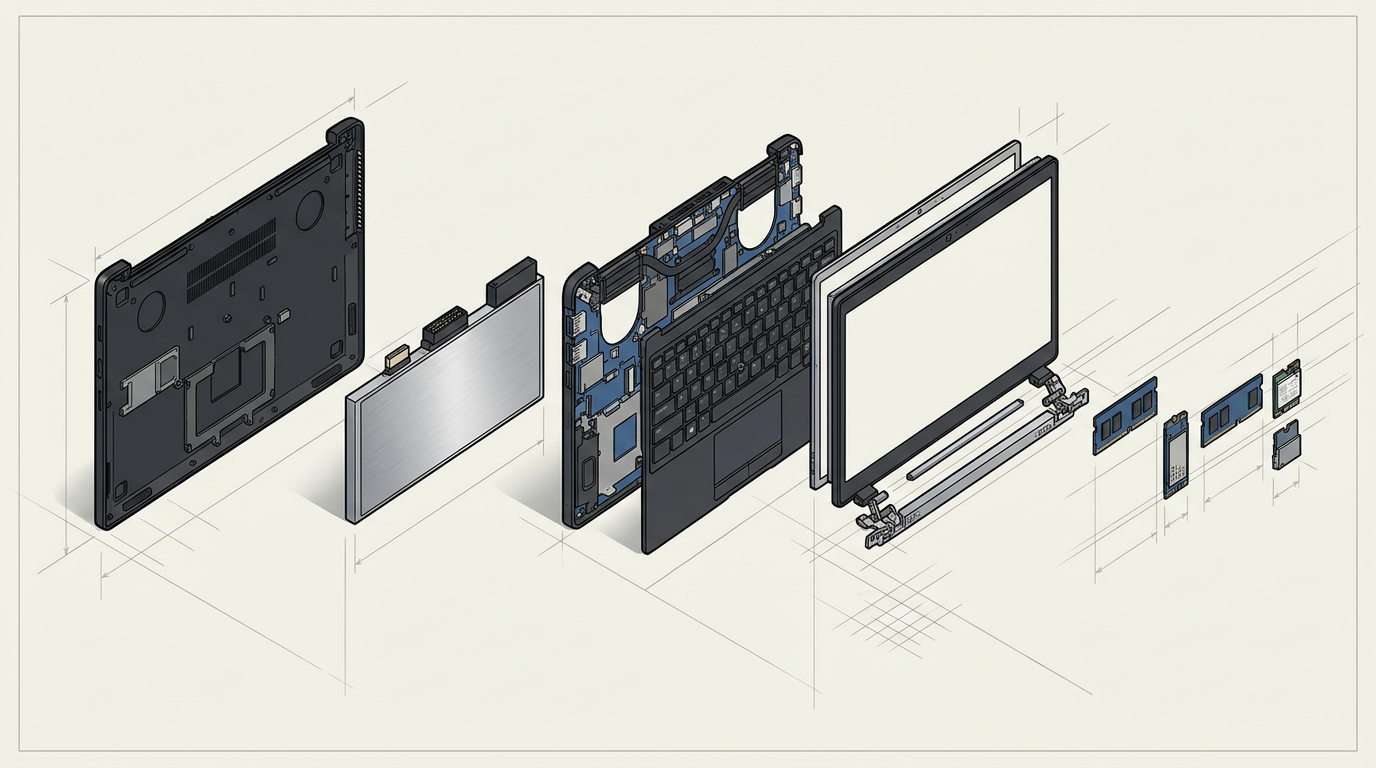
For half a decade, Framework has operated on a singular, defiant thesis: that consumer electronics should be built to last, not to be discarded. Since its debut, the company's Laptop 13 has served as the primary vehicle for that argument, receiving six generations of processor upgrades and various display iterations while maintaining strict adherence to a shared, interchangeable chassis. The approach turned the laptop into something unusual in consumer electronics — a living document, capable of being edited rather than replaced.
That era of strict architectural continuity is now yielding to a more ambitious overhaul. The newly announced Framework Laptop 13 Pro represents the first significant departure from the original design language. While the "Pro" moniker often denotes a mere performance bump in the tech industry, Framework is using it to signal a ground-up redesign. The new machine shifts to Intel's Core Ultra Series 3 "Panther Lake" architecture, includes a larger battery, and marks the company's first foray into touchscreens — all housed in a new black aluminum frame.
From Living Document to Second Edition
The original Framework Laptop 13 was, in essence, a thesis statement with a hinge. It demonstrated that a modular, user-repairable notebook could exist in a market dominated by sealed enclosures and proprietary components. Each successive mainboard swap — from 11th-generation Intel chips onward — reinforced the argument that upgradeability was not merely theoretical but practical. The chassis became a constant around which internals could rotate.
But constants impose constraints. Maintaining backward compatibility with a single chassis design limits what can change: battery capacity is bounded by the internal volume, thermal architecture is locked to a specific layout, and display options are constrained by the original bezel and hinge geometry. At some point, the frame itself becomes the bottleneck.
The Laptop 13 Pro appears to be Framework's acknowledgment of that ceiling. A ground-up redesign allows the company to revisit decisions made in 2021, when the original was engineered as a startup's first product. The addition of a touchscreen, for instance, requires different display stack engineering and digitizer integration — changes difficult to retrofit into an existing chassis without compromise. A new aluminum frame in a different colorway further signals that this is not another iterative refresh but a distinct product generation.
The Tension Between Innovation and Ecosystem Loyalty
The move raises a question that sits at the heart of the modular hardware proposition: how does a company innovate structurally without orphaning the customers who bought into the original ecosystem? Framework built its reputation on the promise that buying one of its laptops was not a dead-end transaction. Expansion cards, mainboards, and input covers were designed to be swapped across generations. A new chassis architecture necessarily disrupts some portion of that interchangeability.
This is not a novel dilemma. It echoes challenges faced by any platform company — from desktop PC standards to automotive platforms — where the desire for forward progress collides with the obligation to an installed base. The question is whether Framework can manage the transition transparently enough to maintain trust. The company's track record of publishing repair guides and selling individual components suggests an awareness that credibility, once lost in the right-to-repair community, is difficult to recover.
The broader context matters as well. The repairable electronics movement has gained regulatory tailwind in recent years, with the European Union's push toward repairability scores and several U.S. states enacting right-to-repair legislation. Framework no longer operates in a vacuum of idealism; it operates in a market where repairability is becoming a competitive axis rather than a niche differentiator. A more polished, professional-grade product positions the company to compete not just on principle but on fit and finish — the territory where Apple and Dell have long held the advantage.
What remains to be seen is whether the Laptop 13 Pro can serve two audiences simultaneously: the early adopters who valued the original's hackability and the broader computing public that expects a premium laptop to simply work well out of the box. The redesign suggests Framework believes those audiences are not mutually exclusive. Whether the market agrees will determine if modular hardware graduates from a compelling argument into a durable product category.
With reporting from Ars Technica.
Source · Ars Technica