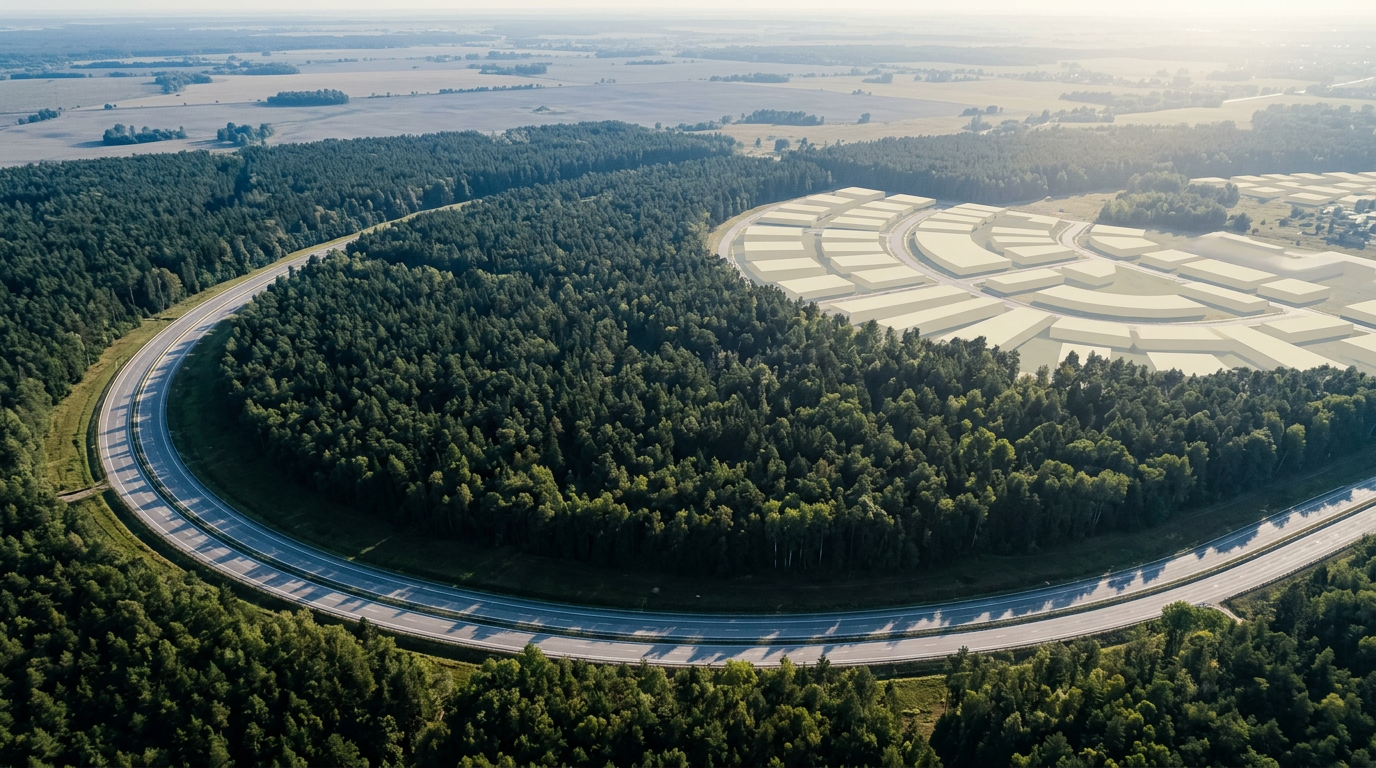
From 250 miles above, the Maryland suburbs of Washington, D.C., present a study in contrast: the rigid, gray loop of the Capital Beltway cutting through a dense canopy of midsummer green. Captured by an astronaut aboard the International Space Station in July 2023, the image highlights the historic city of Greenbelt, Maryland — a site where the aesthetics of the New Deal era remain etched into the landscape with a clarity that nearly a century of suburban sprawl has failed to erase.
At the heart of the frame lies Greenbelt Park, a five-square-kilometer expanse of forest that serves as a verdant buffer against the encroaching concrete of the D.C. metro area. Originally slated for urban expansion, the land was instead transferred to the National Park Service in 1950. Today, it stands as a preserved relic of the region's original topography, offering a rare pocket of wilderness accessible via the same highways that define the modern suburban experience.
A Depression-Era Blueprint, Still Legible From Orbit
Just north of the park, the crescent-shaped layout of Greenbelt's historic district is clearly visible. This geometry was no accident. Greenbelt was one of three "greenbelt towns" commissioned in the 1930s under the Resettlement Administration, a New Deal agency led by Rexford Tugwell that sought to relocate struggling families from overcrowded urban slums and unproductive farmland into planned communities designed around cooperative living. The other two towns — Greenhills, Ohio, near Cincinnati, and Greendale, Wisconsin, near Milwaukee — followed similar principles: superblocks that minimized automobile traffic, homes oriented toward shared interior green spaces rather than streets, and a deliberate integration of residential life with surrounding forest and farmland.
The design philosophy drew on the Garden City movement pioneered by Ebenezer Howard in England at the turn of the twentieth century, which proposed self-contained communities encircled by permanent belts of agricultural and natural land. Howard's concept had already influenced the development of Letchworth and Welwyn Garden City in the United Kingdom. The American greenbelt towns adapted the idea to Depression-era imperatives: federal employment through construction, affordable cooperative housing, and a social architecture that prioritized communal facilities — a school, a cooperative grocery store, a community center — over private accumulation.
Greenbelt's crescent layout, still legible from the International Space Station, was the physical expression of that ideology. Pedestrian pathways connected homes to shared amenities without crossing automobile roads. The town's original residents were selected through an application process that screened for cooperative temperament as much as financial need. It was, in effect, a federally managed experiment in community design — one that attracted both admiration and political opposition from those who saw it as an overreach of government into private life.
The Tension Between Preservation and Pressure
What makes the orbital photograph striking is not merely the persistence of the original plan but the visible pressure surrounding it. The Capital Beltway, completed in the early 1960s, transformed the region's development patterns, turning formerly rural land into some of the most densely developed suburban corridors in the United States. Greenbelt Park and the historic district survived this transformation in part because of their federal and institutional protections, but the contrast between the planned green geometry and the surrounding sprawl is sharp.
The greenbelt towns occupy an unusual position in American planning history. They were among the most deliberate attempts by the federal government to shape not just housing but social behavior through physical design. Greenhills and Greendale have undergone significant alteration over the decades, their original layouts partially absorbed by conventional suburban development. Greenbelt, Maryland, has retained more of its original character, aided by its proximity to federal institutions — including NASA's Goddard Space Flight Center, located adjacent to the historic district — and by an active local preservation culture.
The photograph, then, captures more than topography. It frames a question that American urbanism has never fully resolved: whether planned communities built around collective principles can survive within a development model that overwhelmingly favors private land markets and automobile-oriented growth. Greenbelt's crescent endures, but the forces that surround it have not relented. Whether the next century of satellite imagery will show the same geometry — or something gradually consumed by the gray grid beyond it — depends on decisions that remain very much in play.
With reporting from NASA Breaking News.
Source · NASA Breaking News