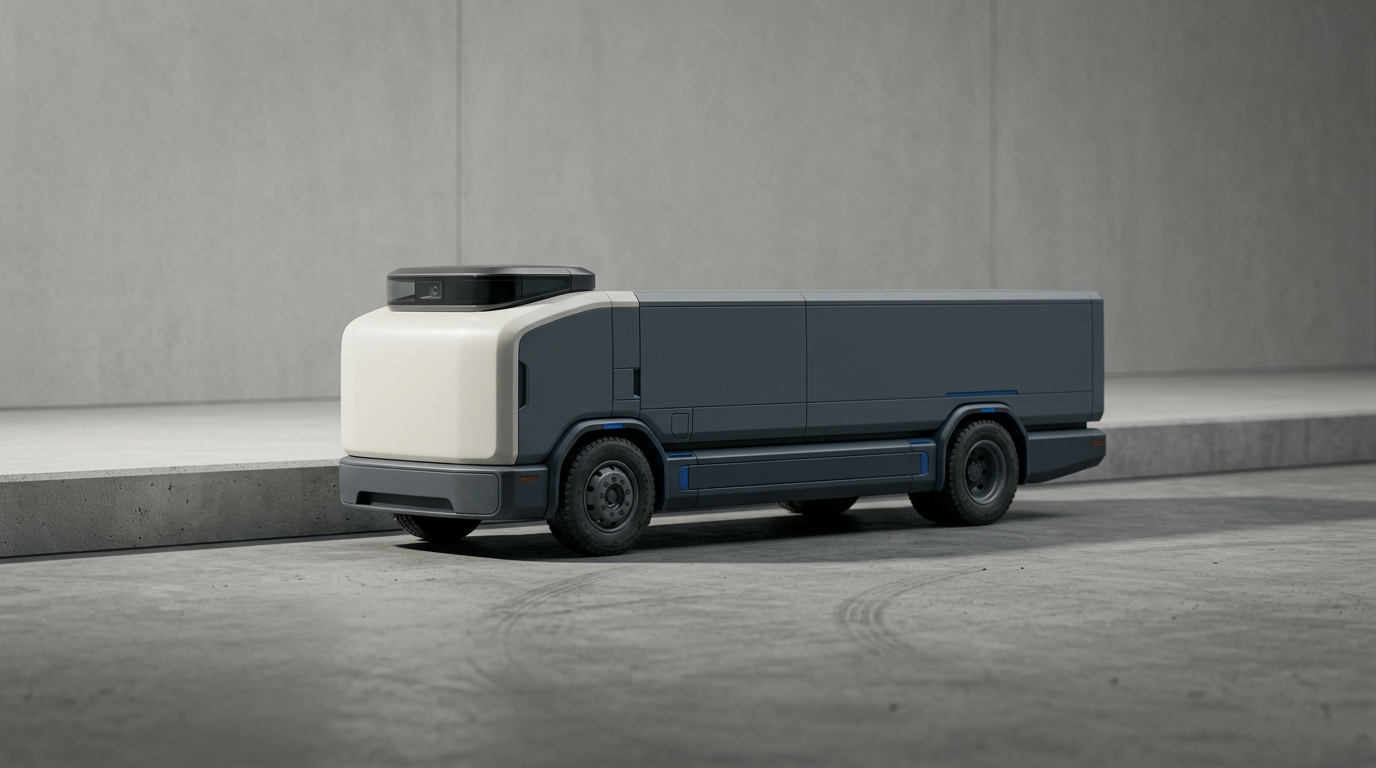
The autonomous trucking industry has long been defined by a compromise: retrofitting existing semi-trucks with sensors while keeping a safety driver — or at least a driver's seat — behind the wheel. Humble, a San Francisco-based startup emerging from stealth with $24 million in seed funding, is discarding that legacy architecture entirely. Founded by veterans of Uber ATG and Waabi, the company has unveiled a cabless, electric freight vehicle designed to operate without human intervention, moving goods directly from one loading dock to another.
Unlike competitors such as Aurora or Kodiak, which typically focus on "hub-to-hub" logistics — where autonomous trucks handle highway stretches but hand off trailers to human drivers for the first and last mile — Humble intends to automate the entire journey. By removing the driver's cabin, the startup reduces weight and aerodynamic drag while reclaiming space for batteries and cargo. It is a shift from seeing the truck as a modified vehicle to seeing it as a purpose-built industrial robot.
A design philosophy borrowed from robotics, not automotive
The decision to eliminate the cab is more than an engineering novelty. It reflects a broader argument about how autonomous freight should be designed. The conventional approach in the industry has been incremental: take an existing Class 8 tractor, bolt on a sensor suite — typically a combination of lidar, radar, and cameras — and develop software capable of handling highway driving under constrained conditions. That path offers the advantage of compatibility with existing trailer fleets and infrastructure, but it also inherits the constraints of a form factor built around a human operator. Weight budgets are consumed by the cab structure, climate control, and ergonomic systems that serve no function in a driverless context.
Humble's ground-up approach sidesteps those constraints. A cabless platform can redistribute mass toward battery capacity, potentially extending range — a persistent limitation for battery-electric trucks competing against diesel on long-haul routes. It also opens possibilities for aerodynamic profiles that conventional truck geometry does not permit. The concept is not entirely without precedent: Einride, a Swedish company, has been operating cabless electric pods on limited routes in controlled environments for several years. But where Einride has focused on short, low-speed shuttles within logistics yards and industrial campuses, Humble appears to be targeting dock-to-dock routes that include public roads — a considerably more complex operational domain.
The VLA bet: reasoning over rules
The technical core of Humble's approach lies in its software stack. Rather than relying on the rigid, rule-based systems that governed previous generations of self-driving technology, Humble utilizes vision-language-action (VLA) models — a class of AI architecture that fuses visual perception with language-based reasoning to generate physical actions. In practical terms, a VLA model can interpret a scene, contextualize it against learned representations of driving behavior, and produce a control output, all within a single integrated pipeline. This contrasts with the modular stacks common in the industry, where perception, prediction, and planning operate as separate subsystems that pass structured data between them.
The appeal of VLA models is their potential to handle edge cases — the rare, ambiguous situations that rule-based systems struggle to anticipate. A construction zone with hand-painted detour signs, a loading dock with non-standard geometry, a pedestrian behaving unpredictably near a warehouse entrance: these are the scenarios where brittle decision trees tend to fail. Whether VLA models can handle them reliably enough for unsupervised commercial operation remains an open question. The architecture draws from the same foundation model paradigm that has driven recent advances in language and image generation, but deploying it in safety-critical physical systems introduces failure modes that a chatbot never faces.
Humble enters a freight autonomy landscape shaped by two competing pressures. On one side, the economics of trucking — chronic driver shortages, rising labor costs, and the operational inefficiency of hub-and-spoke handoffs — create genuine demand for full automation. On the other, the regulatory and technical barriers to operating heavy vehicles without any human in the loop on public roads remain substantial. No U.S. federal framework currently governs cabless autonomous trucks, and state-level rules vary widely. The startup's founding team, drawn from organizations that confronted these challenges at scale, presumably understands the gap between a compelling demo and a commercially deployed fleet. Whether a purpose-built cabless platform and a novel AI architecture can close that gap faster than the incumbents' incremental approach is the central tension worth watching.
With reporting from The Next Web.
Source · The Next Web