NASA's Kennedy Space Center is upgrading its Payload Hazardous Servicing Facility (PHSF) to receive the Nancy Grace Roman Space Telescope ahead of a planned launch as soon as early September aboard a SpaceX Falcon Heavy rocket from Launch Complex 39A. According to NASA reporting, the upgrades include a new air-shower system, enhanced HVAC infrastructure, and a HEPA filtration wall to meet the stringent ISO class 7 clean room standards the telescope requires.
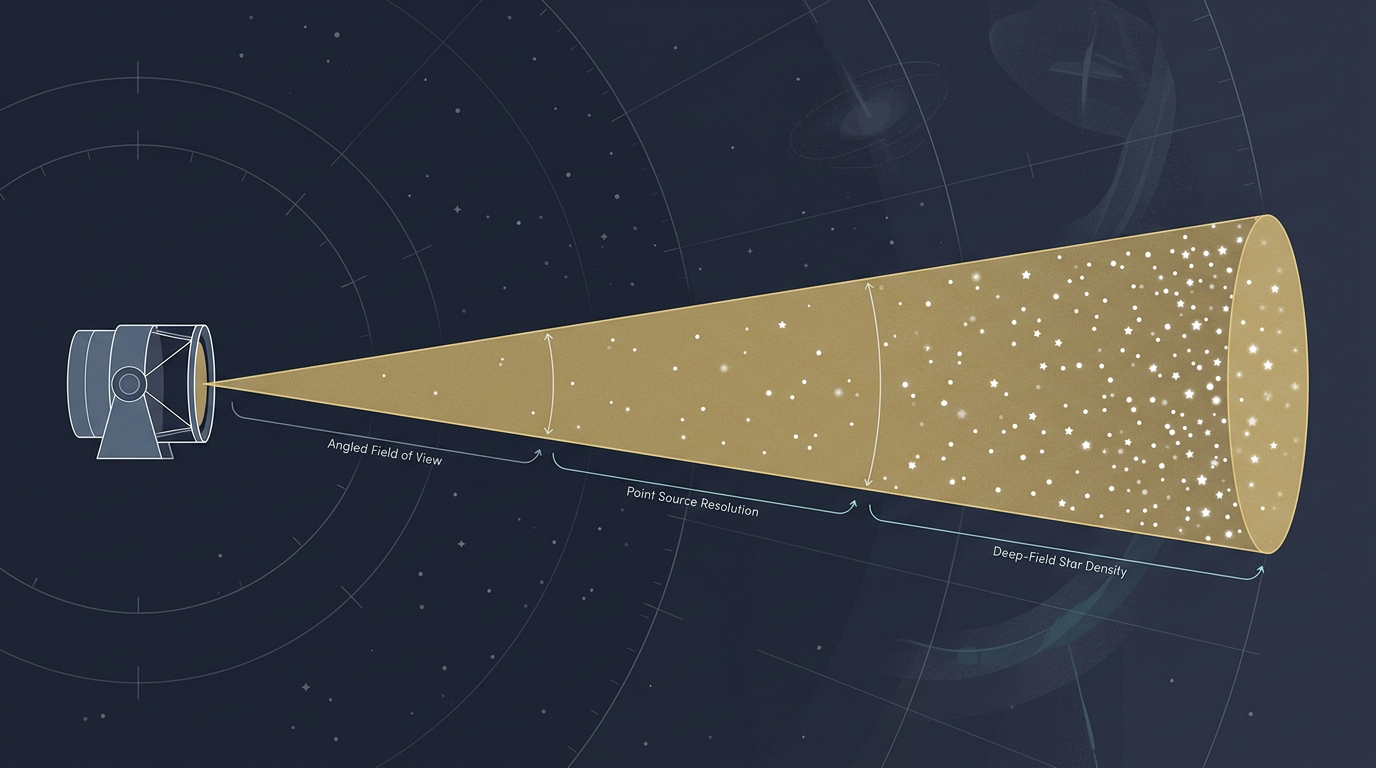
The Roman Space Telescope is designed to deliver a field of view 100 times larger than the James Webb Space Telescope and up to 200 times larger than Hubble, making it a survey instrument of unprecedented scope. Its core scientific mission — mapping the cosmos to investigate dark energy, detect exoplanets, and advance broad astrophysical research — positions it as a complement to, rather than a replacement for, the deep but narrow observational power of Webb and Hubble. The meticulous facility preparations at Kennedy underscore just how much rides on getting a spacecraft this sensitive safely to orbit.
A Clean Room for a Cosmic Cartographer
The PHSF, operational since 1986, has processed spacecraft ranging from Mars rovers to the Europa Clipper. But Roman presents particular challenges. Ryan Boehmer, launch site integration manager with NASA's Launch Services Program, noted that the telescope's instruments demand extreme care, describing people as "one of the biggest sources of contamination for a spacecraft." The facility's air-shower chambers, which blast HEPA-filtered air onto technicians before they enter the clean room, were fully replaced. A new chiller coil system ensures climate control with redundancy, maintaining temperatures around 70°F and relative humidity between 30% and 60% — a narrow band that prevents both corrosion and static discharge.
Even the facility's 15-ton bridge crane received fresh paint — not for appearance, but to prevent paint chips from becoming foreign object debris that could settle on hardware. These details may seem granular, but they reflect the operational reality of preparing an optical instrument that will scan enormous swaths of sky for faint cosmological signals. Any contamination on Roman's sensors or optics could degrade data quality on observations designed to probe some of the most elusive phenomena in physics. The gap between a clean room and a scientific breakthrough is, in this case, measured in microns.
Surveying the Dark Side of the Universe
Roman's scientific ambition is anchored in its survey architecture. Where Webb excels at studying individual targets in extraordinary detail, Roman is built to map. Its wide-field instrument will capture panoramic images across vast regions of the sky, enabling statistical studies of galaxy distributions, gravitational lensing patterns, and the expansion rate of the universe. These are the observational tools needed to constrain models of dark energy — the poorly understood force accelerating cosmic expansion — and to catalog exoplanets through microlensing events that are inherently rare and require broad sky coverage to detect.
The complementary relationship between Roman and Webb is by design. NASA envisions Roman identifying rare or unexpected objects across its sweeping surveys, with Webb then following up on specific targets for deeper investigation. This division of labor represents a maturing strategy in space-based astronomy: rather than building a single instrument to do everything, the agency is constructing an observational ecosystem. The question is whether the scientific return justifies the complexity. Roman's ability to deliver on dark energy science, in particular, depends not only on the quality of its hardware but on the analytical frameworks ready to interpret the flood of data it will produce.
As Roman moves through its final prelaunch processing — thermal protection, solar array work, hydrazine fueling — the telescope edges closer to becoming operational. Its launch will mark the beginning of a mission whose value will ultimately be measured not in the cleanliness of its preparation but in whether its panoramic view of the cosmos reveals structures and forces that narrower instruments have missed. For a universe whose dominant components remain labeled "dark," a wider lens may be exactly what the field needs — though what it finds is, by definition, not yet known.
With reporting from NASA Breaking News
Source · NASA Breaking News