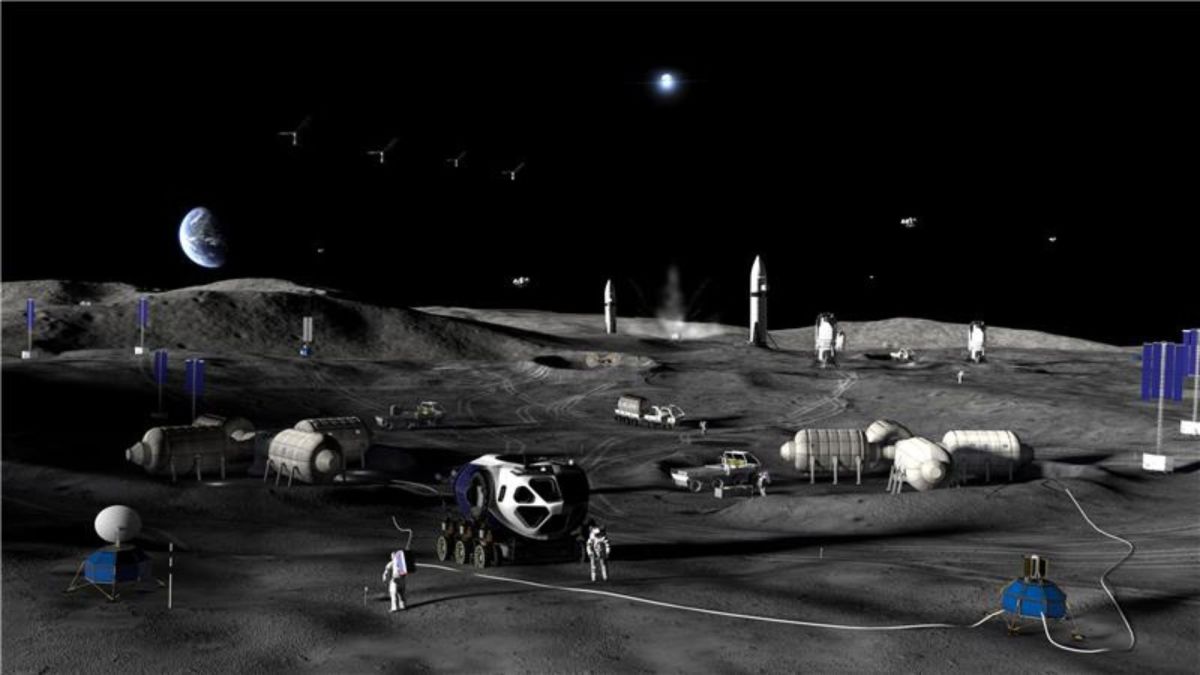
For decades, the moon has served as a destination for brief, high-stakes visits — a place to plant flags, collect samples, and return home within days. NASA's evolving roadmap for the Artemis program signals a fundamental shift in that philosophy. Rather than planning another round of temporary sorties, the agency is now articulating a vision for sustained human presence on the lunar surface. The latest conceptual materials for the "Artemis Base Camp" describe a future in which the lunar south pole becomes a site of ongoing scientific and industrial activity — not a monument to a single mission, but an operating outpost.
The south pole's appeal is well established. Its permanently shadowed craters are believed to contain water ice, a resource that could be processed into drinking water, breathable oxygen, and even rocket propellant. If that thesis holds under direct investigation, it would transform the economics of deep-space exploration by reducing dependence on resupply from Earth. The Artemis Base Camp concept is built around that possibility.
Infrastructure for permanence
The conceptual framework NASA has outlined describes a layered suite of infrastructure designed to sustain crews in one of the most hostile environments known. At its core is a foundational lunar cabin — a pressurized habitat intended to serve as the primary living and working quarters for astronauts on extended surface stays. Surrounding it would be a fleet of unpressurized rovers for short-range sorties, enabling crews to survey terrain, deploy instruments, and service equipment within a limited radius of the base.
More ambitious is the pressurized rover concept, essentially a mobile habitat that would allow astronauts to travel across the lunar surface for weeks at a time without returning to the main base. Such a vehicle would dramatically expand the operational range of any given mission, turning the base camp into a hub from which exploration radiates outward rather than a single fixed point of activity. The overall design philosophy treats the lunar surface not as a wasteland to be endured, but as a landscape to be inhabited and, eventually, industrialized.
This approach echoes the logic behind Antarctic research stations, where permanent infrastructure enables continuous scientific work that short expeditions cannot replicate. The analogy is imperfect — Antarctica has breathable air and resupply by ship — but the strategic principle is the same: sustained presence yields compounding returns in knowledge and capability.
The deliberate absence of dates
What the roadmap does not include is as telling as what it does. NASA remains notably reticent about timelines. The latest materials carefully avoid firm deadlines for when any element of the base camp might become operational. This is not an oversight. It reflects at least two overlapping realities.
The first is technical. Building habitable infrastructure on the moon requires solving problems in life support, radiation shielding, dust mitigation, and autonomous construction that remain at various stages of maturity. Each subsystem carries its own development risk, and stacking them into a single program multiplies uncertainty.
The second reality is political. NASA's budget is set by Congress on an annual cycle, and the agency's strategic direction is subject to revision with each new administration. The Artemis program itself has already seen its initial crewed landing target shift more than once. By presenting the base camp as an architectural goal rather than a scheduled deliverable, NASA insulates the vision from the kind of deadline-driven scrutiny that can turn a slip into a cancellation. It is a posture learned from experience: the agency watched the Constellation program — Artemis's predecessor — get scrapped in part because its timeline became politically untenable.
The strategic ambiguity also leaves room for commercial partners. Companies developing lunar landers, habitats, and surface mobility systems operate on their own schedules and funding cycles. A rigid NASA timeline could either outpace or constrain those efforts; a flexible one allows the agency to integrate commercial capabilities as they mature.
What emerges is a program defined by architectural clarity and temporal vagueness — a detailed answer to "what" and "how" paired with a conspicuous silence on "when." Whether that silence reflects prudent planning or institutional caution depends on which pressure proves stronger in the years ahead: the technical momentum of hardware development, or the gravitational pull of political cycles that reward visible milestones over patient infrastructure work. The tension between those forces will likely determine whether the Artemis Base Camp becomes a functioning outpost or remains an elegant set of renderings.
With reporting from Numerama.
Source · Numerama