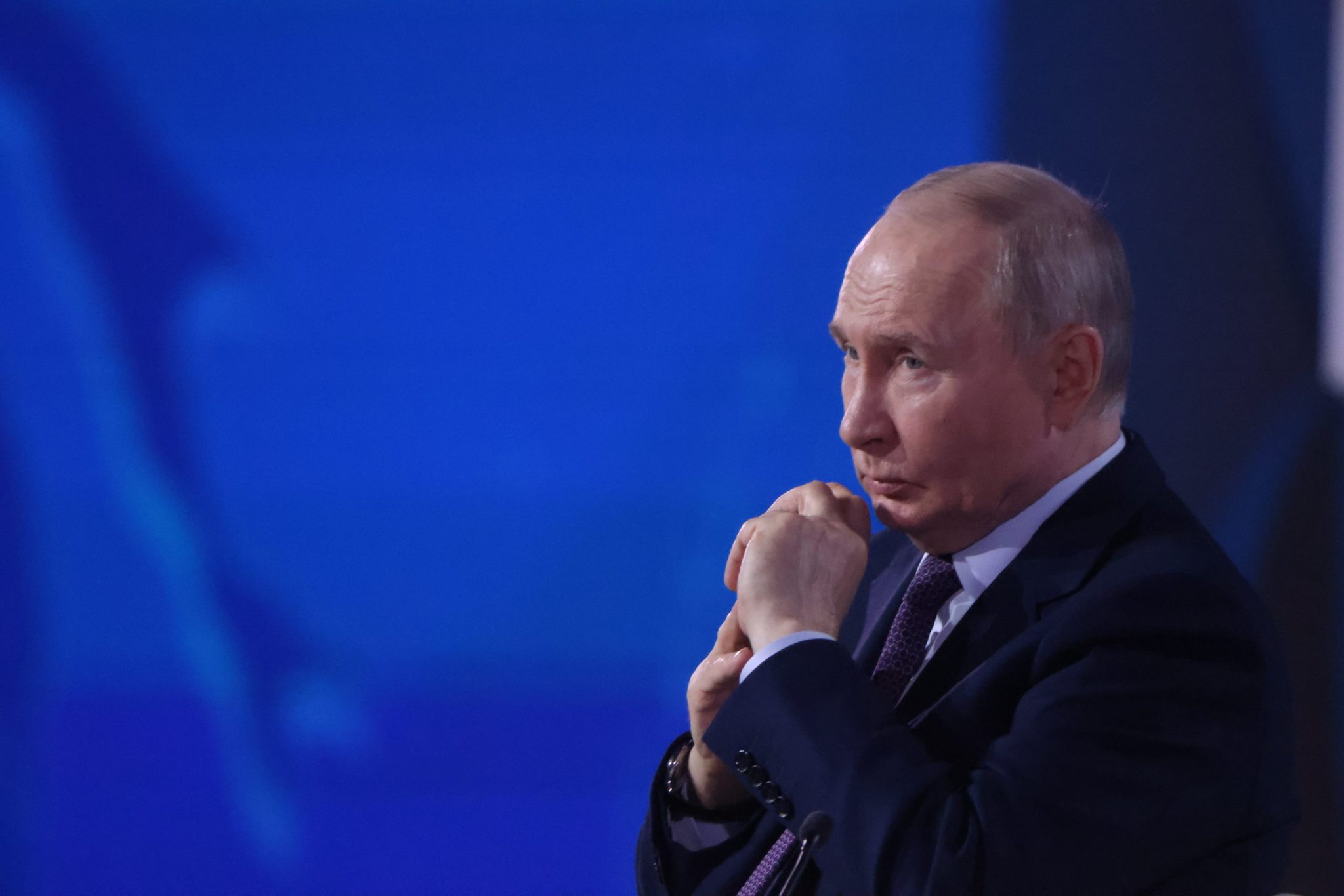
Russia's economy contracted by a combined 1.8% in the opening months of 2024, a reversal sharp enough to prompt President Vladimir Putin to publicly confront his senior economic officials in a televised meeting. Putin singled out declining performance in manufacturing, industrial production, and construction — all of which, he noted, had fallen below the forecasts set by both the government and the Central Bank of Russia.
The admission marks a notable shift in tone from the Kremlin, which for much of the past two years framed the Russian economy as resilient in the face of Western sanctions imposed after the full-scale invasion of Ukraine in February 2022. That narrative rested on genuine, if distorted, growth: wartime fiscal spending — particularly on defense procurement — had kept GDP figures positive through 2023 and into early 2024, even as the underlying structure of the economy grew more fragile.
The Limits of a War Economy
Military Keynesianism has a well-documented shelf life. Government spending on arms production, soldier wages, and compensation payments to families of fallen servicemembers injected demand into the economy, but it did so at the cost of crowding out civilian sectors and accelerating inflation. The Central Bank of Russia responded with aggressive rate hikes, pushing its key rate to levels that made borrowing prohibitively expensive for many businesses outside the defense supply chain.
The consequences are now surfacing. A tight labor market — driven by mobilization, emigration of skilled workers, and demographic decline — has constrained manufacturing capacity. Construction, which benefited from subsidized mortgage programs, appears to be cooling as those programs reach their fiscal limits. Meanwhile, declining oil revenues have eroded the government's primary fiscal cushion. Russia's budget has grown increasingly dependent on energy income even as global oil prices have faced downward pressure and the country's crude trades at a persistent discount due to sanctions and the price cap mechanism coordinated by the G7.
The pattern echoes, in broad strokes, the experience of the Soviet economy in the 1980s, when defense spending consumed an outsized share of GDP while civilian productivity stagnated. The comparison is imperfect — Russia's economy is far more integrated into global markets than the Soviet Union's was — but the core tension is similar: a state directing resources toward military output at the expense of long-term productive capacity.
What Putin's Public Posture Signals
That Putin chose to address the contraction on television, rather than behind closed doors, is itself significant. Public demands for accountability from subordinates are a familiar feature of his governing style, typically deployed to signal that blame lies with implementers rather than with policy direction. The framing positions Putin as the figure demanding solutions, not as the architect of the conditions that produced the problem.
Whether this translates into meaningful policy adjustment remains uncertain. The Kremlin faces a set of constraints that are largely self-imposed: continued war spending is politically non-negotiable as long as the conflict in Ukraine persists; easing monetary policy risks reigniting inflation that already erodes household purchasing power; and attracting foreign investment or technology is functionally impossible under the current sanctions regime.
The question facing Russia's economic planners is not whether the war economy model is sustainable — the contraction suggests it is not, at least in its current form — but what tools remain available to arrest the decline without altering the political commitments that caused it. Fiscal stimulus risks overheating an already inflation-prone economy. Structural reform requires time, capital, and institutional capacity that are in short supply. And the oil revenues that once papered over inefficiencies are no longer reliable enough to serve that function.
The tension, then, is between a political leadership unwilling to revisit its strategic posture and an economy that is beginning to price in the cost of that posture. How long that gap can persist before forcing a choice — on spending, on the war, or on both — is the question that the contraction data has placed squarely on the table.
With reporting from Fortune.
Source · Fortune