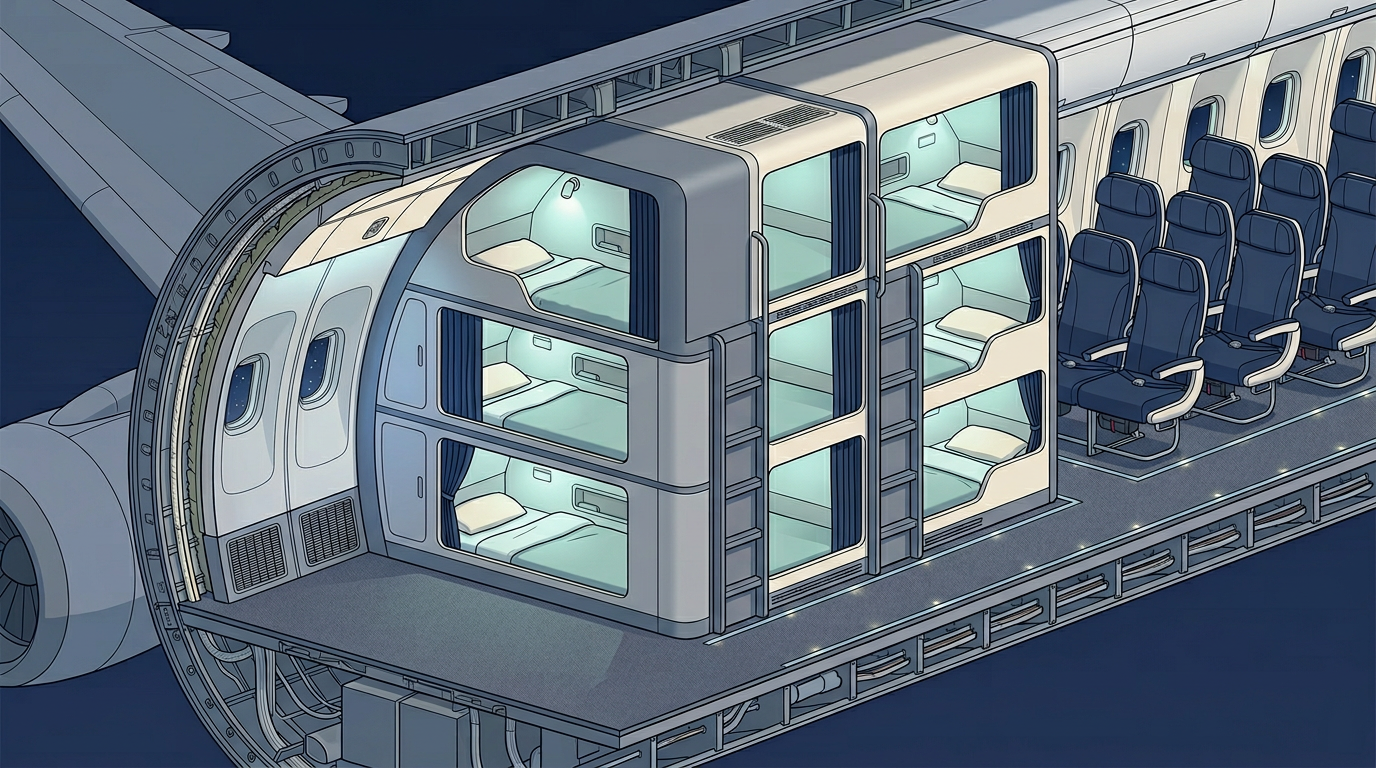
Air New Zealand has begun offering economy-class passengers access to "Skynest" sleep pods on select long-haul routes, introducing a bunk-style sleeping arrangement that allows travelers in the cheapest cabin to lie flat during flights. The pods are configured in sets of six bunks, bookable in time slots rather than assigned for the full duration of a journey. The concept borrows from the capsule hotel model familiar in parts of East Asia, adapted to the pressurized confines of a widebody aircraft fuselage.
The initiative arrives at a moment when ultra-long-haul flying is expanding. Routes exceeding fifteen hours have proliferated over the past decade as airlines connect city pairs that previously required stopovers. For carriers operating these marathon sectors, the challenge is not merely fuel economics or crew scheduling but the physical endurance of passengers seated upright for the better part of a day. Air New Zealand, which operates some of the longest routes in the world from its Auckland hub, has a particular incentive to address this problem.
The economics of horizontal rest
For most of commercial aviation's history, the ability to sleep flat has been the defining feature that separates premium cabins from economy. Business-class lie-flat seats, introduced widely in the early 2000s, became the primary revenue driver on long-haul routes, commanding fares several multiples above economy. The Skynest does not eliminate that gap, but it introduces a middle layer—a paid add-on that offers a fraction of the premium experience at a fraction of the cost.
The shared-resource model is central to the economics. Unlike a business-class seat, which is dedicated to a single passenger for the entire flight, a Skynest bunk rotates through multiple users. This allows the airline to extract revenue from a relatively small footprint of cabin space across several passengers per sector. It is, in effect, an exercise in yield management applied to square footage rather than seat inventory. The question is whether the operational complexity—cleaning between occupants, managing bookings, enforcing time limits—proves manageable at scale or becomes a source of friction for crew and passengers alike.
The concept also reflects a broader trend toward unbundling the flight experience. Over the past two decades, airlines have disaggregated what was once a single product—a seat from point A to point B—into a menu of separately priced components: checked bags, seat selection, meals, priority boarding. The Skynest extends this logic to the most basic human need on a long flight. Sleep, in this framework, becomes another purchasable module within the cabin.
Competitive pressure and cabin design
Air New Zealand is not operating in a vacuum. Several carriers have experimented with economy-class comfort enhancements as competition intensifies on long-haul routes. Some have widened seat pitch or introduced premium-economy cabins as an intermediate product. The Skynest takes a different approach: rather than making the seat itself marginally better, it introduces an entirely separate space for a distinct activity.
This modularity raises questions about where cabin design heads next. The fixed dimensions of an aircraft fuselage impose hard constraints, and every square meter allocated to sleep pods is space unavailable for revenue seats. Airlines will watch closely whether the ancillary revenue from Skynest bookings justifies the opportunity cost of the cabin real estate it occupies. If it does, imitators will likely follow. If it does not, the experiment may remain a niche differentiator rather than an industry standard.
There is also a regulatory dimension. Aviation authorities certify cabin configurations with strict attention to evacuation times, structural loads, and fire safety. Bunk-style arrangements introduce variables that differ from conventional seating, and the certification process for novel cabin elements can be lengthy and costly. How smoothly regulators in different jurisdictions approve similar configurations will influence whether other carriers pursue the concept.
The tension at the heart of the Skynest is between two forces that have defined economy air travel for decades: the relentless drive to maximize passenger density and the growing recognition that human comfort has a commercial value worth capturing. Whether the sleep pod resolves that tension or merely repackages it as another line item on the booking page remains an open question—one that passengers, airlines, and regulators will answer in different ways.
With reporting from Dagens Nyheter.
Source · Dagens Nyheter