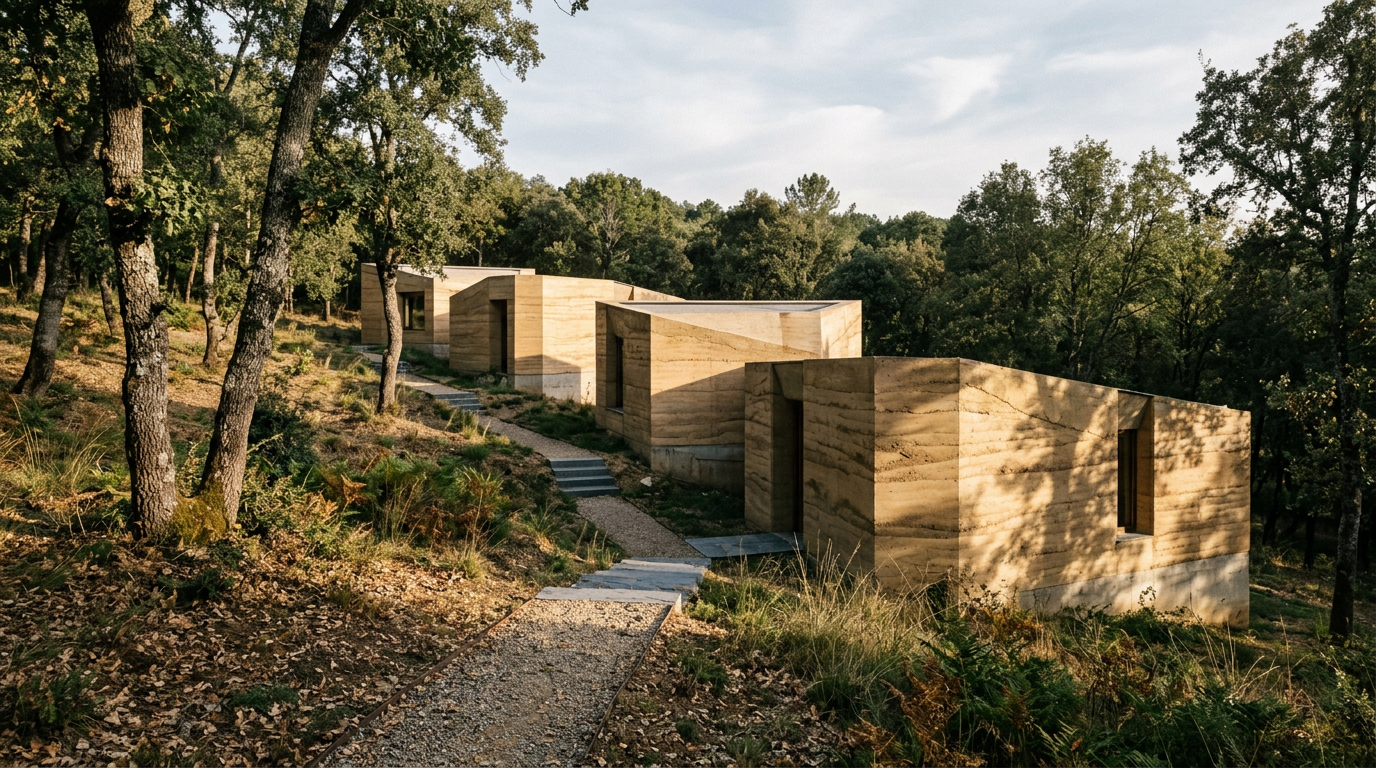
In a departure from the singular, monumental forms that often define institutional architecture, Safdie Architects has unveiled a design for the Cherokee Heritage Center in Oklahoma that prioritizes landscape over presence. The project is conceived as a series of low-slung, faceted volumes scattered across a wooded site — a decentralized campus that eschews a traditional "front" in favor of a discovery-based experience. By following the natural undulations of the terrain, the architecture seeks to dissolve the boundary between the built environment and the forest floor.
The proposal arrives at a moment when cultural institutions serving Indigenous communities are increasingly rejecting the template of the Western museum — the white-walled box that frames artifacts as objects of study rather than living heritage. For the Cherokee Nation, whose forced removal from ancestral lands in the southeastern United States along the Trail of Tears remains one of the defining traumas of American history, the question of how a building relates to the ground it sits on carries weight that is more than metaphorical.
Material as argument
The materiality of the center serves as its primary anchor. The walls are constructed from rammed earth — a technique in which layers of damp soil are compressed into formwork to create dense, load-bearing surfaces — organized in horizontal bands that mirror the geological strata of the region. These surfaces shift in hue from sandy beige to deep ochre, providing a tactile, matte finish that grounds the buildings physically and visually. The choice is not merely aesthetic; it is a structural commitment to the soil itself, ensuring the campus reads as an emergent property of the Oklahoma landscape rather than an imposition upon it.
Rammed earth construction has a long lineage in arid and semi-arid climates, from the fortified villages of North Africa to sections of the Great Wall of China. In contemporary practice, it has gained renewed attention as architects search for low-carbon alternatives to concrete and steel. The technique's thermal mass — its capacity to absorb heat during the day and release it slowly at night — also offers passive climate regulation, a practical advantage in Oklahoma's continental climate of hot summers and variable winters. By centering the project on this material, Safdie Architects positions the Heritage Center within a broader discourse on sustainable construction while anchoring it in site-specific geology.
Geometry and movement
The geometry of the campus is defined by a dialogue between sharp angles and soft curves. While the rammed earth walls provide a consistent base, the rooflines vary — some tapering into crystalline peaks, others curving gently to mimic the tree canopy. A central structure features a triangulated skylight assembly, filtering light into the interior in a way that recalls the dappled shadows of the surrounding woods. Interconnected by paths that wind through clearings and over shallow water, the Heritage Center invites a slow, fragmented approach, asking visitors to move through the environment rather than simply occupy a building.
This decentralized layout echoes strategies seen in other recent cultural projects that reject the gravitational pull of a single monumental entrance. The approach shares a philosophical kinship with campus-style museums that distribute program across multiple pavilions, allowing the landscape itself to become the organizing principle. For a heritage center, the implications are significant: the visitor's journey through the site becomes part of the narrative, not a prelude to it.
Safdie Architects, the firm founded by Moshe Safdie — whose Habitat 67 in Montreal remains a landmark of modular, human-scaled design — has long operated at the intersection of large civic commissions and geometric experimentation. The Cherokee Heritage Center represents a quieter register for the practice, one where restraint and material honesty take precedence over structural spectacle.
What remains to be seen is how the project navigates the distance between rendered proposal and built reality. Rammed earth at institutional scale demands exacting quality control, and the clustered layout, while compelling on paper, must reconcile the practical demands of accessibility, climate management, and programmatic flexibility with its poetic ambitions. The tension between the building as cultural vessel and the building as landscape — between preservation and dissolution — is precisely the space where the project's significance will be tested.
With reporting from Designboom.
Source · Designboom