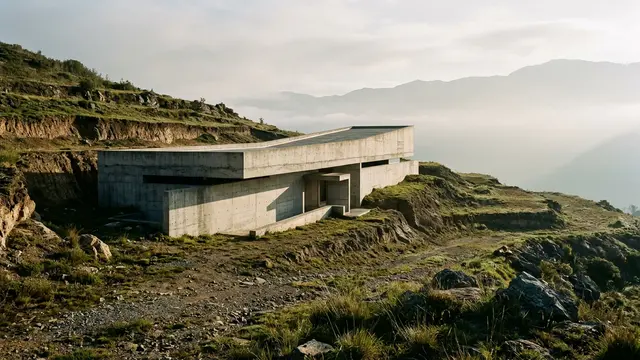
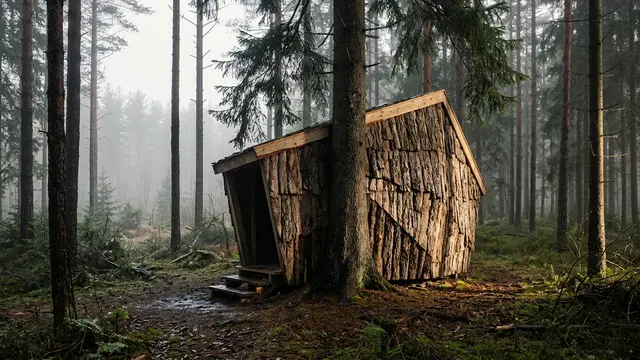
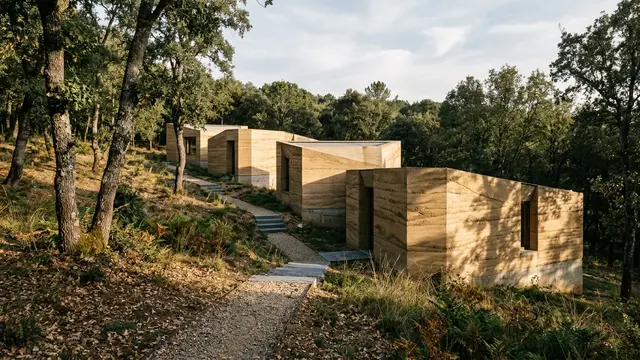
In the wooded landscape of Tahlequah, Oklahoma — the capital of the Cherokee Nation since 1839 — Safdie Architects has unveiled a design for the Cherokee Heritage Center that treats the land itself as a primary collaborator. The proposed campus consists of a series of interconnected pavilions intended to rise from the forest floor, their walls composed of layered materials meant to evoke the sedimentary geology of northeastern Oklahoma. Rather than clearing the site, the design threads its structures through existing tree cover, positioning architecture as an extension of topography.
The centerpiece of the development is the Great Hall, a monumental gathering space whose roof takes the form of a geometric metallic canopy incorporating the seven-pointed star of the Cherokee Nation. By alternating metal panels with glass panes, the design allows natural light to filter into the interior, producing shifting patterns of shadow and illumination as the sun moves across the sky. Surrounding pavilions, lower in profile, are designed to house exhibition spaces, educational facilities, and areas for community gathering.
Architecture as Cultural Infrastructure
The Cherokee Heritage Center project arrives at a moment when indigenous communities across North America are investing in purpose-built cultural institutions — not merely as museums, but as anchors of sovereignty and identity. Facilities like the Smithsonian's National Museum of the American Indian in Washington, D.C., which opened in 2004, demonstrated that architecture could serve as a statement of presence and continuity for indigenous peoples. But that building, designed by a non-Native firm in a federal capital, operated under different constraints than a center built on tribal land, for tribal use, within a tribal capital.
The Tahlequah site carries its own weight. The Cherokee Nation relocated to Indian Territory after the forced removal of the 1830s — the Trail of Tears — and Tahlequah has served as the seat of Cherokee governance for nearly two centuries. Any building placed in this context must negotiate between honoring a painful history and affirming an ongoing political and cultural reality. Safdie Architects' approach — submerging structures into the landscape rather than imposing monumental forms upon it — suggests an awareness of that tension. The layered earthen walls, described as evoking sedimentary history, function as both a material choice and a metaphor: culture deposited over time, compressed but legible.
For Moshe Safdie, now in the seventh decade of a career that began with the modular Habitat 67 complex in Montreal, the project represents a particular kind of commission. Safdie's portfolio includes major cultural institutions — the Crystal Bridges Museum of American Art in Bentonville, Arkansas, and the National Gallery of Canada among them — and his work has consistently explored how buildings can defer to their settings while still asserting formal ambition. The Cherokee Heritage Center extends that logic, but the stakes are different when the client is a sovereign nation and the site is inseparable from a history of displacement.
Geometry, Symbolism, and the Question of Authorship
The seven-pointed star motif embedded in the Great Hall's canopy is not decorative shorthand. The star is a central emblem of Cherokee identity, representing the seven clans of the Cherokee people. Translating such a symbol into architectural geometry raises questions that recur whenever non-indigenous designers work on indigenous projects: who holds interpretive authority over cultural symbols, and how does the design process ensure that formal decisions reflect community meaning rather than external aesthetics?
The project documentation emphasizes integration of tribal symbols and indigenous materials into a modern structural framework, but the deeper test will come in how the Cherokee Nation's own voices shaped the program, the spatial hierarchies, and the narrative arc of the visitor experience. Precedents in indigenous architecture suggest that the most successful projects — such as the Canadian Museum of History's First Peoples Hall or community-led cultural centers in New Zealand and Australia — are those where the commissioning community exercises substantive control over design intent, not just approval of finished drawings.
What remains to be seen is whether the Cherokee Heritage Center will function primarily as a destination for outside visitors or as a living civic space for the Cherokee people themselves — and whether the architecture can serve both purposes without diluting either. The design's commitment to landscape integration and symbolic specificity suggests ambition beyond the conventional heritage museum. Whether that ambition translates into a genuinely new model for indigenous cultural infrastructure depends on decisions that lie well beyond the drawings.
With reporting from Dezeen.
Source · Dezeen