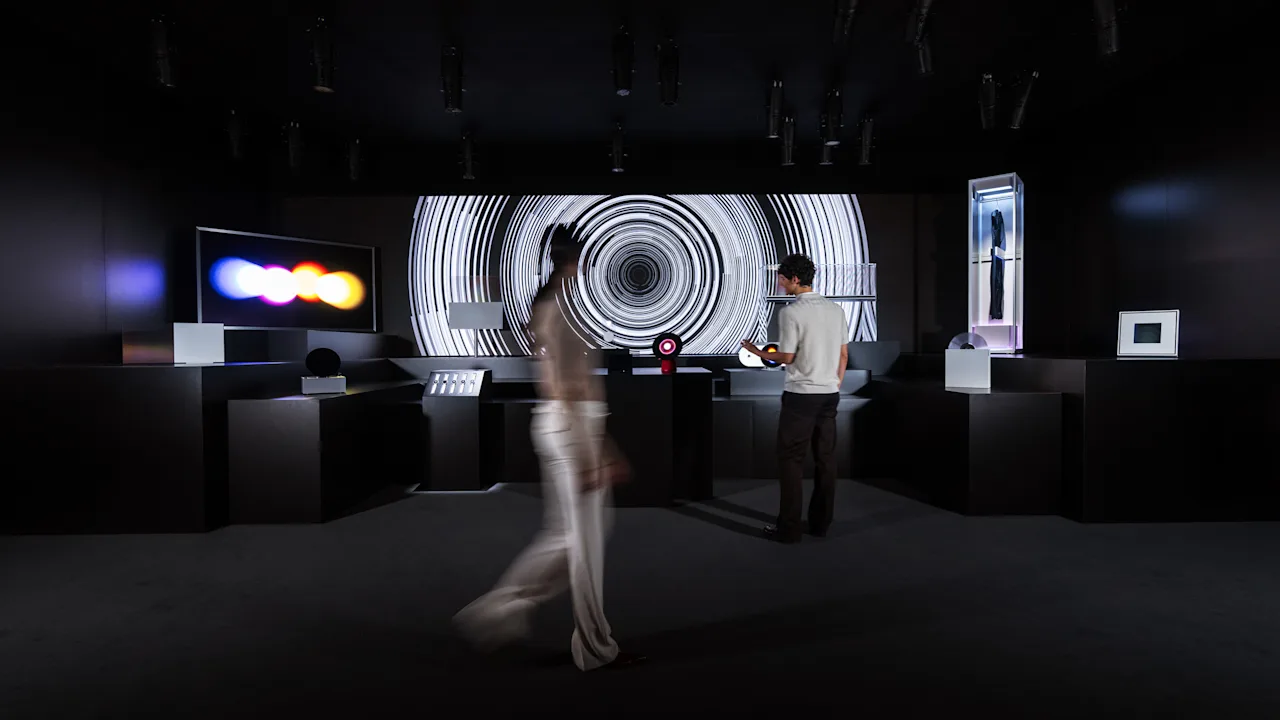
At Milan Design Week, Samsung’s exhibition, "Design Is an Act of Love," serves as a manifesto for the brand’s next era. Among the prototypes on display is Project Luna, a round, swiveling screen that evokes the mechanical whimsy of Pixar’s Luxo Jr. while maintaining a certain high-tech gravity. Alongside a Tri-Fold Galaxy smartphone, these devices act as conductors for a unified ecosystem, linked by a pulsating orb graphic—a visual shorthand for an artificial intelligence that is meant to feel more like a presence than a tool.
The installation represents the first major statement from Samsung’s design team since the appointment of Mauro Porcini as its first foreign chief design officer last year. Porcini’s vision moves away from the cold utilitarianism of traditional hardware toward a "communal AI" that populates the home. While the smartphone remains the locus of personal intelligence, Samsung’s thesis suggests that AI will increasingly inhabit the interstitial spaces of our lives, jumping seamlessly from the refrigerator door to the television screen to ambient tabletop displays.
This design language seeks to solve the problem of digital fragmentation. By using a consistent visual identity—that glowing, HAL-like orb—Samsung aims to humanize the interface between the user and the machine. Though Porcini emphasizes that many of these objects are currently concepts, they are "believable" ones, designed to signal a shift toward hardware that feels less like a collection of disparate appliances and more like a cohesive, responsive environment.
With reporting from *Fast Company Design*.
Source · Fast Company Design


