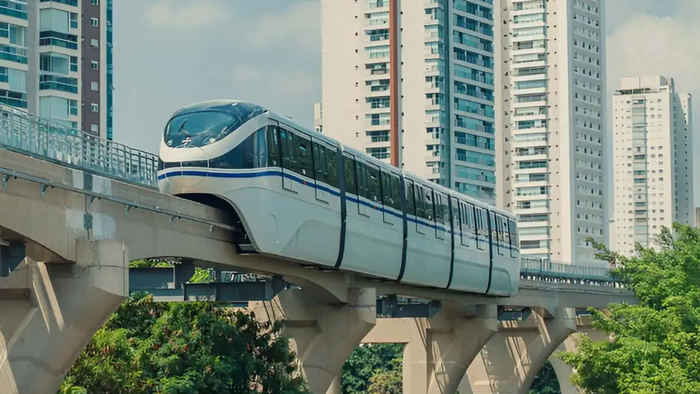
The arrival of São Paulo’s Line 17-Gold monorail marks the end of a decade-long developmental limbo. Originally envisioned as a centerpiece for the 2014 World Cup infrastructure, the project faced years of bureaucratic and technical hurdles before its recent debut. Now operational, the line provides a vital arterial link between Congonhas Airport—the city’s bustling domestic hub—and the Morumbi station, finally integrating the airport into the city’s dense rail network.
The rolling stock, developed by the Chinese conglomerate BYD, introduces a significant technological pivot for Brazilian transit: onboard energy storage. While the monorail draws primary power from the municipal grid, it is equipped with a battery backup system derived from BYD’s electric vehicle architecture. This hybrid approach serves as a critical redundancy; in the event of a grid failure, the trains maintain an 8-kilometer range, sufficient to reach the next station and prevent the mid-track stalls that can often paralyze elevated transit systems.
Beyond the propulsion system, the line reflects a broader push toward digital modernization in urban infrastructure. The entirety of the route is outfitted with 5G and 4G connectivity, addressing the growing demand for seamless data access in transit. For São Paulo, a city defined by its staggering congestion, the monorail is less about raw speed and more about predictability—a high-tech intervention designed to bypass the gridlock of the South Zone.
With reporting from Canaltech.
Source · Canaltech