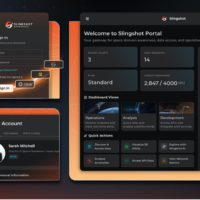
The near-Earth environment is undergoing a rapid transition from a vast, empty frontier to a crowded and contested operational theater. With active satellite counts now in the tens of thousands — driven largely by the proliferation of commercial mega-constellations — the legacy tools used to track objects in orbit are reaching their technical limits. Slingshot Aerospace, a space data analytics company, has introduced Slingshot Portal, an AI-driven platform designed to consolidate the fragmented landscape of space situational awareness (SSA) into a single, unified interface for satellite operators.
The platform functions as a centralized hub, fusing data from Slingshot's proprietary Global Sensor Network with government tracking records, comprehensive object catalogs, and a customer's own mission data. By integrating these disparate streams, the portal allows operators to monitor missions in near real-time, moving beyond simple tracking to active anomaly detection. The stated objective is to provide an environment where operators can not only observe orbital dynamics but also execute critical decisions within the same workflow.
From tracking to decision-making
Space situational awareness has historically been a patchwork discipline. The U.S. Space Command maintains the most comprehensive public catalog of tracked objects, but its data is optimized for national security priorities rather than commercial operations. Private operators often supplement government feeds with their own sensor data, third-party tracking services, and ephemeris information shared by other constellation operators. The result is a fragmented information environment in which critical decisions — whether to maneuver a satellite to avoid a conjunction, for instance — depend on reconciling data of varying quality, latency, and format.
Slingshot Portal represents an attempt to collapse that complexity into a single pane of glass. The use of AI in this context is not about replacing human judgment but about managing the sheer volume of data that modern orbital operations generate. Filtering noise, flagging potential collisions, and detecting anomalies in satellite behavior are tasks that scale poorly with human attention alone, particularly as fleet sizes grow from dozens of spacecraft to hundreds or thousands. As CEO Tim Solms noted, the dynamic nature of today's orbital domain requires tools that can interpret data as quickly as they collect it.
The approach mirrors a pattern familiar from other infrastructure-heavy industries. Air traffic management, maritime shipping, and energy grid operations all underwent similar transitions as their respective domains grew more congested: manual coordination gave way to integrated software platforms that synthesize sensor data, apply algorithmic analysis, and present operators with prioritized action items. Space operations appear to be entering the same phase.
The competitive landscape for orbital intelligence
Slingshot is not operating in a vacuum. Several companies and government agencies are pursuing parallel efforts to modernize space traffic management. The commercial SSA market has attracted a growing number of entrants offering tracking, conjunction assessment, and debris monitoring services. What distinguishes the various offerings is less the underlying data — much of which originates from overlapping sensor networks — than the software layer that processes and presents it.
Slingshot's bet is that integration and workflow design matter as much as raw data fidelity. A platform that allows an operator to move from situational awareness to maneuver planning without switching tools or reconciling spreadsheets could offer a meaningful operational advantage, particularly during time-critical conjunction events where minutes matter.
Looking ahead, Slingshot plans to expand the portal's capabilities throughout the year. Upcoming features include advanced maneuver intelligence and predictive analytics, which would allow operators to simulate and plan complex orbital shifts before execution. These capabilities edge the platform closer to what might be described as an operational command layer — not merely observing the orbital environment but actively shaping decisions within it.
The broader question is whether the commercial sector can build these tools fast enough to keep pace with the environment they are meant to manage. Orbital congestion is not a future problem; it is a present one, and the rate at which new objects are being launched continues to outstrip the rate at which tracking and coordination infrastructure matures. Whether platforms like Slingshot Portal can close that gap — or merely narrow it — remains the central tension in the evolving discipline of space traffic management.
With reporting from Payload Space.
Source · Payload Space