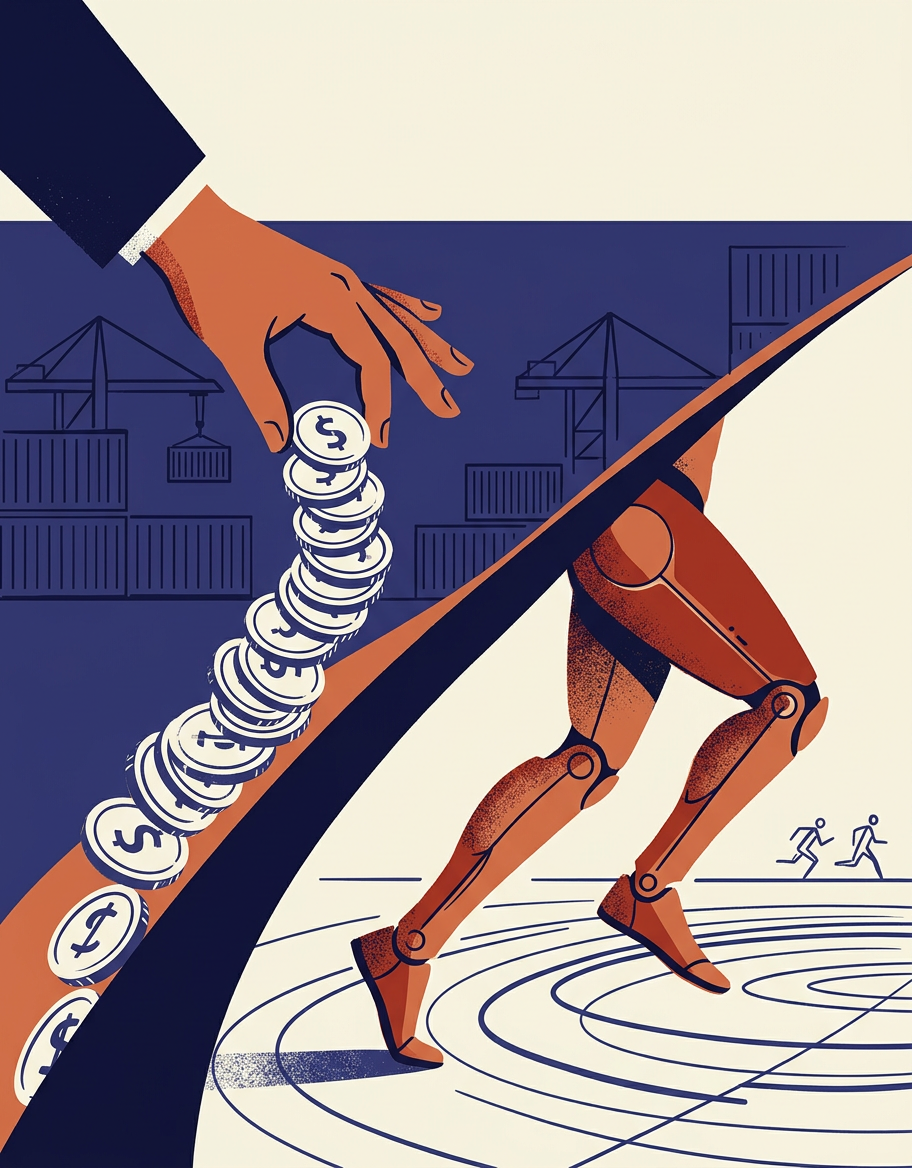
The United States Supreme Court's ruling that former President Donald Trump exceeded his constitutional authority in imposing certain tariffs has triggered a sprawling refund process, with businesses across the country now filing claims to recover duties paid under the contested measures. Separately, a humanoid robot developed in China has reportedly completed a half-marathon faster than the standing human world record — a milestone that, however symbolic, signals the accelerating pace of bipedal robotics development.
The Tariff Refund Machinery Begins to Turn
The refund process follows a legal challenge that had wound its way through the federal courts for months. At issue was whether the executive branch had the statutory basis to levy tariffs unilaterally under the trade authorities invoked during the Trump administration. The Supreme Court's determination that the former president overstepped his authority effectively invalidated a category of duties that had been collected from importers — many of them small and mid-sized firms — over a period of years.
The practical consequences are considerable. Tariff costs are typically borne by the importing entity, not the foreign exporter, meaning American companies absorbed the financial burden in real time. Many passed those costs downstream to consumers; others absorbed them at the expense of margins. The refund mechanism now in motion will require businesses to document payments, file claims with the relevant federal agencies, and wait for processing — a timeline that remains unclear.
The ruling also carries broader implications for the balance of trade policy power between Congress and the executive branch. The Constitution vests tariff authority in the legislature, but successive administrations have relied on emergency and national-security statutes to act without direct congressional approval. The Court's decision may narrow the scope of those delegations, though the precise boundaries will likely be tested again in future disputes.
Meanwhile, the economic backdrop has grown more complicated. Oil prices have surged following Iranian threats to block the Strait of Hormuz, the narrow waterway through which a significant share of global petroleum shipments pass. The resulting disruptions extend beyond energy markets: petrochemical derivatives such as plastics, synthetic fibers, and industrial solvents depend on stable crude supply chains. Manufacturers already contending with tariff uncertainty now face input-cost volatility on a second front.
A Robot Runs Faster Than Any Human
In a development that sits at the intersection of robotics, artificial intelligence, and national prestige, a humanoid robot built in China has reportedly completed a half-marathon — 21.1 kilometers — in a time that surpasses the current human world record. The achievement, while narrow in direct commercial application, serves as a benchmark for the maturation of bipedal locomotion systems, battery endurance, and real-time terrain adaptation.
China has invested heavily in humanoid robotics as a strategic technology category. Several domestic firms and state-backed research institutes have announced ambitious development timelines, positioning humanoid platforms as eventual participants in manufacturing, logistics, elder care, and disaster response. A half-marathon record, in this context, functions less as a sporting curiosity and more as a public demonstration of sustained mechanical reliability — the ability of a machine to operate continuously under physical stress without failure.
The milestone also arrives at a moment of intensified geopolitical competition over advanced robotics. The United States, Japan, and South Korea each maintain significant humanoid robotics programs, and the sector has attracted growing venture capital interest globally. Whether bipedal humanoid form factors prove commercially superior to wheeled or quadruped alternatives remains an open question, but the engineering progress is difficult to dismiss.
Taken together, the two stories illustrate a recurring tension in the current global economic landscape. Trade policy disruptions — whether from tariff disputes or energy supply threats — impose friction on physical supply chains. Robotics and automation, meanwhile, promise to reduce dependence on some of those same vulnerable links. The question is whether the pace of technological capability can outrun the pace of geopolitical fragmentation, or whether the two forces will continue to compound one another in unpredictable ways.
With reporting from France24 Business Tech.
Source · France24 Business Tech