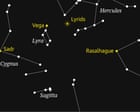
This week, the night sky offers its annual reminder of the solar system’s long memory. The Lyrid meteor shower, a fixture of the spring celestial calendar, has reached its peak activity. While the shower has been active since mid-April, its most concentrated display occurs during the late hours of Wednesday, April 22, and the early morning of Thursday, April 23.
The Lyrids are among the oldest known meteor showers, with human observations stretching back as far as 687 BC. The streaks of light are the result of Earth passing through a trail of debris left by a comet first identified by modern astronomers in 1861. As these particles—most no larger than a grain of sand—enter the atmosphere at high speeds, they incinerate, creating the brief, luminous arcs that define the event.
For observers, the meteors appear to radiate from the constellation Lyra, positioned near the bright star Vega. This "radiant" point serves as a navigational anchor for those watching the eastern horizon in the post-midnight hours. Unlike the more prolific showers of late summer, the Lyrids are valued less for their sheer volume and more for their historical continuity, representing a rare direct encounter with the ancient architecture of our orbital path.
With reporting from The Guardian Science.
Source · The Guardian Science


