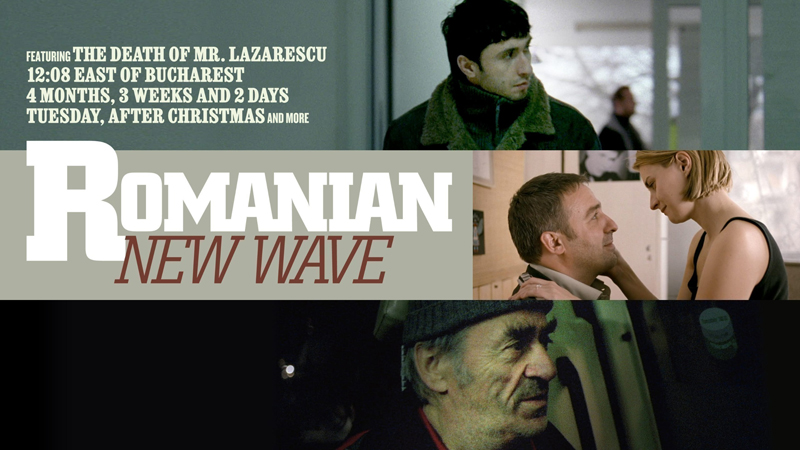
In the mid-2000s, a generation of Romanian filmmakers began producing work that would alter the trajectory of European art cinema. Characterized by long takes, naturalistic performances, sparse musical scores, and a dry, often mordant humor directed at the absurdities of post-communist life, the movement came to be known as the Romanian New Wave. Two recent developments have brought it back into focus: the translation of the widely used textbook Film History: An Introduction into Romanian, and a new retrospective program on the Criterion Channel dedicated to the movement's landmark films.
The textbook, co-authored by Kristin Thompson and the late David Bordwell, has served as a standard reference in university film programs across the world since its first edition. Its Romanian translation represents something of a symbolic homecoming — a work of global film scholarship arriving in the language of a national cinema it helped canonize for English-speaking audiences. Thompson's visit to Bucharest to mark the occasion included conversations at local universities and informal exchanges with filmmakers, among them Cristian Mungiu and Radu Jude, two directors whose work has been central to the movement's international reputation.
A Cinema Forged in Bureaucratic Absurdity
The Romanian New Wave did not emerge in a vacuum. Romania's film industry under Nicolae Ceaușescu operated under heavy state censorship, producing a body of work largely shaped by ideological constraints. After the revolution of 1989 and the chaotic transition that followed, a younger generation of filmmakers turned their cameras on the texture of everyday life in a society still grappling with institutional dysfunction. The result was a cinema of radical restraint — one that trusted the audience to sit with discomfort, to watch scenes unfold in something close to real time, and to draw moral conclusions without directorial prompting.
Cristi Puiu's The Death of Mr. Lazarescu (2005) is often cited as the work that announced the movement to international audiences. Its nearly two-and-a-half-hour depiction of an elderly man's passage through a failing healthcare system operates simultaneously as social critique and formal experiment. Cristian Mungiu's 4 Months, 3 Weeks and 2 Days (2007), which won the Palme d'Or at Cannes, extended the movement's reach further, presenting a harrowing narrative set in the final years of the Ceaușescu regime with an unflinching, observational style that refused melodrama. Both films share a commitment to durational storytelling — scenes that stretch beyond conventional editing rhythms, forcing the viewer into a kind of complicity with the characters' predicaments.
The Criterion Channel's new program collects these and other essential works, offering a concentrated survey of the movement for audiences who may have encountered individual titles without seeing the broader pattern. For a streaming platform built around curated programming, the Romanian New Wave is a natural fit: it rewards the kind of attentive, patient viewing that the channel's audience tends to seek.
Scholarship and Practice in Dialogue
The convergence of the textbook translation and the Criterion retrospective raises a question worth sitting with: what happens when a national cinema becomes fully absorbed into the global academic canon? On one hand, inclusion in a widely adopted textbook and a prestigious streaming library confers a kind of permanence — it ensures that future students and cinephiles will encounter these films as part of an established lineage. On the other, canonization can flatten the very qualities that made the work distinctive, reducing a living artistic community to a set of stylistic descriptors in a syllabus.
The Romanian filmmakers themselves have not stood still. Radu Jude's recent work has moved toward essay-film hybrids and archival collage, pushing well beyond the observational realism that defined the movement's early phase. Mungiu continues to work within longer narrative forms but has shifted his thematic concerns. Whether the label "Romanian New Wave" still usefully describes what these directors are doing now is an open question — one that the retrospective, by anchoring its program in the canonical titles, does not fully address.
What remains clear is that the movement's formal innovations — its trust in duration, its refusal of sentimentality, its insistence that the viewer do interpretive work — have left a mark on art cinema well beyond Romania's borders. The tension between a living tradition and its institutional preservation is not unique to Romanian film, but the proximity of these two events makes it unusually visible.
With reporting from David Bordwell Blog.
Source · David Bordwell Blog