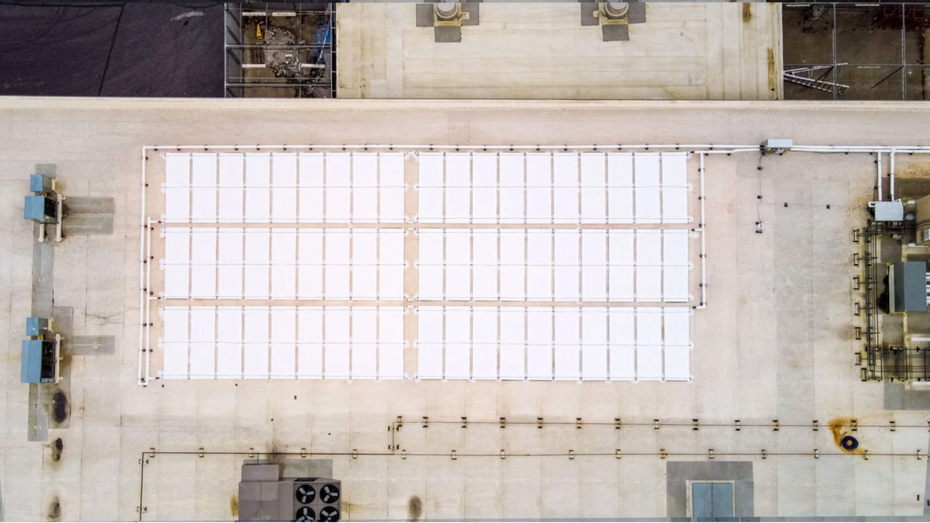
As summer temperatures become increasingly difficult to manage across much of the world, the search for cooling solutions that do not rely on the energy-intensive cycle of traditional air conditioning has intensified. One promising avenue is radiative cooling — a passive technology designed to bypass the power grid entirely by leveraging the fundamental physics of heat transfer.
The mechanism is elegantly simple in theory: surfaces are engineered to reflect sunlight while simultaneously emitting thermal radiation at wavelengths that pass through the Earth's atmosphere and into the cold expanse of space. The atmosphere has a transparency window — roughly between 8 and 13 micrometers — through which infrared radiation can escape without being absorbed by water vapor or carbon dioxide. By effectively using the universe as a heat sink, these materials can maintain temperatures several degrees below their surroundings without consuming a single watt of electricity.
From physics curiosity to applied engineering
Radiative cooling is not a new concept. The phenomenon has been observed for centuries: desert dwellers long noticed that surfaces exposed to a clear night sky could cool below ambient temperature, sometimes enough to form frost even in arid climates. What has changed is the ability to engineer materials that achieve meaningful cooling during the day, when solar radiation would otherwise overwhelm any passive heat loss.
Recent advances in nanophotonic films and multilayer polymer coatings have made daytime radiative cooling viable at a material level. These engineered surfaces can reflect more than 90 percent of incoming sunlight while maximizing emission in the atmospheric transparency window. Applied to rooftops or building facades, they offer the prospect of reducing indoor temperatures without compressors, refrigerants, or electricity — a significant proposition given that conventional air conditioning accounts for a substantial share of global electricity demand and relies on hydrofluorocarbon refrigerants with high global warming potential.
The appeal is obvious in the context of escalating heat waves. Urban heat islands — where dense construction and asphalt trap thermal energy — amplify the problem, creating feedback loops in which more air conditioning units dump more waste heat into already overheated streets. A passive technology that breaks this cycle could offer relief precisely where it is most needed.
The environmental trade-off
However, the transition from laboratory promise to widespread urban application is not without friction. The materials used in high-performance radiative cooling films often involve polymers, metal oxides, or nanostructured layers whose production carries its own environmental footprint. Manufacturing processes may require energy-intensive deposition techniques, and the long-term durability of these coatings under real-world conditions — dust, humidity, UV degradation — remains an open question. A film that must be replaced every few years shifts the environmental calculus considerably.
There is also the matter of scale. Coating individual buildings is one thing; achieving a meaningful reduction in urban heat at the district or city level is another. Performance depends heavily on climate: radiative cooling works best under clear, dry skies, where the atmospheric window is most transparent. In humid tropical cities — often the places where cooling demand is greatest — water vapor partially closes that window, reducing effectiveness.
The field sits at a familiar juncture in the history of green technology: a solution that addresses one environmental problem while introducing others. The carbon savings from eliminating compressor-driven cooling are real, but they must be weighed against the lifecycle impact of the materials themselves, including sourcing, fabrication, and disposal. Whether the net environmental balance favors radiative cooling at scale depends on advances in material science that are still underway.
The tension, then, is structural. On one side stands a technology that could decouple thermal comfort from the electrical grid — a prospect with profound implications for energy security, emissions, and equity in a warming world. On the other stands the stubborn reality that no material is free of ecological cost, and that the most elegant physics cannot exempt a technology from the messy economics of manufacturing and deployment. Which force prevails may depend less on the science itself than on whether the engineering can mature fast enough to meet the climate it was designed to answer.
With reporting from t3n.
Source · t3n