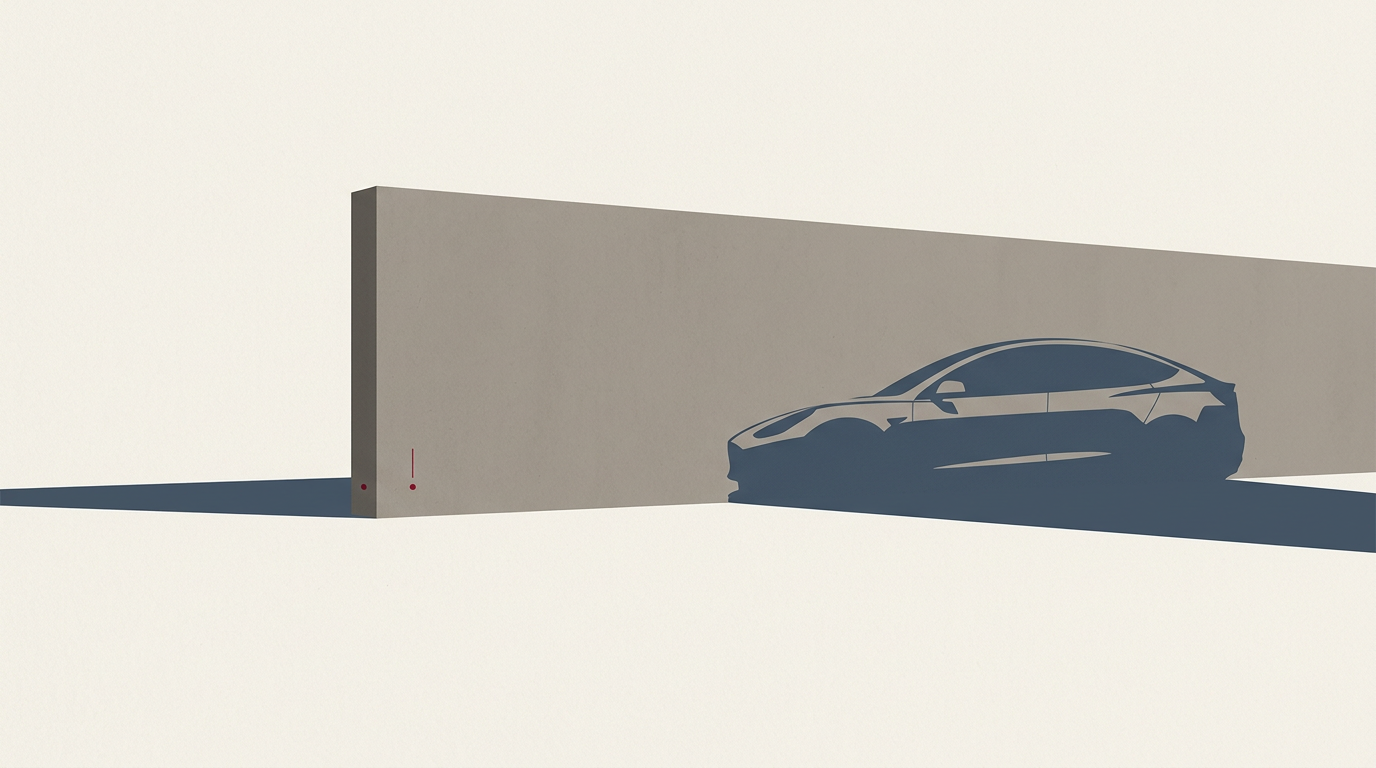
The United States has erected a formidable trade barrier — a 100% tariff — designed to insulate the domestic market from the influx of Chinese electric vehicles. The policy goal was straightforward: make these cars effectively invisible to the American consumer by pricing them out of existence. By any conventional measure of trade protectionism, the tariff should work. Chinese EVs, many of which are priced well below their Western counterparts before duties are applied, become uncompetitive the moment they reach a U.S. port. Yet recent data suggests that while the physical vehicles are being held at the border, their cultural presence has already established a beachhead in the American digital consciousness.
According to a survey of 9,000 potential EV buyers conducted by consultancy AlixPartners, the algorithmic reach of TikTok and YouTube is rendering traditional trade protectionism increasingly porous. The study found that 58% of respondents had encountered Chinese EVs on TikTok. Among the 18-to-25-year-old demographic, brand awareness surged to 76%. More strikingly, 69% of those aware of these brands expressed a willingness to consider them for their next purchase, despite the current lack of availability on American roads.
Phantom demand and the limits of tariff walls
This disconnect highlights a fundamental shift in how global markets are formed. In a previous era, a product that was not on the showroom floor effectively did not exist for the consumer. Brand awareness required physical distribution — dealerships, test drives, local advertising. Tariffs and import restrictions could therefore function as near-total demand suppressants. A car that could not be bought could not be wanted.
That logic no longer holds. Short-form video creates what might be described as "phantom demand" — consumer desire for technology that remains legally and economically out of reach. The mechanism is not mysterious: a well-produced TikTok walkthrough of a BYD interior or a YouTube comparison test filmed in Europe or Southeast Asia reaches American viewers with the same ease as any domestic content. The algorithm does not respect customs borders. And the content is often not produced by the manufacturers themselves but by independent creators, reviewers, and enthusiasts, which lends it a credibility that traditional advertising struggles to match.
The historical parallel is instructive. Japanese automakers in the 1970s and 1980s faced significant American skepticism and periodic trade friction, but they had to build that brand equity slowly, dealership by dealership, across decades. Korean manufacturers followed a similar trajectory in the 1990s and 2000s. Chinese EV makers appear to be compressing that timeline dramatically — accumulating brand equity and purchase intent among younger demographics before selling a single unit on American soil.
The strategic dilemma for Detroit and Washington
For the American automotive industry, the challenge is no longer confined to competing on domestic manufacturing capability, battery range, or sticker price. It now extends to contending with a digital-native generation that has already formed favorable impressions of an ecosystem they are not allowed to enter. The AlixPartners data implies that if tariffs were reduced or circumvented — through manufacturing partnerships, third-country assembly, or a future policy shift — latent demand could convert rapidly.
This places policymakers in an uncomfortable position. Tariffs are designed to buy time for domestic industry to become competitive. But if consumer preference is being shaped in real time by content platforms operating outside the reach of trade policy, the window that tariffs are supposed to provide may be narrower than assumed. Detroit is not merely racing against Chinese manufacturing scale and cost advantages; it is racing against a preference curve that is bending without a single transaction taking place.
The tension, then, is structural. Trade policy operates on the movement of goods. Brand formation increasingly operates on the movement of information. These two forces now run on different tracks, at different speeds, governed by different rules. Whether American automakers can close the perception gap before the tariff wall becomes politically or economically unsustainable remains an open question — one whose answer depends as much on content algorithms as on industrial policy.
With reporting from The Next Web.
Source · The Next Web