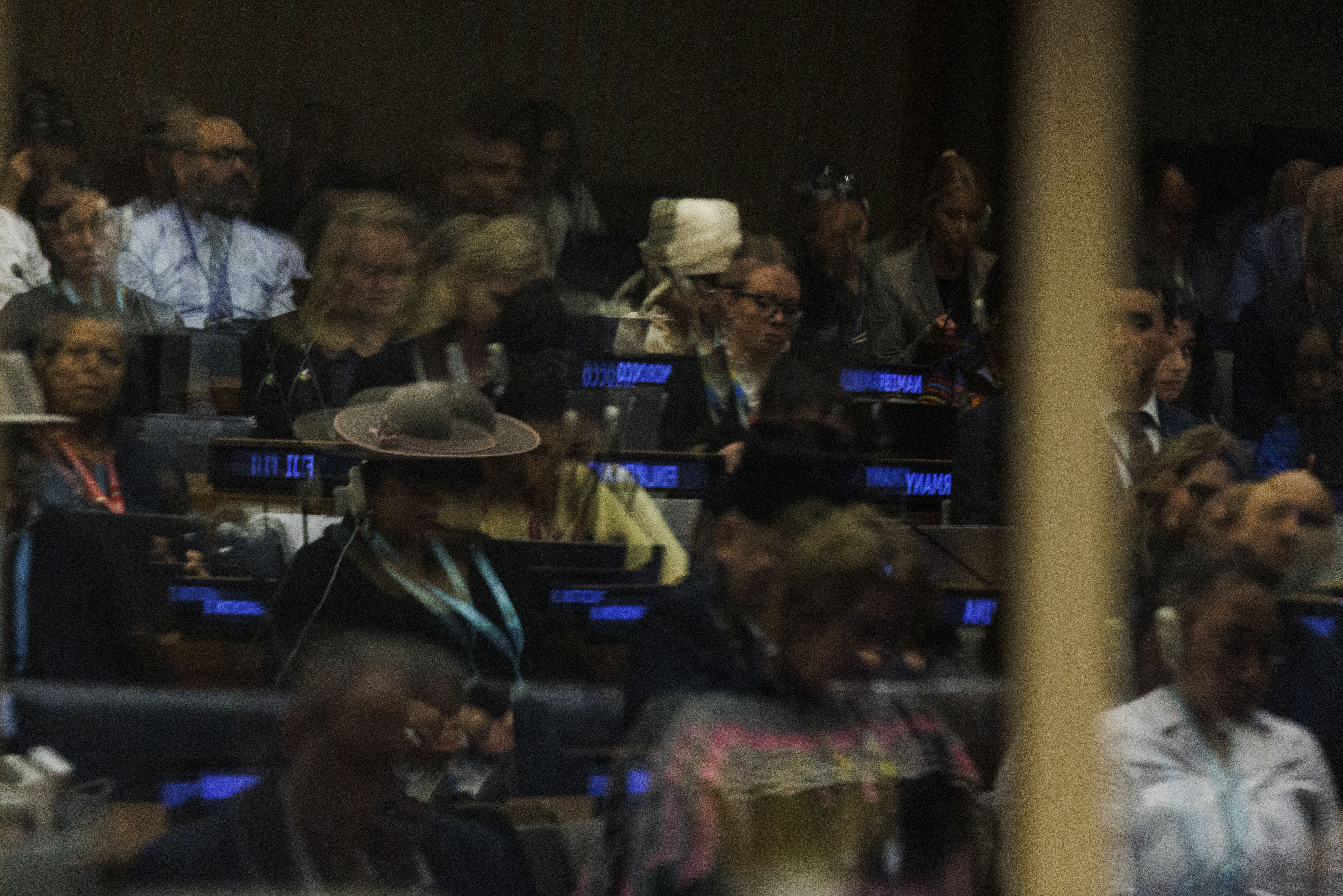
The legal architecture of climate accountability is expanding, but its foundations remain fragile. Over the past year, the International Court of Justice and the Inter-American Court on Human Rights have issued landmark opinions asserting that sovereign states are legally responsible for the environmental harm they facilitate. These rulings were intended to serve as a shield for Indigenous communities in the Pacific and the Amazon, where rising seas and encroaching mining operations pose existential threats. At the United Nations Permanent Forum on Indigenous Issues this week, Indigenous leaders and legal advocates gathered to confront a question that no court opinion can answer on its own: how to make sovereign states comply.
The transition from legal theory to territorial protection has been stalled by a familiar obstacle — the absence of enforcement mechanisms. In regions like Ecuador, oil extraction continues despite domestic and international pressure, exposing what advocates describe as a "compliance gap" that renders even the most progressive rulings effectively toothless. The forum's agenda this year reflects a strategic pivot: from winning legal arguments to the harder, less glamorous work of leveraging international law against state inaction.
Advisory opinions and the limits of moral authority
International courts operate under structural constraints that distinguish them from domestic judicial systems. The ICJ, established under the United Nations Charter, issues advisory opinions that carry significant legal and diplomatic weight but lack direct enforcement power. States may acknowledge such opinions in principle while declining to alter policy in practice. The Inter-American Court on Human Rights has somewhat stronger mechanisms within the Organization of American States framework, including the ability to order reparations, but compliance depends on the political will of member states — a resource that has historically proved scarce when extractive industries and economic interests are at stake.
This gap between jurisprudence and enforcement is not new. It echoes decades of tension in international law, from the ICJ's 1986 ruling against the United States in the Nicaragua case — which Washington simply ignored — to the persistent non-compliance with International Criminal Court warrants. What makes the current moment distinct is the nature of the harm. Climate-related destruction of Indigenous lands is not a discrete event that can be adjudicated after the fact; it is cumulative and, in many cases, irreversible. A ruling that arrives after a coastline has been swallowed or a forest cleared offers documentation, not protection.
Indigenous advocates at the forum are acutely aware of this temporal dimension. Their push to reframe court opinions as "instruments of power" rather than symbolic victories reflects a pragmatic reading of international law's possibilities and limitations. The strategy involves linking legal mandates to concrete pressure points — trade agreements, multilateral development financing, and diplomatic relationships — where non-compliance carries a tangible cost.
Sovereignty, accountability, and the question of leverage
The tension at the heart of this effort is one of the oldest in international relations: the friction between state sovereignty and external accountability. Governments that resist compliance with climate rulings do not typically reject the legal reasoning outright. Instead, they invoke sovereign authority over natural resources and domestic economic policy, framing enforcement as an intrusion. For Indigenous communities whose territorial claims predate the modern state system, this argument carries a particular irony.
The forum's discussions suggest that advocates are exploring multiple channels simultaneously. One approach involves strengthening the procedural links between international rulings and the conditionality requirements of multilateral institutions such as the World Bank and regional development banks. Another focuses on building coalitions with climate-vulnerable small island states, whose diplomatic leverage at the UN has grown in proportion to the visibility of their existential risk. A third track involves domestic litigation strategies that translate international opinions into enforceable obligations within national courts — a path that has shown uneven but real results in jurisdictions across Latin America and Europe.
None of these channels offers a clean solution. Multilateral conditionality is subject to geopolitical negotiation. Coalition diplomacy depends on sustained alignment among states with divergent interests. Domestic litigation requires judicial independence that not all countries guarantee. The question facing Indigenous advocates is not whether any single mechanism will close the enforcement gap, but whether a combination of legal, diplomatic, and economic pressures can shift the calculus for states that currently treat international climate obligations as aspirational.
The rulings themselves have established a legal baseline that did not exist a decade ago. Whether that baseline becomes a floor from which accountability rises or a ceiling that ambition cannot penetrate depends less on the courts than on the political and institutional structures that surround them. The advocates gathered at the UN this week are betting that law, properly leveraged, can still function as more than a record of what was lost.
With reporting from Grist.
Source · Grist