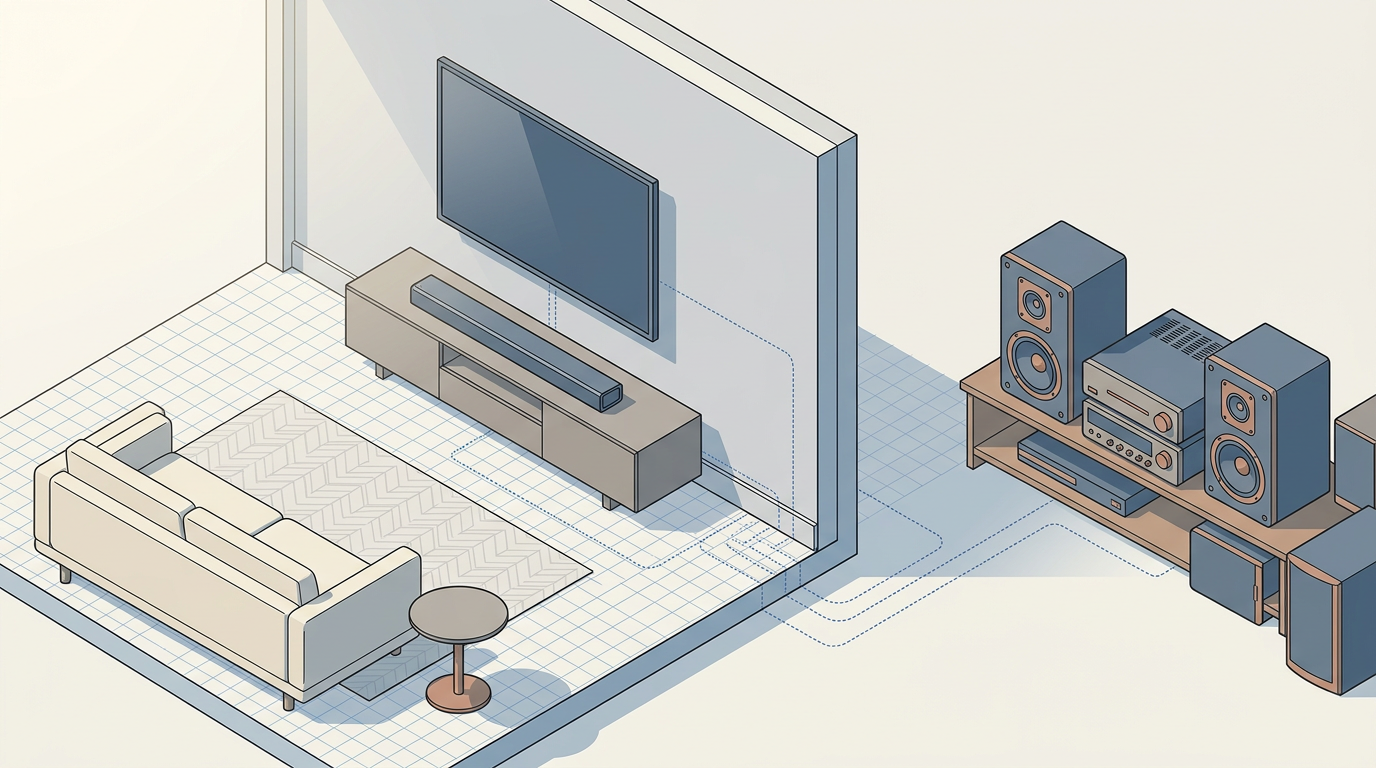
The home theater, once a labyrinth of copper wiring and bulky cabinetry, has undergone a quiet consolidation. For decades, high-fidelity domestic audio meant dedicated rooms, receiver stacks, and speaker arrays that demanded both space and expertise. The modern living room, shaped by open floor plans and minimalist design sensibilities, demands a more discreet acoustic footprint. That shift has driven the engineering of the soundbar from a mere television accessory to a sophisticated hub of digital signal processing.
Recent offerings from industry staples like JBL and Samsung illustrate this trajectory. Products such as the 2.1-channel JBL Cinema SB180 and Samsung's HW-B450F prioritize wireless integration to eliminate the physical clutter of traditional subwoofers and speaker wire runs. The result is a category of device that would have been unrecognizable to the audiophile of even a decade ago: a single bar and a cordless bass module, promising a credible stereo or surround experience from hardware that fits beneath a wall-mounted screen.
Software as the New Acoustic Architecture
As hardware footprints shrink, software-driven optimization has become the primary differentiator. The competitive axis in consumer audio has shifted from driver size and amplifier wattage toward computational acoustics — the ability of onboard processors to analyze and reshape sound in real time. LG's current lineup, including the SH5A and the S60TR, leans heavily on AI-driven acoustics. Technologies branded as AI Sound Pro and Clear Voice Pro represent real-time adjustments to equalization and dialogue clarity, calibrating output to preserve the nuances of a film score or a televised broadcast regardless of the room's unique geometry.
This is not an isolated strategy. Across the consumer electronics sector, machine learning has migrated from cloud-based services into edge devices — smartphones, cameras, and now audio hardware. The pattern is consistent: a general-purpose processor running inference models replaces what once required bespoke analog circuitry. For soundbars, the practical implication is that a device can, in theory, compensate for hard floors, soft furnishings, or awkward room dimensions without manual tuning. Whether these algorithms deliver perceptible improvements over well-designed passive equalization remains a matter of ongoing debate among audio engineers, but the direction of investment is clear.
The Democratization of Spatial Audio
Perhaps the most consequential development is the effort to bring spatial audio formats into mainstream hardware. Dolby Atmos, the object-based audio standard that maps sound to three-dimensional coordinates rather than fixed channels, once required a dedicated room and ceiling-mounted speakers — an installation measured in thousands of dollars and considerable architectural commitment. Systems like the ULTIMEA Poseidon D60 now attempt to recreate that three-dimensional soundstage through compact, 5.1-channel footprints, leveraging wireless rear speakers and advanced processing to simulate height and surround cues from ear-level drivers.
The approach carries inherent trade-offs. Psychoacoustic processing can approximate the sensation of overhead sound, but it remains bounded by the physics of speaker placement and room reflections. What these products do accomplish, however, is a lowering of the entry barrier. The gap between a casual listener and an enthusiast narrows when spatial audio no longer presupposes a construction project.
This trajectory — from analog complexity to computational simplicity, from dedicated rooms to adaptive algorithms — mirrors a broader pattern in consumer technology. The value migrates from hardware to software, from fixed infrastructure to flexible processing. For the audio industry, the tension ahead lies between the promise of algorithmic convenience and the irreducible constraints of acoustic physics. How far software can stretch before diminishing returns set in will shape not only product roadmaps but consumer expectations of what a living room can sound like.
With reporting from Olhar Digital.
Source · Olhar Digital