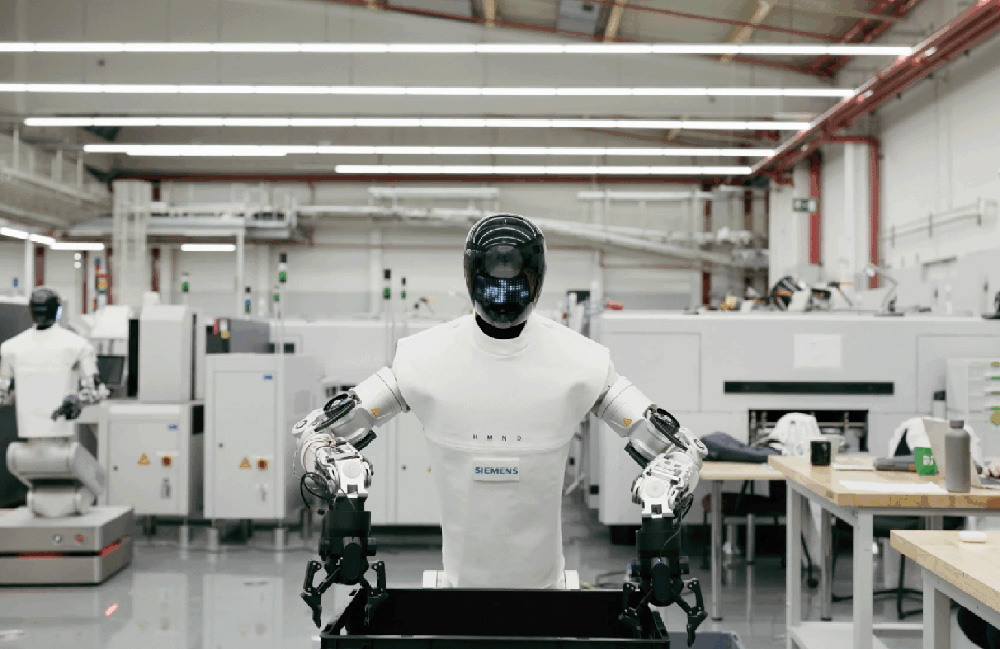
In a quiet corner of Siemens' electronics factory in Erlangen, Germany, the distinction between digital simulation and physical labor is beginning to blur. Siemens and the London-based startup Humanoid recently completed a successful pilot of the HMND 01 Alpha, a wheeled humanoid designed to navigate the intricate logistics of a working industrial site. Unlike the static robotic arms that dominate most factory floors, the HMND 01 is a mobile manipulator — built to move autonomously through human-centric spaces and perform tasks that once required manual intervention.
The deployment is part of a broader push by Siemens and NVIDIA to develop what the industry calls "physical AI": the discipline of training intelligent systems to interact with the material world rather than merely processing data. By combining NVIDIA's simulation tools with Siemens' industrial digital frameworks, Humanoid's proprietary KinetIQ AI allows the robot to adapt to diverse tasks rather than following a rigid, pre-programmed script. The stated goal is a factory that is not just automated but adaptive — capable of reconfiguring its logistics in response to shifting conditions.
From Safety Cages to Open Floors
The history of industrial robotics is largely a history of containment. Since the first Unimate arms appeared on General Motors assembly lines in the early 1960s, robots in factories have operated behind barriers, in carefully delimited zones where human workers are not permitted to enter while machines are active. The logic was straightforward: industrial robots are fast, strong, and blind to their surroundings. Keeping them separated from people was the simplest way to prevent injury.
The HMND 01 Alpha pilot represents a departure from that paradigm. A wheeled humanoid operating in a working electronics facility must contend with foot traffic, variable floor layouts, and the kind of unstructured clutter that characterizes real logistics environments. The robot is not replacing a single fixed task on an assembly line; it is navigating the connective tissue of production — the movement of parts, materials, and tools between stations.
This shift tracks with a broader trend across the robotics sector. Several companies, from established players to well-funded startups, are developing mobile manipulators intended to operate alongside human workers rather than in isolation. The technical challenge is formidable: the robot must perceive its environment in real time, plan safe paths through dynamic spaces, and manipulate objects with enough dexterity to be useful without enough force to be dangerous. The fact that Humanoid, a company founded only in 2024, has reached the stage of testing in a live Siemens facility suggests that advances in simulation-to-reality transfer — training robots in virtual environments and deploying the learned behaviors on physical hardware — are maturing faster than many observers expected.
The Digital Twin as Training Ground
Central to the approach is the concept of the digital twin, a high-fidelity virtual replica of a physical environment used for testing, optimization, and increasingly, for training AI systems. Siemens has invested heavily in digital twin infrastructure across its manufacturing operations, and NVIDIA's Omniverse platform has become a widely adopted tool for building the simulated worlds in which robotic behaviors can be rehearsed at scale before deployment.
The value proposition is clear in principle: simulation allows engineers to expose a robot to thousands of scenarios — dropped objects, blocked pathways, unexpected human movement — without risking equipment or safety. The persistent question, however, is how well behaviors learned in simulation transfer to the physical world, where sensor noise, lighting variation, and mechanical imprecision introduce errors that no simulation perfectly replicates. The Erlangen pilot appears designed, at least in part, to stress-test that transfer gap.
For Siemens, the strategic logic extends beyond a single robot trial. As industrial manufacturers face persistent labor shortages in logistics and material handling roles, mobile manipulators offer a potential buffer — not a wholesale replacement of human workers, but a flexible resource that can be redeployed as production demands shift. For Humanoid, the pilot serves as a credibility marker, demonstrating that its technology can function outside controlled laboratory conditions.
What remains to be seen is whether the economics and reliability of mobile humanoids can scale beyond pilot programs. The gap between a successful demonstration and a commercially viable fleet deployment is wide, and it is littered with the remains of robotics ventures that solved the technical problem but stumbled on cost, maintenance, or integration complexity. The Erlangen test is a data point, not a conclusion — but it is the kind of data point the industry has been waiting to generate.
With reporting from The Robot Report.
Source · The Robot Report