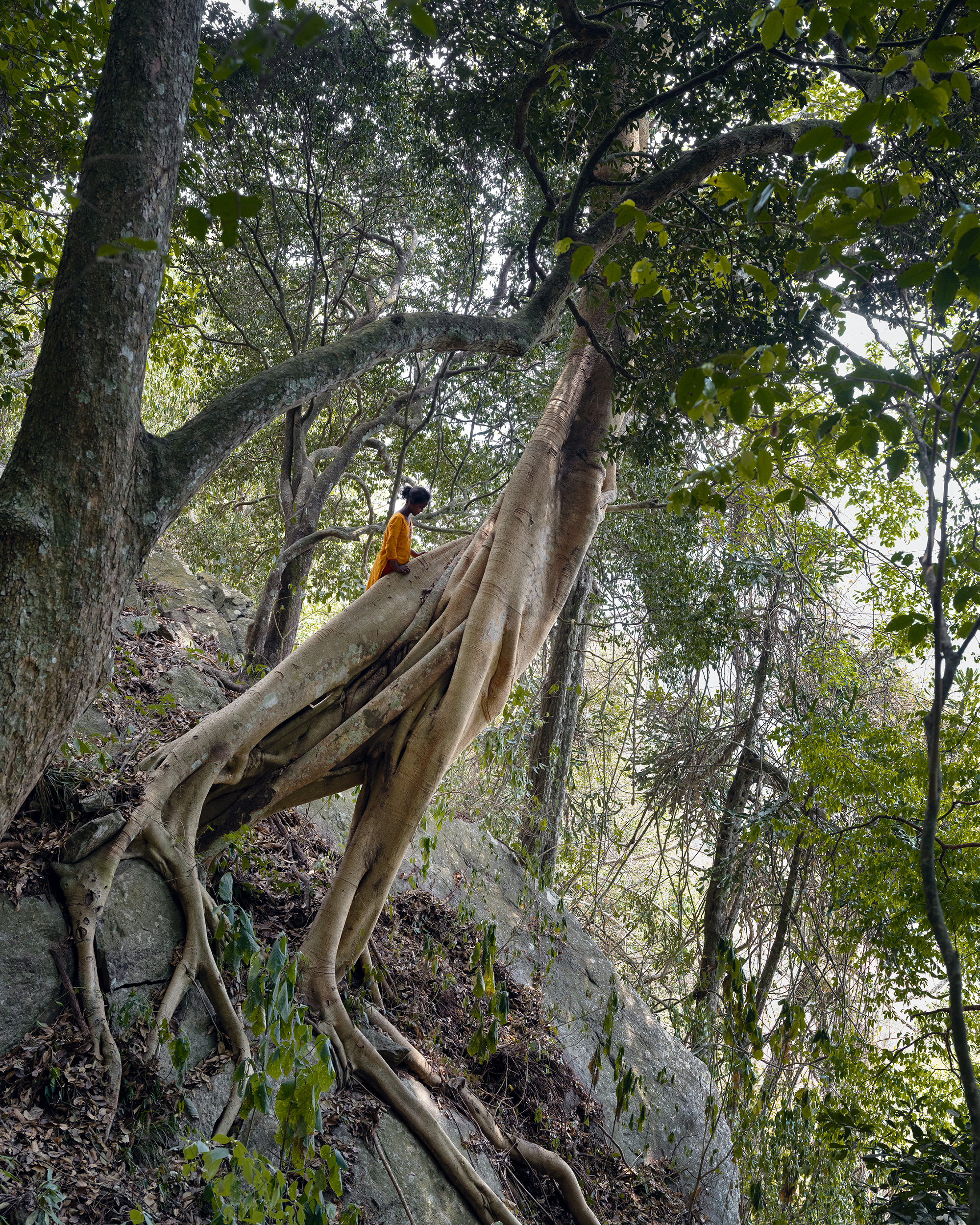
In the dense canopy of the Nilgiri forest in Tamil Nadu, Bengaluru-based photographer Gayatri Ganju has spent years practicing a form of visual ethnography rooted in silence. Working alongside Kurumba guides, Ganju's process is defined by what she calls "close listening"—a slow, ritualistic engagement where photography is secondary to the act of gathering memory. In circles of shared recollection, she documents the ancestral landscape of the Kurumba people, navigating the inherent friction between an outside observer and a community wary of cultural extraction.
This friction led to a formal agreement between the photographer and Kurumba representatives: Ganju was permitted to document the forest, but the vast majority of the stories shared during her treks would remain within the community. The Kurumba decided that only one narrative could be carried out into the wider world. The result is a project defined less by what it reveals than by what it withholds—a study in curated absence, where images serve as vessels for a history the viewer is largely forbidden from knowing.
The politics of the permitted image
The Nilgiri Hills, part of the Western Ghats biodiversity hotspot, are home to several indigenous groups collectively known as the Nilgiri tribes, of which the Kurumba are among the most forest-dependent. Their relationship with the landscape is not merely economic but cosmological: the forest functions as archive, temple, and kinship network simultaneously. For communities whose knowledge systems are transmitted orally rather than through text, the question of who gets to record—and redistribute—that knowledge is existential rather than academic.
Ganju's negotiated constraint sits within a broader and increasingly visible tension in documentary photography. The discipline has long grappled with the power asymmetry between the person holding the camera and the person being photographed, particularly when the subject belongs to a marginalized or indigenous community. Historically, ethnographic photography operated under extractive assumptions: the photographer arrived, captured, and departed with material that served outside audiences. The communities depicted rarely controlled the terms of their own representation.
What distinguishes the Kurumba arrangement is its specificity. Rather than a blanket refusal or an open invitation, the community exercised editorial authority, selecting which fragment of their oral tradition could circulate beyond the forest. The act of choosing a single exportable story implies that dozens of others were evaluated and deliberately kept private. In this framework, the photographer becomes something closer to a courier operating under strict terms of carriage than a conventional documentarian exercising creative discretion.
A creation myth as controlled disclosure
The single story Ganju was allowed to carry outward is a creation myth regarding the birth of the forest. It describes a time when God granted birds seeds to plant in a barren world, only for a wicked giant to intercept them in an attempt to prevent the trees from ever taking root. It is a story about the fragility of beginnings and the persistence of life—a fitting metaphor for a culture working to preserve its oral traditions against the encroaching erasures of modernity.
The choice of a creation myth as the sole permitted export is itself revealing. Creation stories tend to be the most public-facing layer of any oral tradition—foundational enough to share without exposing the more intimate or sacred narratives that govern daily life, ritual practice, and internal governance. By offering this particular story, the Kurumba disclosed something legible and resonant to outsiders while keeping the deeper architecture of their knowledge intact. The gesture is generous and strategic in equal measure.
Ganju's photographs, then, operate in a peculiar register. They depict a real place dense with meaning, yet the viewer lacks the narrative key to most of that meaning. The images become evidence of a relationship rather than a record of a culture—proof that an exchange occurred, not a transcript of its contents. This inversion challenges the assumption that the value of documentary work lies in maximum disclosure. Here, restraint is the point.
The project raises a question that extends well beyond photography and into any field where outside institutions seek access to indigenous knowledge, from pharmaceutical bioprospecting to academic anthropology: what happens when the subject community, rather than the researcher, sets the terms of extraction? The Kurumba did not refuse engagement. They edited it. Whether that model can scale—or whether it depends on the particular trust built between one photographer and one community over years of patient presence—remains an open question with no comfortable answer.
With reporting from Aperture.
Source · Aperture