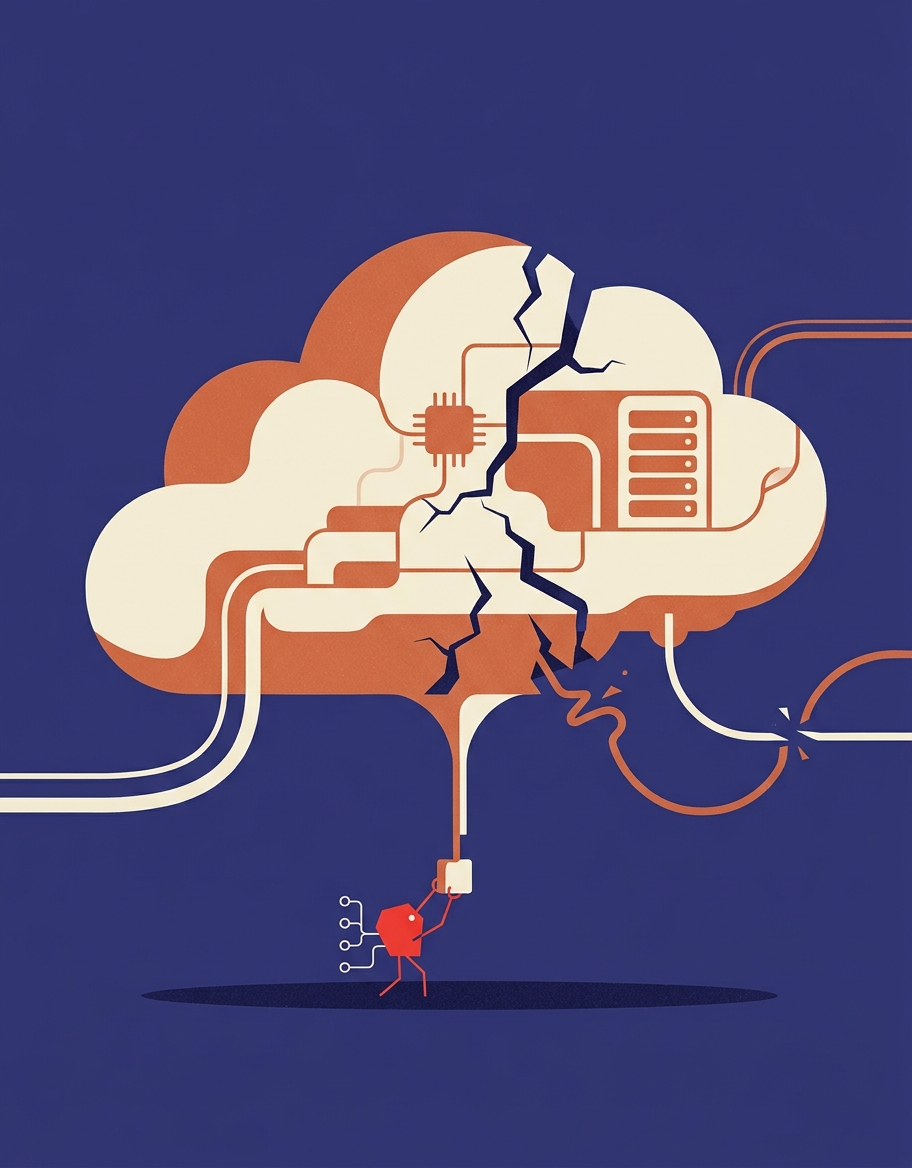
Vercel, the deployment platform that underpins a substantial share of production websites and applications, experienced a system-wide outage recently — not because of a coordinated cyberattack or a hardware failure, but because of an unlikely collision between a Roblox cheat script and an AI-assisted code generation tool. The incident offers a case study in a category of risk that cloud infrastructure providers have only begun to reckon with: cascading failures triggered not by malice, but by the compounding velocity of automated, low-skill deployments.
The sequence, as reconstructed by the developer community, is straightforward in its mechanics. An AI tool designed to streamline code generation was used to package and deploy a cheat script targeting Roblox, the gaming platform with hundreds of millions of monthly users. The deployment triggered a surge of automated requests and resource consumption that outpaced Vercel's scaling safeguards, creating a bottleneck that propagated across the platform. The result was downtime affecting not just the offending project, but a broad swath of unrelated sites and services hosted on Vercel's infrastructure.
When Frictionless Meets Uncontrolled
The modern cloud stack is engineered around the principle of minimal friction. Platforms like Vercel, Netlify, and Cloudflare Pages have spent years removing the barriers between writing code and running it in production. One-click deployments, automatic scaling, and generous free tiers are features, not bugs — they are the core value proposition. But friction, in infrastructure, also serves as a natural rate limiter. It slows down the pace at which mistakes, misuse, or outright abuse can propagate through shared systems.
The Roblox-cheat incident illustrates what happens when that friction is removed asymmetrically. AI code generation tools have made it trivial for users with limited technical knowledge to produce deployable artifacts. The barrier between intention and execution has collapsed. A user who might previously have struggled to configure a server can now, with a few prompts, generate and ship code that consumes significant platform resources. When the code in question is a gaming exploit designed to generate high volumes of automated traffic, the mismatch between ease of deployment and cost of resource consumption becomes acute.
This is not a problem unique to Vercel. Any platform that offers automatic scaling on shared infrastructure faces a version of the same tension. The economics of cloud hosting depend on the assumption that most deployments are well-behaved — that resource consumption follows predictable patterns. AI-assisted development, particularly when combined with grey-market software like game cheats, introduces a class of deployments that violate those assumptions at machine speed.
The Expanding Attack Surface of Automation
The incident sits at the intersection of two trends that have accelerated in parallel. The first is the democratization of deployment through AI tooling, which has lowered the skill floor for shipping production code. The second is the persistent and sprawling ecosystem of gaming exploits, which generates enormous volumes of automated traffic and has long been a source of abuse on cloud platforms. Individually, each trend is manageable. Together, they create feedback loops that existing safeguards — rate limiting, abuse detection, resource quotas — were not designed to absorb.
Cloud providers have historically focused their security investments on defending against intentional attacks: DDoS, credential stuffing, supply chain compromises. The Vercel outage suggests that a growing share of systemic risk may come not from adversaries, but from the sheer throughput of automated, unsupervised deployments that are individually unremarkable but collectively overwhelming. The distinction between abuse and misuse blurs when the user may not fully understand what the AI-generated code does or how many resources it demands.
For Vercel and its competitors, the engineering challenge is clear but not simple: how to preserve the frictionless experience that defines the platform while introducing controls that can absorb the unpredictable load patterns generated by AI-assisted workflows. Quota systems, deployment review gates, and anomaly detection are all plausible responses, but each reintroduces a degree of friction that runs counter to the product philosophy. The tension between openness and resilience is not new in infrastructure, but the speed at which AI tooling can amplify edge cases into platform-wide incidents compresses the timeline for resolving it.
The question facing the industry is whether the current architecture of shared, auto-scaling platforms can adapt fast enough — or whether the economics of frictionless deployment will need to be fundamentally repriced.
With reporting from Hacker News.
Source · Hacker News