In the sterile environment of the modern art museum, the "tombstone" — the small rectangular label affixed beside a work — serves as a definitive, if narrow, record of existence. It lists a name, a date, and a place of origin, effectively closing the book on an artist's biographical lifespan. Yet, as art historian Winnie Wong argues in her forthcoming study, The Many Names of Anonymity: Portraitists of the Canton Trade, these taxonomies often fail to capture the fluid, multi-layered realities of the creators themselves, particularly those working within the complex machinery of global trade.
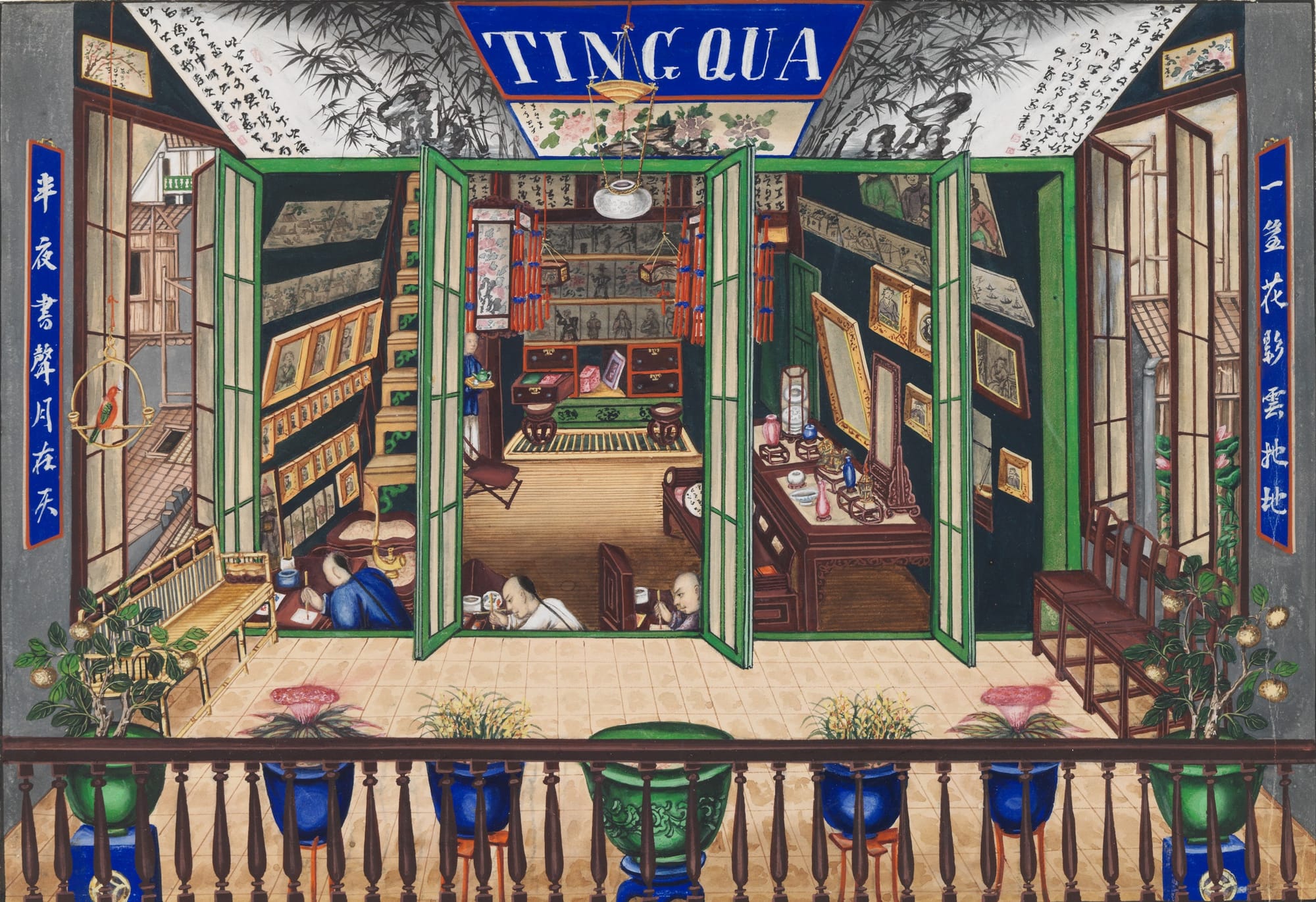
Wong's research focuses on the 18th and 19th centuries in Guangzhou, then known as Canton, where a strictly regulated mercantile system isolated Western traders to a single port. Within this enclave, Chinese portraitists produced a vast corpus of work for foreign clientele. These objects have long been relegated to the category of "Asian export art," a term Wong notes was retroactively applied in the 20th century to satisfy the organizational needs of markets and institutions. This label often obscures more than it reveals, flattening the sophisticated agency of artists who operated at the intersection of divergent cultural aesthetics.
The Canton System and Its Invisible Artisans
The Canton trade system, formalized under the Qing dynasty, confined foreign merchants to a narrow strip of waterfront known as the Thirteen Factories. European and American traders could not venture beyond this district, could not learn Chinese, and conducted business exclusively through a guild of licensed Chinese merchants known as the Cohong. Within these constraints, an entire visual economy emerged. Chinese painters produced portraits, harbor scenes, botanical studies, and genre paintings tailored to Western tastes — works that would travel aboard merchant vessels to parlors in London, Boston, and Amsterdam.
The painters who produced these works operated in a commercial context that bore little resemblance to the European model of the named, singular genius. Workshops were collaborative. Styles were deliberately adapted to match foreign expectations. Some artists adopted Western-sounding trade names — a practice that has led to persistent confusion in later cataloguing efforts. The result is a body of work that sits uncomfortably in institutional frameworks designed around individual authorship. When a museum tombstone reads "Unknown Chinese artist," it is not simply acknowledging a gap in the archive. It is, as Wong's research suggests, imposing a framework of individual attribution onto a system where authorship functioned differently.
This problem extends beyond Canton. The broader history of art institutions in Europe and North America has long struggled with objects produced outside the Western tradition of signed, dated, individually authored works. African masks, Persian miniatures, and pre-Columbian ceramics have all been subjected to similar taxonomic compression. What distinguishes the Canton case is the degree to which these artists were actively engaged with Western visual conventions — producing oil paintings on canvas, working in perspective, rendering European faces — while remaining invisible within the very system of classification that their Western clients would later build.
Anonymity as Structure, Not Absence
The crisis of naming in this context is not merely a lack of archival data, but a byproduct of the system itself. By interrogating the anonymity of these painters, Wong challenges the Western impulse to project intentionality and biography onto every brushstroke. The assumption that anonymity equals obscurity — that an unnamed artist is a forgotten one — carries its own ideological weight. In the Canton workshops, anonymity may have been a commercial strategy, a cultural norm, or simply irrelevant to the transaction at hand.
This line of inquiry arrives at a moment when major museums in Europe and North America are reconsidering how they label and contextualize non-Western collections. Provenance research, once focused narrowly on ownership chains, increasingly grapples with the conditions of production. The question is no longer only "who owned this object" but "who made it, under what conditions, and what systems rendered them invisible."
Wong's work, then, does more than recover lost names. It asks whether the act of naming — as museums currently practice it — is adequate to the historical realities it claims to represent. The rigid boundaries used to define "Western" or "Asian" art are often modern impositions on a past that was far more interconnected and commercially driven than the museum labels suggest. Whether institutions can develop taxonomies supple enough to accommodate that complexity, without collapsing into vagueness, remains an open and unresolved tension — one that sits at the heart of how the global history of art is told.
With reporting from Hyperallergic.
Source · Hyperallergic