The High Stakes of Foresight
In the ancient world, the trade of the prophet was governed by a brutal, binary accountability. To claim insight into the divine or the temporal future was to stake one's life on the outcome; should the predicted victory turn to defeat or the promised harvest fail, the penalty was often execution. Mesopotamian diviners served at the pleasure of kings who measured counsel in battlefield results. Hebrew scripture laid out explicit tests for false prophets, with death as the prescribed remedy for inaccuracy. This high-stakes environment ensured that prophecy was not merely a career, but a terminal commitment to one's own accuracy.
Today, the consequences of a failed forecast have shifted from the physical to the professional. Economists, tech pundits, and political analysts may see their reputations bruised or their portfolios diminished when their models fail, but the visceral danger has evaporated. The modern forecaster operates inside a system that tolerates — and sometimes barely notices — serial wrongness, provided the presentation remains authoritative.
From Entrails to Algorithms
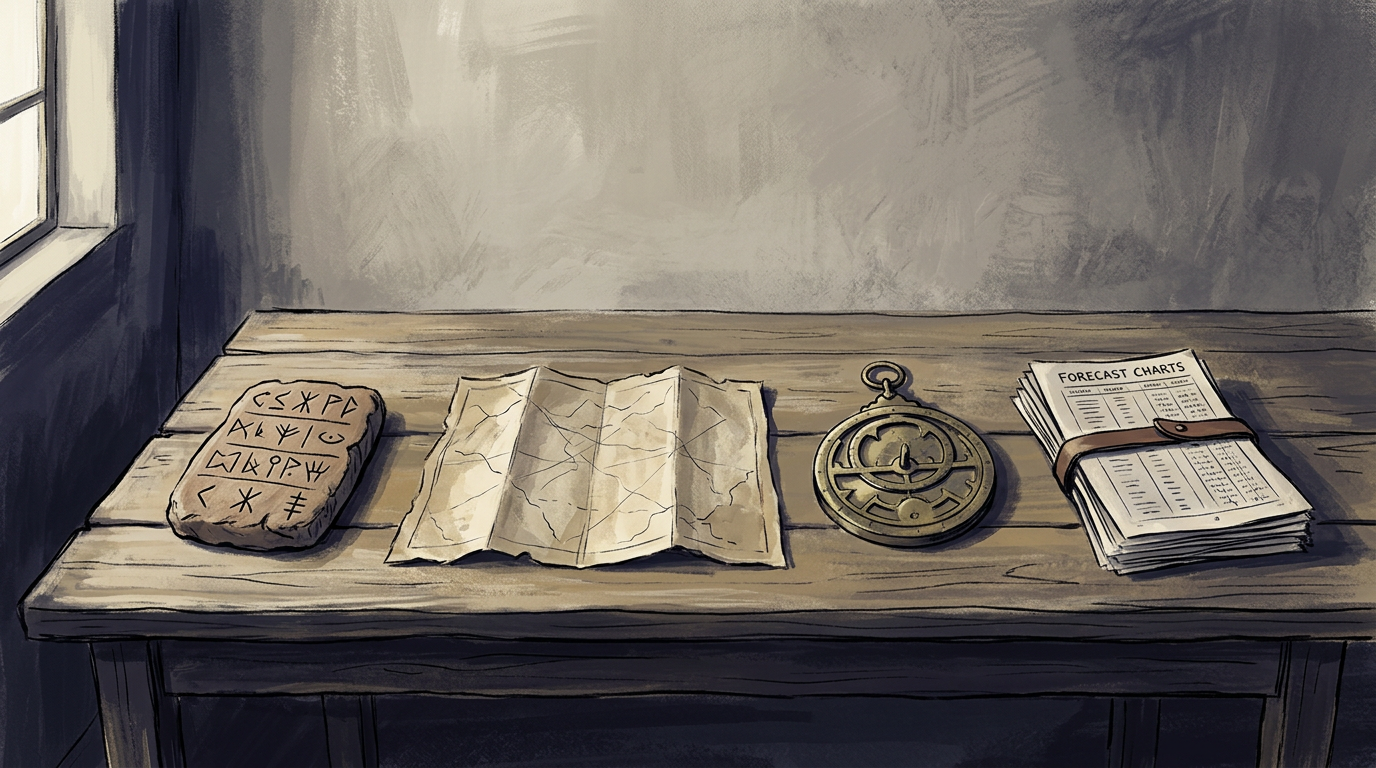
The tools of prediction have undergone a surface transformation so thorough that it obscures a deeper continuity. Babylonian haruspices examined the livers of sacrificed animals, mapping irregularities in tissue to irregularities in fate. Greek oracles at Delphi inhaled volcanic vapors and delivered pronouncements whose ambiguity was itself a hedge against falsification. Roman augurs watched the flight patterns of birds with the methodical attention of field researchers. Each system dressed intuition and pattern recognition in the garments of ritual authority.
Modern forecasting has replaced those garments with others. Algorithmic modeling, Monte Carlo simulations, sentiment analysis, and high-frequency data feeds now perform the same structural role: they lend an air of procedural rigor to the fundamentally uncertain act of describing what has not yet happened. The shift from sacred to secular framing has not altered the core transaction. A client — whether a Bronze Age monarch or a contemporary asset manager — pays for a reduction in perceived uncertainty. The prophet's value lies less in being correct than in providing a framework that makes the future feel navigable.
This is not to dismiss the genuine advances in probabilistic reasoning. Weather forecasting, actuarial science, and certain domains of epidemiology have demonstrably improved the accuracy of short-term prediction. But in the arenas where prophecy carries the most cultural weight — geopolitics, financial markets, technological disruption — the track record of expert forecasters remains, as research into prediction accuracy has repeatedly shown, only modestly better than chance over longer time horizons.
The Economy of Confident Wrongness
What distinguishes the contemporary prophetic economy is its tolerance for elegant failure. A pundit who predicted a market crash that never arrived may suffer a brief reputational dip, only to resurface with a revised thesis and a new book deal. The penalty structure has inverted: where ancient societies punished inaccuracy with death, modern media and consulting ecosystems often reward consistency of voice over consistency of result. Confidence, fluency, and narrative coherence function as currencies in their own right.
This dynamic creates a market incentive that would have puzzled an Assyrian king. The forecaster is compensated not primarily for accuracy but for the psychological service of imposing order on disorder. Audiences and institutions pay for the feeling of preparedness, a sense that someone, somewhere, has a map. The map need not correspond precisely to the territory.
Yet the underlying psychological lure remains identical across millennia. Uncertainty is cognitively expensive. The human nervous system treats ambiguity about the future as a low-grade threat, and any narrative that reduces that ambiguity — however provisionally — offers genuine neurological relief. Prophecy, in this reading, is less an intellectual exercise than a form of emotional regulation at civilizational scale.
The question that lingers is whether the collapse of consequences has made modern forecasting more honest or less. Ancient prophets, facing execution, had every incentive to hedge, to cultivate ambiguity, or to remain silent when genuinely uncertain. Today's forecasters, facing at worst a cycle of irrelevance before reinvention, have every incentive to speak boldly and often. Whether a culture that no longer kills its prophets for being wrong produces better predictions — or simply more of them — remains an open tension, one that says as much about the consumers of prophecy as about its producers.
With reporting from Arts and Letters Daily.
Source · Arts and Letters Daily