For decades, the industrial robot was a creature of habit — a rigid machine executing a meticulously scripted sequence of motions. Programming a robotic arm to weld, paint, or pick-and-place meant writing thousands of lines of deterministic code, each instruction tied to a precise coordinate in space. The approach worked, but it was brittle: any change in the production line — a new part geometry, a shifted pallet, a different lighting condition — required engineers to rewrite or recalibrate the entire routine.
That model is now under sustained pressure. As artificial intelligence integrates into the factory floor, the paradigm of manual programming is beginning to dissolve. In its place is a new class of machines that use sensor data to interpret their surroundings and make decisions in real-time, replacing hard-coded instructions with adaptive, learned behaviors. The shift was a central theme at the 2026 Robotics Summit and Expo, where industry leaders gathered to discuss not the theoretical promise of AI-driven robotics but the practical friction of deploying it at scale.
From Scripted Motion to Learned Behavior
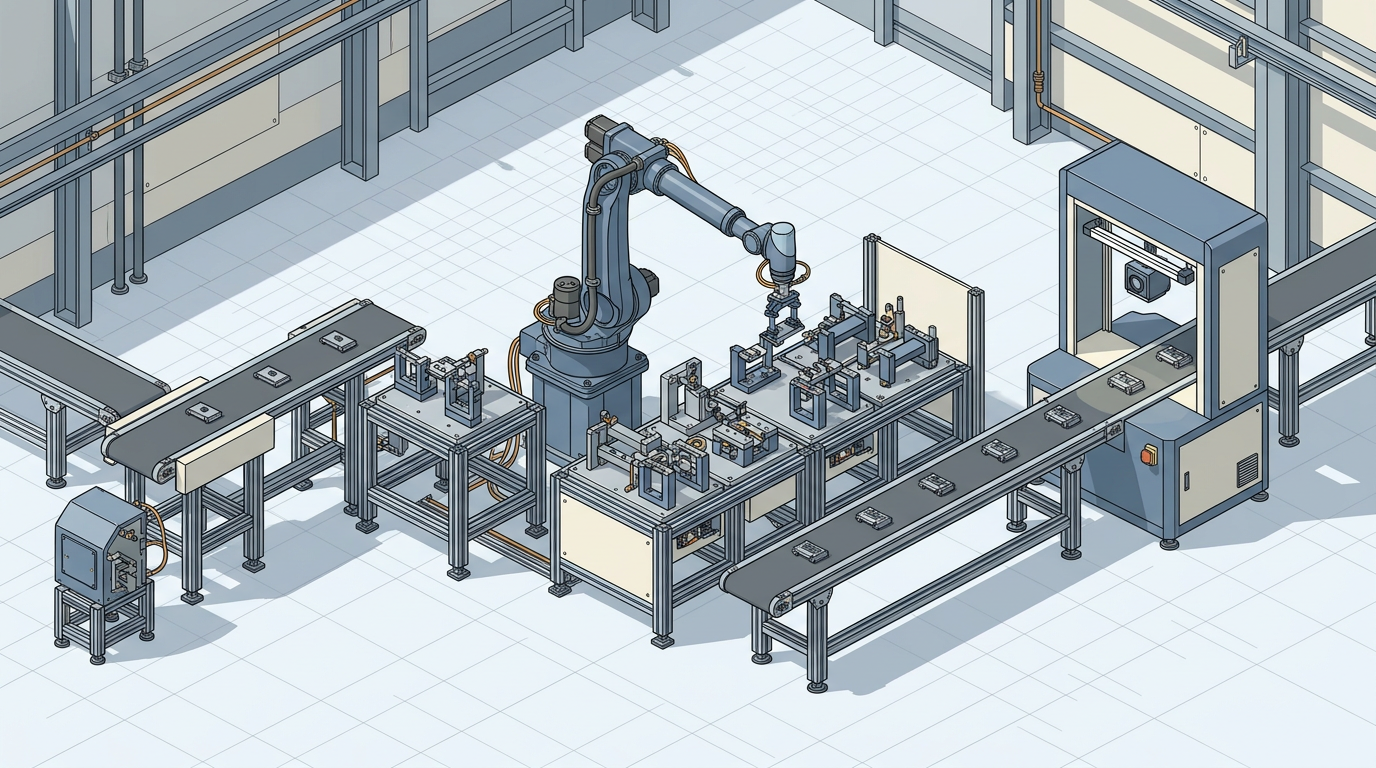
The conceptual leap is significant. Traditional industrial robots operate in what engineers call a "structured environment" — a workspace where every variable is controlled, every object is in a known position, and deviation is treated as failure. AI-enabled systems, by contrast, are designed to tolerate ambiguity. Using a combination of computer vision, force-torque sensing, and machine learning models trained on large datasets of manipulation tasks, these robots can generalize from prior experience to handle novel situations.
The appeal for manufacturers is clear. High-mix, low-volume production — where product variants change frequently and batch sizes are small — has long been hostile territory for conventional automation. The cost and time required to reprogram a robot for each variant often exceeded the labor savings. If a robot can instead learn a task from demonstration or simulation and then adapt on the fly, the economics shift dramatically.
But the transition from the controlled environment of the laboratory to the messy reality of the production line is not without friction. Lighting changes between shifts. Parts arrive with dimensional variation. Conveyor speeds fluctuate. The question the industry is currently grappling with is how much supervised training — how much "handholding" — a robot needs before it can reliably master a new skill, and how quickly these systems can adapt when a production line requires a sudden changeover.
The Infrastructure Problem
Beyond the robot itself, the supporting infrastructure demands attention. AI-driven systems are data-hungry: they require robust sensor arrays, edge computing hardware capable of running inference models in milliseconds, and network architectures that can move large volumes of data between the shop floor and cloud-based training pipelines. For many manufacturers, particularly small and mid-sized operations, this represents a capital and organizational burden that extends well beyond the price of the robot.
There is also the question of maintenance. A traditionally programmed robot, once validated, behaves identically on day one and day one thousand. A learning system, by definition, evolves — and that evolution must be monitored. Who is responsible when a model drifts? How are safety certifications maintained when the robot's behavior is no longer fully deterministic? These are not abstract concerns; they sit at the intersection of engineering, regulation, and operational risk.
The collaborative robotics segment, pioneered by firms such as Universal Robots, has already demonstrated that lowering the barrier to deployment can unlock automation in settings previously considered uneconomical. The next frontier is whether AI can lower that barrier further — not just making robots easier to program, but making programming itself largely unnecessary.
At the 2026 Summit, leaders from Universal Robots, PickNik Robotics, and Path Robotics addressed precisely this tension. Their focus was less on showcasing capabilities and more on cataloging the logistical realities: the effort required for initial deployment, the long-term maintenance burden of autonomous systems, and the gap between what works in a research demonstration and what survives a three-shift production schedule.
The industrial robot is acquiring a new kind of intelligence. Whether the factory floor is ready to receive it — organizationally, infrastructurally, regulatorily — remains the harder question.
With reporting from The Robot Report.
Source · The Robot Report