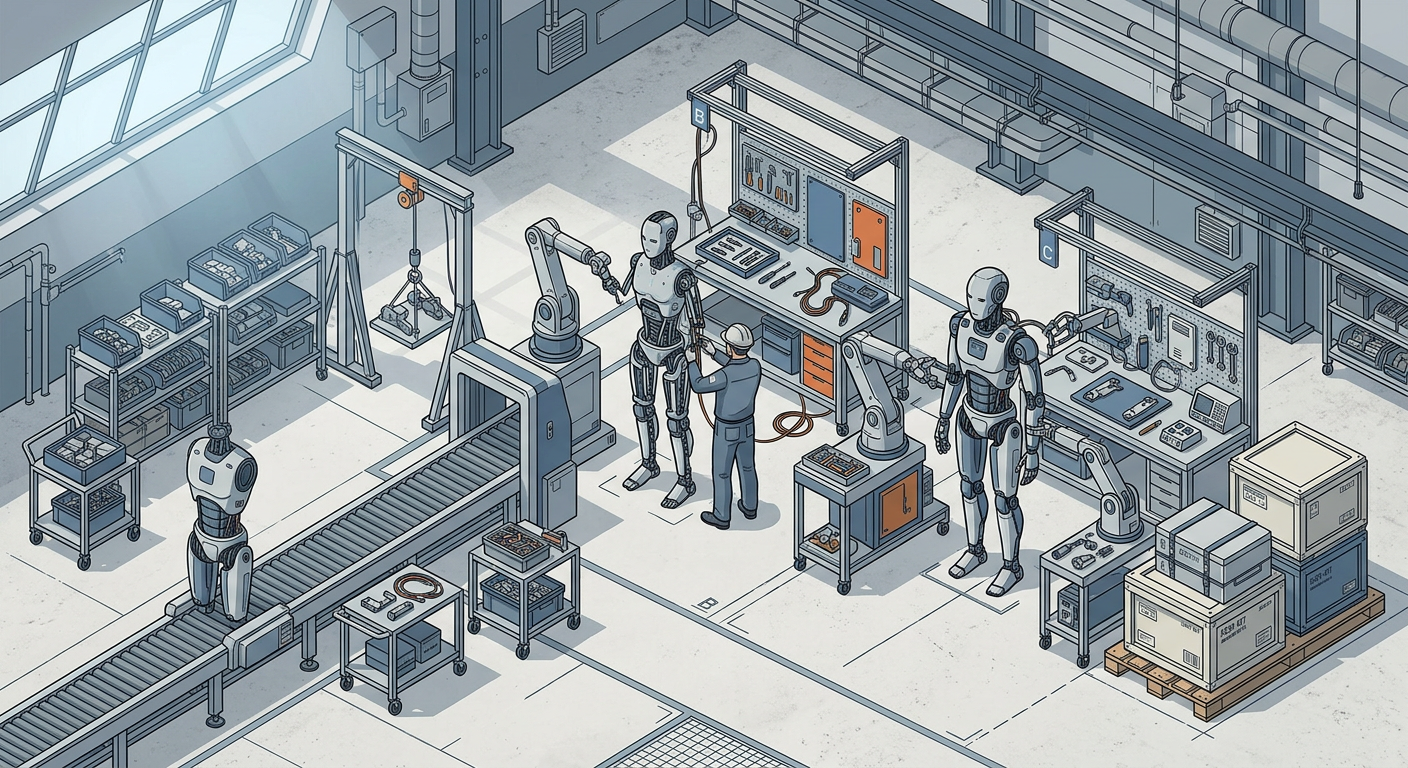
1X Technologies, the Norwegian robotics firm supported by OpenAI, has inaugurated a 58,000-square-foot manufacturing facility in Hayward, California. This development marks a pivotal transition for the company, moving from laboratory-focused research and development to the tangible, high-stakes environment of industrial-scale production. The facility is designed to support the assembly of 10,000 humanoid robots within its inaugural year, representing an ambitious attempt to bridge the gap between sophisticated artificial intelligence and physical utility in residential settings.
According to Bloomberg reporting, the expansion into the United States is a strategic maneuver intended to position 1X as a frontrunner in the nascent market for general-purpose humanoid robots. By establishing a physical footprint in the Bay Area, the company is aligning itself with the deep talent pools of robotics engineering and AI research, while simultaneously addressing the logistical requirements of scaling a hardware-intensive business. This move underscores a broader industry pivot, where the promise of embodied AI is no longer confined to simulated environments or limited beta testing, but is instead being forced into the harsh realities of factory floors and unit economics.
The Shift from Prototype to Production
The robotics industry has long been defined by the "prototype paradox": the ability to create highly capable, dexterous machines that function flawlessly in controlled environments, while failing to achieve the reliability or cost-efficiency required for mass adoption. For years, the sector was dominated by academic institutions and specialized industrial robotics firms that focused on repetitive, high-precision tasks in manufacturing. The emergence of humanoid robotics seeks to break this mold by introducing machines designed to navigate unstructured human environments, such as homes and offices, rather than fixed assembly lines.
Scaling production is not merely a matter of increasing component procurement or expanding floor space; it requires a fundamental rethinking of how robots are assembled and maintained. Unlike traditional industrial arms, humanoids require complex integration of sensors, actuators, and power management systems that must operate safely alongside humans. By targeting a production volume of 10,000 units, 1X is signaling that it has moved past the initial design phase and is now tackling the "manufacturing valley of death," where many hardware startups fail due to the inability to maintain quality control while driving down per-unit costs.
This transition also highlights the necessity of software-hardware co-design. Because these robots rely on sophisticated AI models for navigation and interaction, the manufacturing process must account for the continuous deployment of software updates that alter the robot's physical behavior. The integration of OpenAI’s backing suggests a strategy where the "brain" of the robot is treated as a service, allowing the hardware to remain relatively standardized while the intelligence evolves. This decoupling of software iteration from hardware cycles is a significant departure from legacy manufacturing norms.
The Economics of Embodied Intelligence
The economic viability of consumer humanoids remains the primary hurdle for the industry. To date, the cost of high-degree-of-freedom actuators and advanced sensing suites has relegated humanoid robots to research labs or high-end industrial pilot programs. If 1X is to succeed in bringing these machines into homes, it must solve the challenge of manufacturing at a price point that makes sense for consumer or small-business utility. The decision to establish a factory in California, a region characterized by high labor and operational costs, suggests that the company is prioritizing speed to market and proximity to engineering talent over the immediate pursuit of the lowest possible manufacturing overhead.
Furthermore, the competitive landscape is intensifying. Major tech incumbents and well-funded startups are all racing to achieve similar milestones in commercial viability. The mechanism of success here is likely to be driven by data acquisition; as more robots are deployed into real-world environments, the companies that can effectively ingest and process this data to improve their navigation and interaction models will gain a compounding advantage. Consequently, the Hayward factory serves as both a production hub and a data collection engine, providing the necessary telemetry to refine the AI models that underpin the entire platform.
Implications for Regulation and Safety
The introduction of thousands of humanoid robots into the wild carries significant implications for policymakers and regulators. Unlike stationary industrial robots, which are typically caged or cordoned off, these new machines are intended to operate in proximity to individuals who may not be trained in robotics safety. This shift necessitates a new framework for certifying hardware, focusing on unpredictable interaction scenarios rather than simple mechanical failure rates. Regulators will be watching the initial deployment closely to determine how to address issues of liability, privacy, and safety in residential spaces.
For competitors, the move by 1X sets a clear benchmark for what is expected in the current market cycle. It forces other players to either accelerate their own manufacturing timelines or clearly articulate their value proposition if they remain in the research phase. The presence of a commercial-scale factory also changes the conversation with potential customers, who now have a tangible reference point for assessing the feasibility of integrating humanoids into their own operations. The pressure is no longer on demonstrating what a robot can do in a video, but on proving that it can be built, delivered, and supported at scale.
The Outlook for Humanoid Integration
As 1X Technologies begins its production ramp-up, several questions remain regarding the durability of these machines in non-industrial settings. The ability to perform tasks in a factory environment is vastly different from navigating the clutter, staircases, and unexpected obstacles of a private home. The long-term success of this endeavor will depend not just on the initial production numbers, but on the real-world performance metrics of the first few thousand units once they move beyond the controlled environment of early adopters.
Furthermore, the broader market will be observing whether the consumer demand for such technology actually exists at the current price points. While the technological potential for general-purpose robots is immense, the transition from novelty to necessity requires a clear value proposition that justifies the capital expenditure for the end user. Whether these robots become essential tools or remain specialized curiosities will depend heavily on the software’s ability to handle the infinite variety of human tasks that are currently beyond the reach of automated systems.
As the manufacturing of humanoids moves from a theoretical goal to a logistical reality, the focus of the industry will inevitably shift from the capabilities of the hardware to the reliability of the entire ecosystem. The success of this factory will serve as a bellwether for the viability of the humanoid sector, demonstrating whether the promise of embodied AI can finally be scaled to meet the demands of a global market. With reporting from Bloomberg
Source · Bloomberg — Technology


