For decades, the quantum computer has remained more of a promise than a product — a delicate assembly of superconducting loops or trapped ions that lived exclusively in the ultra-cold isolation of the physics lab. The challenge was never just about making a qubit work; it was about making millions of them work at once. The manufacturing processes required for these machines were fundamentally incompatible with the high-volume lithography that defines modern computing. Now, two of the semiconductor industry's most established players are betting that the path forward runs through the same factories that already produce billions of classical chips every year.
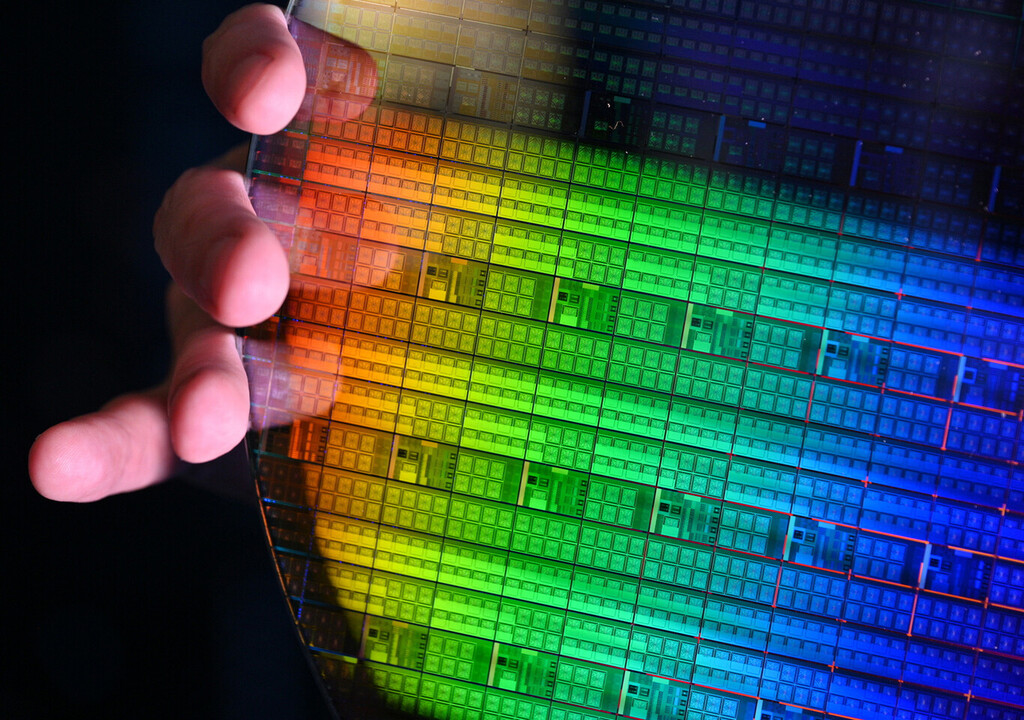
In early 2024, Intel and the QuTech research institute demonstrated that qubits could be produced using standard semiconductor manufacturing techniques — the same photolithography, deposition, and etching steps that pattern transistors at nanometer scale. Rather than building quantum processors in specialized, low-yield laboratory settings, the collaboration showed that silicon spin qubits could ride the existing infrastructure of a modern fab. GlobalFoundries has since begun pursuing a similar strategy, positioning its foundry capabilities as a platform for quantum-ready silicon.
From Laboratory Curiosity to Fab-Compatible Component
The significance of this shift is best understood against the backdrop of quantum computing's manufacturing problem. Most leading quantum architectures — superconducting circuits from IBM and Google, trapped-ion systems from Quantinuum — require exotic materials, extreme cooling, or highly customized fabrication environments. These approaches have produced working processors, but none has offered a clear route to the kind of volume production that classical computing achieved through decades of Moore's Law scaling.
Silicon spin qubits take a different approach. They encode quantum information in the spin state of individual electrons confined in silicon quantum dots — structures that, at least in principle, can be fabricated with the same CMOS processes used for conventional chips. The Intel-QuTech work demonstrated that a 300-millimeter wafer fab could produce these devices with meaningful yield and uniformity, two metrics that matter far more to an engineer planning production than to a physicist proving a concept.
This matters because the semiconductor industry's greatest asset is not any single technology but rather the cumulative investment in fabrication infrastructure. The global installed base of advanced fabs represents capital expenditure measured in the trillions of dollars. If quantum processors can be manufactured inside that existing base — even with modifications — the economics of scaling change dramatically. The cost curve bends from the steep, bespoke trajectory of laboratory prototyping toward something closer to the exponential improvement the classical chip industry has delivered for half a century.
The Gap Between Fabrication and Fault Tolerance
Manufacturing qubits at scale, however, is a necessary condition for practical quantum computing, not a sufficient one. The field's central obstacle remains error correction. Current qubits are noisy: they lose coherence quickly and interact with their environment in ways that corrupt calculations. Building a fault-tolerant quantum computer will likely require thousands of physical qubits for every logical qubit that performs useful computation. That ratio places enormous pressure on fabrication volume and device uniformity — precisely the strengths of industrial semiconductor manufacturing.
Here the strategies of Intel and GlobalFoundries intersect with a broader industry dynamic. As hyperscale cloud providers and national governments increase investment in quantum research, the question of who manufactures the hardware becomes strategically important. A foundry model for quantum chips would mirror the structure that already governs classical semiconductors, where design and fabrication are often handled by separate entities. GlobalFoundries' entry into this space signals that at least some industry participants see quantum fabrication as a future revenue line, not merely a research exercise.
Yet the approach carries its own risks. Silicon spin qubits, while fab-compatible, currently lag behind superconducting and trapped-ion systems in qubit count and demonstrated computational capability. The bet is that manufacturability will eventually outweigh early performance advantages — the same logic that allowed silicon to displace germanium and gallium arsenide in classical computing decades ago. Whether that historical parallel holds depends on whether the error rates of silicon spin qubits can be driven low enough, fast enough, to keep pace with architectures that are further along in algorithmic demonstrations.
The industrialization of the qubit does not guarantee that quantum computing will fulfill its most ambitious promises. What it does is reframe the challenge: from whether quantum hardware can be built at all, to whether it can be built well enough, cheaply enough, and reliably enough to matter. That is a different kind of problem — and one the semiconductor industry has spent seventy years learning how to solve.
With reporting from Xataka.
Source · Xataka