Last year, more than 500,000 industrial robots were installed globally, a figure that underscores the accelerating pace of factory automation. Yet behind that headline number lies a structural constraint the industry has struggled to resolve: a robot, no matter how advanced its sensors or control software, does not deploy itself. Someone has to design the workcell, wire the peripherals, program the motion paths, validate safety compliance, and tune the system until it meets production targets. That someone is almost always a system integrator — a specialized firm whose work remains poorly understood and, until recently, poorly documented.
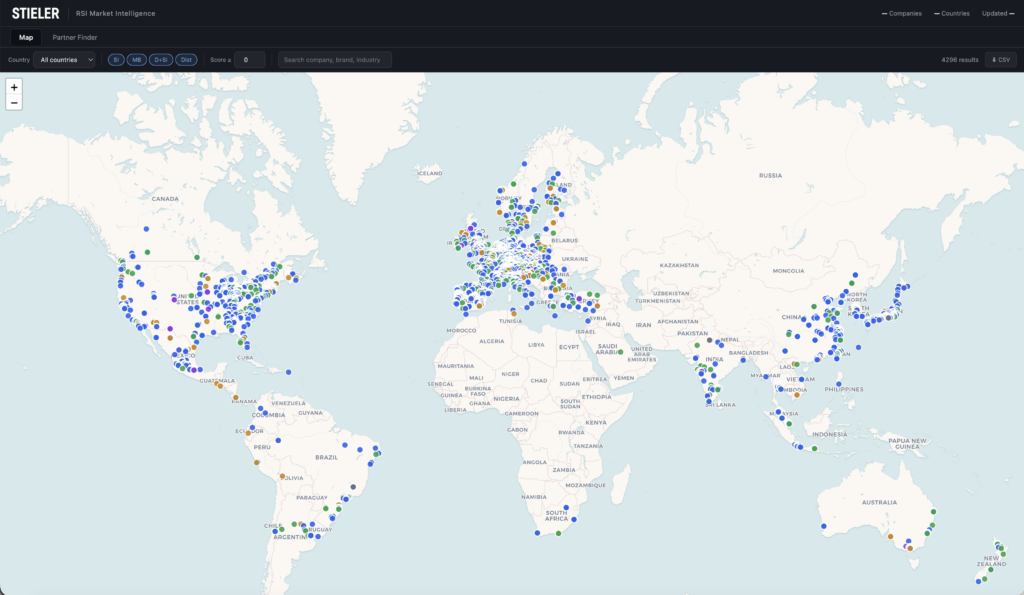
A joint effort by STIELER Technology & Market Advisors and RSI Market Intelligence has begun to address that gap, cataloging 4,296 integrator and machine-builder companies across 64 countries. The database represents the first serious attempt to map the fragmented partner layer that sits between robot manufacturers and end users. Its existence highlights an uncomfortable truth: the infrastructure that actually delivers automation to factory floors is less a structured supply chain than an unmapped frontier.
The cobot myth and the persistence of complexity
For much of the past decade, the robotics industry promoted a compelling narrative. Collaborative robots — cobots — would be so intuitive that small and mid-sized manufacturers could set them up without outside help. The pitch was "plug and play": unbox the arm, walk it through a few motions by hand, press start. In theory, this would democratize automation and erode the need for traditional integrators.
That narrative has largely failed to materialize. Even relatively straightforward applications — palletizing boxes, tending a CNC machine, assembling a simple kit — involve layers of complexity that extend well beyond the robot arm itself. Grippers must be matched to part geometry. Vision systems require lighting and calibration. Safety assessments must account for the specific layout of each facility. And the process knowledge needed to make a cell run reliably at production speed is rarely something an end user possesses in-house, particularly at the small and mid-sized enterprises cobots were supposed to serve.
The result is that integrators remain the essential translation layer between what a robot can do in principle and what it actually does on a given production line. Their role is less about installing hardware than about encoding process expertise into a functioning system. This makes them indispensable — but it also makes them a bottleneck.
An opaque ecosystem meets a growing demand signal
The scale of the mapping effort — nearly 4,300 firms across 64 countries — hints at how dispersed and heterogeneous this layer is. System integrators range from large engineering firms with hundreds of employees to small regional shops with deep expertise in a single application domain. Many serve only one or two robot brands. Some specialize by industry vertical; others by process type. The lack of a centralized directory has made it difficult for robot manufacturers to manage channel strategies and for end users to find qualified partners.
This opacity matters more as demand grows. With annual installations now above the half-million mark, the constraint on automation adoption is shifting from hardware availability and cost toward deployment capacity. A manufacturer that decides to automate a welding line or a logistics operation must find an integrator with the right combination of brand certification, application experience, and geographic proximity. In many regions and application niches, the supply of qualified integrators is thin.
The parallel to enterprise software is instructive. Major platforms like SAP and Salesforce long ago recognized that their growth depended not just on product quality but on the depth and reach of their implementation partner ecosystems. Those companies invest heavily in partner certification, training, and co-selling programs. The robotics industry, by comparison, has been slower to treat its integrator network as a strategic asset rather than a downstream afterthought.
Whether the new database catalyzes a more deliberate approach to building out this layer remains to be seen. Robot manufacturers face a tension: investing in integrator enablement increases deployment capacity but also reinforces dependence on a channel they do not fully control. Meanwhile, the push toward simpler programming interfaces and AI-assisted deployment tools continues, holding out the possibility — however distant — that some applications may eventually require less human intermediation.
The question is not whether integrators will remain relevant. It is whether the industry can scale their capacity fast enough to match the ambitions of a sector installing more than half a million machines a year — or whether the integration bottleneck becomes the binding constraint on automation's next chapter.
With reporting from The Robot Report.
Source · The Robot Report