In the long-running project of re-evaluating cinema history year by year, 1935 presents a curious challenge. While 1934 provided a robust lineup of classics and 1936 looms with the promise of Jean Renoir and Fritz Lang, the midpoint of the decade feels, in the estimation of film historian Kristin Thompson, like a period of pleasant entertainment rather than transformative art. It is a year defined less by its peaks and more by its archival gaps — a plateau in what is otherwise remembered as one of cinema's most fertile stretches.
The struggle to curate a credible "best of" list for 1935 is as much about logistics as it is about aesthetics. Thompson notes the increasing difficulty of sourcing high-quality versions of significant works; films such as Kenji Mizoguchi's Oyuki the Virgin or The Downfall of Osen remain trapped in archives or relegated to nearly unwatchable low-resolution uploads. The friction between the desire for historical completeness and the reality of decaying physical media highlights the fragile nature of a shared cinematic heritage that scholars tend to treat as settled.
The Archival Bottleneck
Film history, as it is commonly taught and consumed, rests on a foundation of availability. A work that cannot be seen cannot be canonized, and a work that can only be seen in degraded form is unlikely to receive the sustained critical attention that builds reputation over decades. The problem is not unique to 1935, but the year exposes it with particular clarity. By the mid-1930s, the global film industry was producing at industrial scale — Hollywood alone released several hundred features per year, and studios in Japan, the Soviet Union, France, and Germany maintained comparable output relative to their markets. Yet survival rates for films from this period remain uneven. Nitrate stock, the standard carrier of the era, is chemically unstable and notoriously flammable; entire national filmographies have been reduced by neglect, war, and simple decomposition.
The consequence for a project like Thompson's is that any ranking of a given year's output is necessarily provisional. A lost or inaccessible Mizoguchi may be the masterpiece that reframes the entire year, but until it resurfaces in viewable condition, the list must be assembled from what remains. This is a methodological constraint that applies across film historiography, though it is rarely foregrounded as openly as Thompson does here. Most canonical lists present themselves as judgments of quality; Thompson's approach foregrounds the judgment of circumstance.
Consolidation, Not Decline
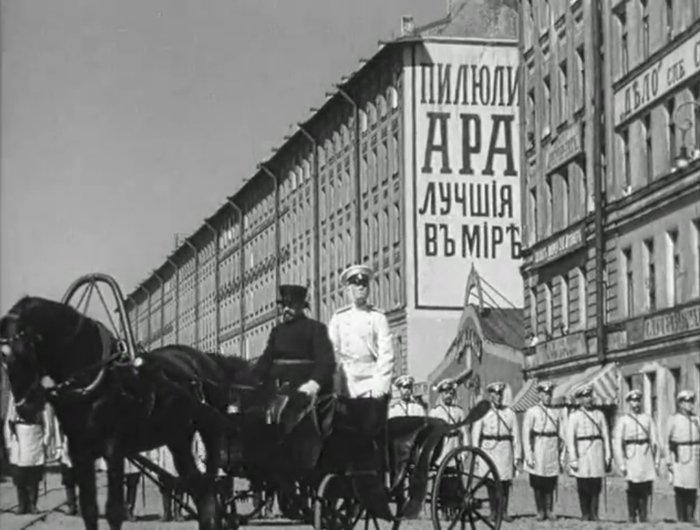
To call 1935 a weak year risks mischaracterizing what the surviving evidence actually shows. The films that remain — including Grigoriy Kozintsev and Leonid Trauberg's The Youth of Maxim — suggest a year of consolidation rather than stagnation. Studios and filmmakers across multiple national cinemas were absorbing the technical and narrative possibilities opened by the transition to synchronized sound, which had only stabilized a few years earlier. Consolidation years tend to produce work that is technically proficient and culturally legible but that lacks the disruptive energy of periods when new formal vocabularies are being invented or old ones are being dismantled.
This pattern is not unusual in the history of any art form. Literary historians have long noted analogous plateaus between periods of intense innovation — years in which the infrastructure of a medium catches up with its avant-garde. In cinema, the mid-1930s occupy a space between the early sound experiments of 1929–1932 and the mature classical style that would crystallize by the end of the decade. If 1935 feels like a lull, it may be because the groundwork being laid was structural rather than spectacular.
The deeper question Thompson's exercise raises is whether the rhythm of film history is intrinsic — driven by the creative cycles of individual artists and movements — or contingent, shaped by what happens to survive and in what condition. The answer is almost certainly both, but the relative weight of each factor shifts depending on the year under examination. For 1935, contingency looms large. The absence of key works from directors known to have been active that year means the historical record is not merely incomplete but potentially misleading. Whether future restorations or archival discoveries will revise the picture remains an open question — one that depends less on scholarly effort than on the physical chemistry of aging celluloid and the funding priorities of the institutions that house it.
With reporting from David Bordwell Blog.
Source · David Bordwell Blog