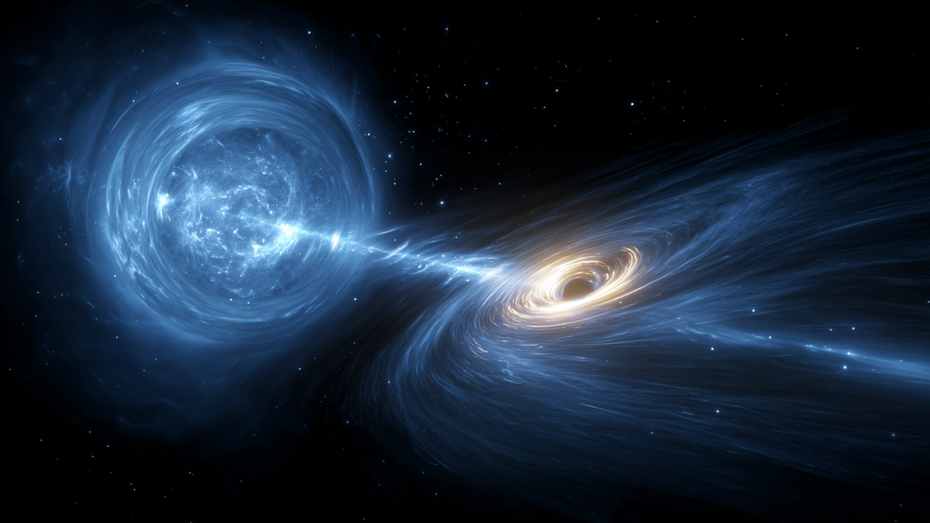
Cygnus X-1 holds a storied place in the history of astrophysics as the first object to be widely accepted as a black hole. Discovered in the early 1960s, it has long served as a laboratory for understanding how these gravitational titans interact with their surroundings. Recent observations have provided a fresh perspective on its power, revealing an energy output that underscores the black hole’s role as a primary architect of the cosmos.
The system, located roughly 6,000 light-years away, is a binary pair consisting of a massive blue supergiant star and a black hole. As the black hole pulls matter from its companion, it creates a high-energy environment that releases kinetic energy equivalent to 10,000 suns. This isn't merely a passive consumption of matter; it is a violent, systemic feedback loop that ejects powerful jets of particles into the surrounding interstellar medium.
This massive release of energy serves as more than just a celestial spectacle. Researchers suggest that such forces are fundamental to the evolution of galaxies. By heating the surrounding gas and pushing it away, black holes like Cygnus X-1 can regulate star formation and influence the structural development of their host galaxies over millions of years. It is a reminder that the most destructive forces in the universe are often the same ones that dictate its long-term organization.
With reporting from t3n.
Source · t3n