The Limits of Martian Exploration at Antofagasta Crater
For over 4,800 Martian sols — each roughly 24 hours and 39 minutes — NASA's Curiosity rover has served as a solitary field geologist inside Gale Crater. Its recent arrival at a small impact feature informally named "Antofagasta," roughly 33 feet (10 meters) across, raised expectations among mission planners. Impact craters of that scale can act as natural excavations, punching through surface layers and exposing deeper rock that would otherwise require drilling or trenching to reach. At Antofagasta, the science team hoped to find strata long shielded from the relentless bombardment of cosmic rays — a prerequisite for detecting preserved organic compounds, the molecular building blocks that inform questions about Mars's ancient habitability.
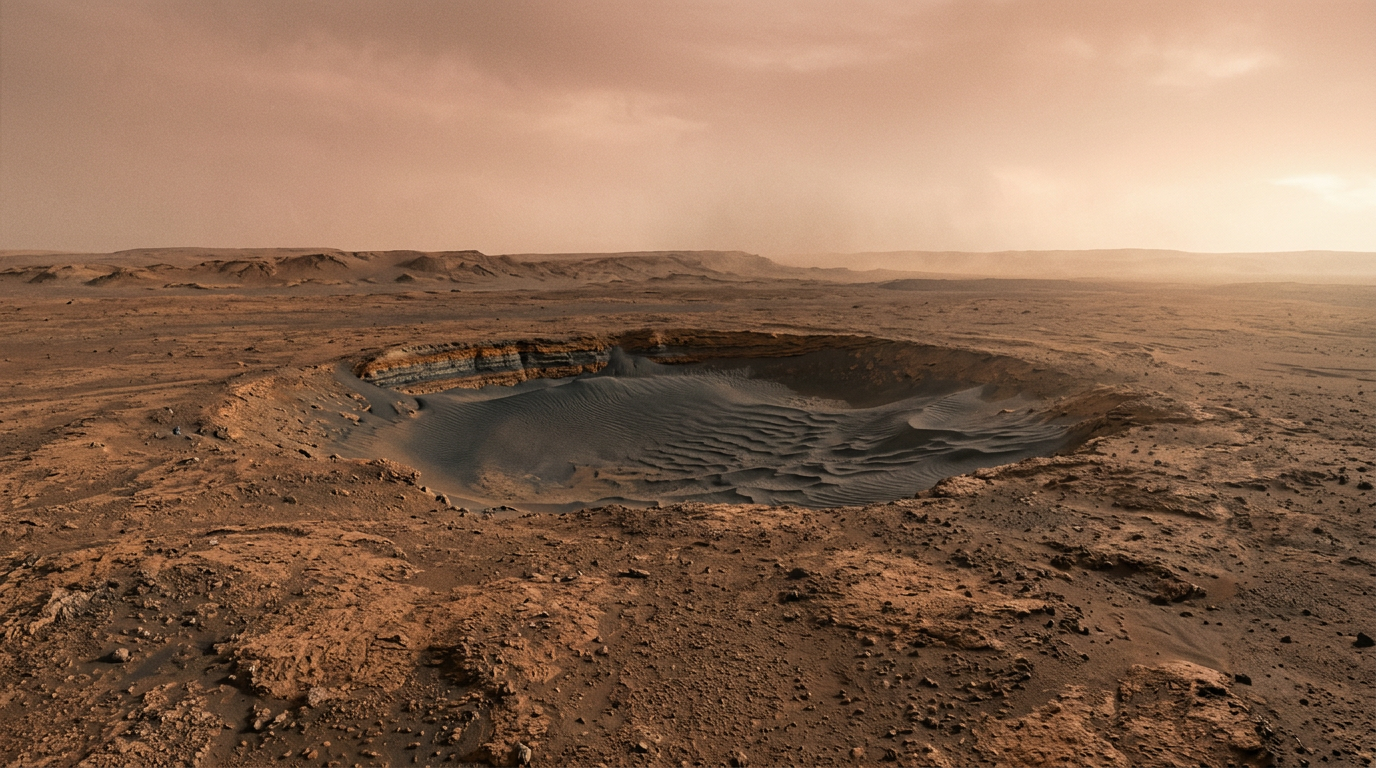
The reality on the ground, however, diverged from what orbital reconnaissance had suggested. When Curiosity's mast-mounted cameras surveyed the crater rim, they revealed a basin largely filled with dark, rippled sand. Wind-driven sediment — aeolian material, in geological terminology — had blanketed the deepest and most scientifically valuable rock exposures. Only a narrow band of outcrop remained visible just above the sand line, offering far less analytical surface than the team had anticipated.
Why Buried Strata Matter
The scientific logic behind targeting impact craters is straightforward. Mars lacks a global magnetic field and possesses only a thin atmosphere, which means its surface is continuously irradiated by galactic cosmic rays and solar energetic particles. Over geological timescales, this radiation degrades organic molecules in exposed rock, making surface samples unreliable indicators of past chemistry. Rock that has been buried — whether beneath meters of overburden or inside a crater wall — stands a better chance of preserving whatever organic signatures it once held.
Curiosity's drill, capable of boring roughly two inches into rock, has been the mission's primary tool for accessing these shielded layers. The rover's Sample Analysis at Mars (SAM) instrument suite can then heat the powdered rock and analyze the gases released, searching for carbon-bearing compounds. At Antofagasta, the combination of a relatively fresh impact and significant depth appeared to offer an unusually direct path to well-preserved material. Sand infill turned that prospect into a logistical dead end.
The phenomenon is not unique to this crater. Aeolian processes are among the most active geological forces on present-day Mars. Wind-blown sand migrates across the surface in dunes and ripples, filling depressions and obscuring outcrops on timescales that are short by geological standards but long enough to frustrate a rover that arrives at any given location only once. Curiosity encountered analogous challenges earlier in its traverse through Gale Crater, where sand sheets periodically covered targets of interest along the foothills of Mount Sharp.
Pivoting Under Constraint
The mission team evaluated whether Curiosity could descend into the crater to reach the remaining exposed rock just above the sand line. The geometry worked against them. Navigating the steep, uneven rim would have required approach angles that risked compromising the rover's stability — a calculation that carries increasing weight as the vehicle ages. Curiosity landed in August 2012; its wheels, actuators, and power source have all accumulated wear that narrows the margin for aggressive maneuvers.
Rather than accept the risk, planners chose to redirect the rover toward more accessible terrain in search of the next viable drill target. The decision reflects a broader operational philosophy that has defined Curiosity's longevity: conservative path selection in service of sustained scientific output. A single mechanical failure on a slope could end the mission outright, forfeiting years of potential data for one speculative sample.
The episode at Antofagasta illustrates a tension that runs through all robotic planetary exploration. Orbital instruments can identify promising targets from above, but they cannot fully resolve surface conditions at the scale that matters to a rover — grain size, slope stability, sand depth. The gap between what looks accessible from orbit and what proves reachable on the ground remains one of the defining constraints of Mars surface science. Each such encounter refines the models that will inform target selection for future missions, including those that may one day return samples to Earth. Whether those future explorers will find Antofagasta's buried strata still waiting beneath the sand — or swept clean by the same winds that deposited it — is a question only Mars will answer on its own schedule.
With reporting from NASA Breaking News.
Source · NASA Breaking News