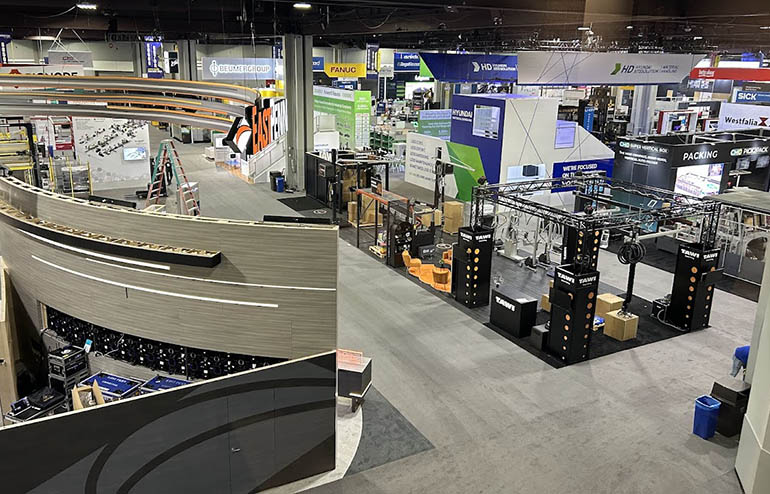
The cavernous halls of Atlanta's Georgia World Congress Center recently played host to MODEX 2026, an event that has evolved from a niche material handling trade show into a sprawling barometer for the global supply chain. With over 1,000 exhibitors and 50,000 attendees, the scale of the gathering underscored a fundamental shift: automation is no longer a speculative luxury for the few, but the baseline infrastructure for the many. This year's floor was defined not just by the hum of machinery, but by an industry grappling with the complexities of interoperability and the maturation of artificial intelligence.
MODEX, organized by MHI and held on a biennial cycle alternating with ProMat, has long served as a venue where logistics operators evaluate the next generation of warehouse technology. But the tenor of the 2026 edition marked a departure from previous years. Where earlier shows featured robotics as a novelty — a crowd-drawing spectacle on the periphery of conveyor belts and racking systems — this iteration placed autonomous systems at the center of nearly every major booth and panel discussion.
The ASRS Arms Race and the Problem of the Last Pallet
The competitive landscape for automated storage and retrieval systems (ASRS) has intensified considerably. Established players like AutoStore, whose cube-based grid storage architecture helped define the modern micro-fulfillment center, now face credible challengers such as Attabotics, which employs a vertical, single-structure design intended to reduce the physical footprint of storage. The proliferation of ASRS vendors reflects a market where the underlying technology is increasingly commoditized, pushing differentiation toward software orchestration, throughput guarantees, and ease of integration with existing warehouse management systems.
Beyond storage density, the pursuit of the so-called "rainbow pallet" — the ability to build mixed-case loads with surgical precision, combining products of varying size and weight on a single pallet — emerged as a recurring theme. Collaborations between FANUC, the Japanese industrial robotics giant, and Angelini Technologies illustrated the kind of cross-disciplinary engineering required to solve this problem at scale. Mixed-case palletizing sits at an awkward intersection of vision systems, gripper design, and real-time planning algorithms, and it remains one of the harder unsolved challenges in warehouse automation.
The conversation extended further downstream to truck unloading, widely regarded as one of the most physically demanding and least standardized tasks in logistics. Companies like Boston Dynamics and Slip Robotics are attempting to automate these nodes — areas where the variability of package geometry, trailer conditions, and loading patterns has historically resisted automation. The difficulty of the problem helps explain why these segments have lagged behind more structured tasks like goods-to-person picking.
Humanoids at the Threshold
Perhaps the most telling signal from MODEX 2026 was the evolving discourse around humanoid robots and general-purpose AI agents. The general-purpose humanoid remains, by any honest assessment, a work in progress. Locomotion in cluttered environments, dexterous manipulation of irregular objects, and the ability to adapt to novel tasks without extensive reprogramming are all areas where current systems fall short of the reliability demanded by commercial logistics operations.
Yet the proximity of these machines to the warehouse floor has never felt closer. The broader robotics industry has benefited from rapid advances in foundation models and sim-to-real transfer — training robots in simulated environments and deploying learned behaviors on physical hardware. These techniques have compressed development timelines and expanded the range of tasks that prototype humanoids can credibly demonstrate, even if production-grade deployment remains ahead.
The narrative at MODEX 2026 suggested that the defining question for the next phase of logistics automation is not whether robots will be present, but how seamlessly they can be integrated into existing workflows. The era of isolated pilot programs — a single robotic arm in a corner of a distribution center, monitored by a dedicated team — appears to be giving way to a period of systemic deployment, where heterogeneous fleets of autonomous machines must coordinate with each other and with human workers across entire facilities.
That transition introduces a different class of challenge. Interoperability standards remain fragmented. The labor dynamics of mixed human-robot environments are still poorly understood at scale. And the capital expenditure required to retrofit legacy warehouses sits in tension with the margin pressures that motivate automation in the first place. Whether the industry can resolve these tensions incrementally or whether a more disruptive reconfiguration of warehouse design is required remains an open question — one that the next edition of MODEX will almost certainly revisit.
With reporting from The Robot Report.
Source · The Robot Report