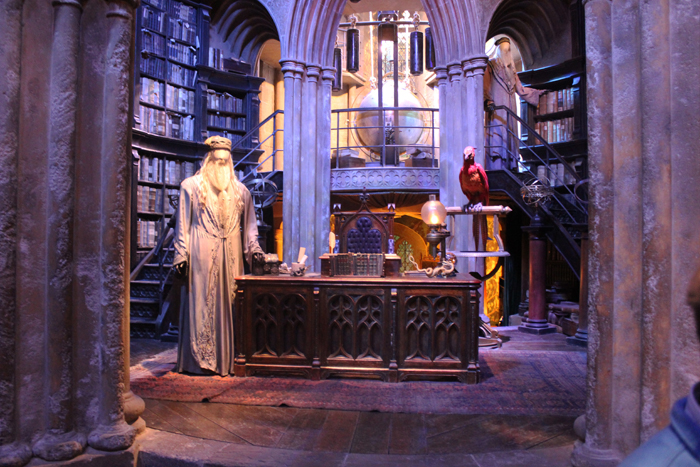
At Warner Bros. Leavesden Studios, northwest of London, the artifice of cinema is laid bare. For film historian Kristin Thompson, a recent excursion to "The Making of Harry Potter" provided a deep dive into the physical infrastructure of one of the most significant franchises in modern film history. Located in the very sound stages where the eight films were produced between 2001 and 2011, the tour serves as a permanent exhibition of the labor required to sustain a decade-long production — and a reminder that blockbuster filmmaking remains, at its core, a manufacturing enterprise.
The tour's appeal lies in its focus on the tangible. While the Harry Potter films are often remembered for their digital wizardry, the exhibition emphasizes the physical craft — the hand-carved props, the weathered costumes, and the massive, timber-framed sets. It is a testament to the industrial scale of world-building, where the transition from page to screen is mediated by thousands of specialized artisans and designers. For a franchise that grossed billions at the global box office, the sheer materiality on display at Leavesden offers a corrective to the assumption that contemporary spectacle is born primarily inside computers.
Craft as Counter-Narrative
Studio tours have a long lineage in Hollywood's relationship with its audience. Universal opened its backlot to visitors as early as 1915, and the practice has evolved into a significant revenue stream for major studios. But the Leavesden exhibition occupies a distinct niche. Rather than offering a theme-park simulation of fictional worlds, it foregrounds process: how things were built, painted, aged, and lit. The emphasis falls on departments — set decoration, creature effects, costume design — that rarely receive public attention proportional to their contribution.
This curatorial choice aligns with a tradition in film scholarship that treats movies not as immaterial stories but as physical artifacts produced under specific industrial conditions. Thompson, whose academic work with David Bordwell has long examined the formal and material dimensions of filmmaking, is a natural interlocutor for this kind of exhibition. The tour, in her framing, becomes less a fan pilgrimage and more an open archive — one that documents the organizational complexity behind a production that spanned four directors, hundreds of sets, and a cast that aged in real time across a decade of shooting.
The scale is worth pausing on. Leavesden itself was a former aerospace factory, repurposed by Warner Bros. after the studio acquired the site during pre-production on the first film. The conversion of an industrial facility into a permanent filmmaking campus — and later into a heritage attraction — mirrors a broader pattern in the British film industry, where large-scale productions from Hollywood studios have reshaped the country's physical and economic landscape.
The Weight of the Object
Accessing this archive of film history involves a pilgrimage from London's Euston Station to the outskirts of Watford. Whether through independent travel or guided services, the journey highlights a logistical complexity that mirrors the production itself. For those interested in the systems of cinema, the tour offers more than nostalgia; it provides a rare look at the sheer weight and volume of the materials that constitute a modern myth.
There is something instructive in the gap between how audiences experience a film and how it is made. Digital effects flatten everything into pixels on a screen; the Leavesden tour restores dimension. A prosthetic goblin mask has texture, heft, the faint smell of silicone. A miniature of Hogwarts castle, built at extraordinary detail, reveals the paradox of scale models — they are simultaneously smaller than what they represent and larger than what the camera needs to see. These objects resist the dematerialization that defines so much of contemporary media consumption.
As Warner Bros. prepares a new Harry Potter television adaptation, the question of how much physical craft will survive into the next iteration remains open. Television budgets, even generous ones, operate under different constraints than theatrical tentpoles. The virtual production techniques that have proliferated since the pandemic — LED volumes, real-time rendering — offer efficiency but alter the relationship between performer and environment. Whether the next generation of the franchise will produce artifacts worth preserving in a warehouse outside Watford, or whether the magic will live entirely on hard drives, is a tension the Leavesden tour frames without resolving.
With reporting from David Bordwell Blog.
Source · David Bordwell Blog