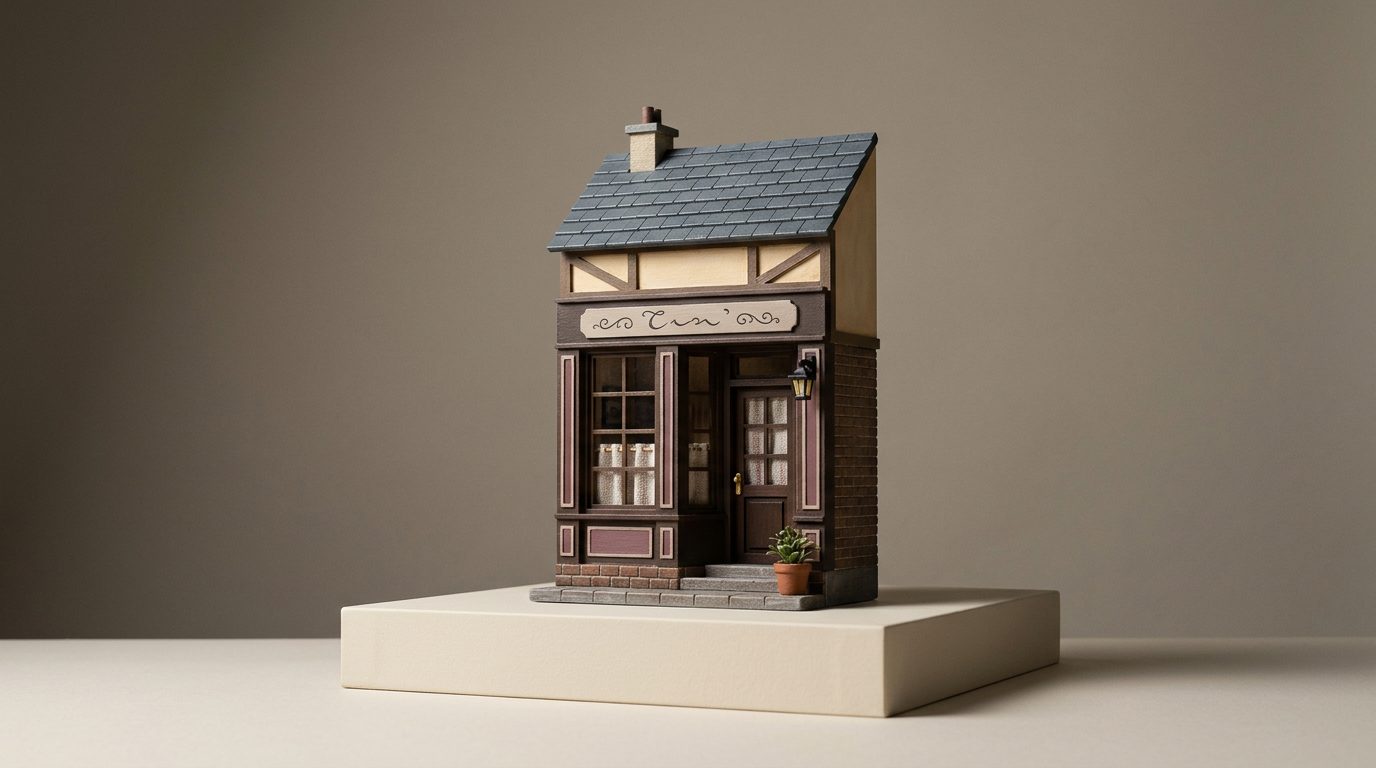
The global coffee ritual has long oscillated between the public theater of the café and the private utility of the home kitchen. At this year's Milan Design Week, Italian appliance maker De'Longhi is attempting to collapse that distance with an installation called "The World's Smallest Coffee Shop." Created in partnership with Simon Weisse Studio — the workshop responsible for the tactile, idiosyncratic miniature worlds seen in Wes Anderson's films — the project features five hyper-detailed miniature facades, each representing the coffee culture of a different city: Paris, Tokyo, Milan, Copenhagen, and Berlin.
The collaboration places De'Longhi's Rivelia machine at the center of a narrative about craft, ritual, and domestic aspiration. Weisse's team built everything from microscopic bistro curtains to tiny, functional windows that open to reveal the interface of the appliance itself. For Weisse, the choice to use physical miniatures over digital renderings is deliberate: physical models possess a "sense of wonder and precision" that CGI often fails to replicate. That tactile fidelity doubles as a metaphor for the machine's own mechanical precision — specifically its ability to switch between bean varieties with ease.
Design Week as Brand Theater
Milan Design Week has evolved well beyond its origins as a furniture trade fair. Over the past decade, it has become the preferred stage for consumer brands seeking to associate their products with design credibility. Automotive companies, fashion houses, and electronics manufacturers now routinely commission installations that blur the line between product showcase and art exhibition. The logic is straightforward: proximity to the design world confers a seriousness that conventional advertising cannot.
De'Longhi's installation fits squarely within this tradition but adds a layer of specificity. Rather than presenting an abstract design statement, the brand chose to root each miniature in a recognizable urban coffee culture. Paris gets its zinc-counter bistro aesthetic; Tokyo, the precision of a kissaten; Copenhagen, the clean minimalism of Nordic specialty coffee. The effect is to position a kitchen appliance not merely as a functional object but as a cultural artifact — one that carries the accumulated meaning of the places where coffee is taken most seriously. The partnership with Weisse, whose work audiences associate with the meticulous world-building of Anderson's films, reinforces the message: this is an object that rewards close attention.
The Countertop as Third Place
Beyond the aesthetic charm, the project signals a broader shift in industrial design toward what might be called domestic professionalization. The sociologist Ray Oldenburg coined the term "third place" to describe the social spaces — cafés, barbershops, bookstores — that exist between the obligations of work and the privacy of home. For much of the specialty coffee movement's history, the third place was the independent café, a space defined by the barista's skill and the room's atmosphere.
De'Longhi's installation argues, implicitly, that this experience can be distilled into a countertop appliance. It is not the first brand to make such a claim — the entire premium home-espresso segment rests on a version of it — but the framing through architectural miniatures sharpens the proposition. The message is not simply that the machine makes good coffee; it is that the machine inherits the cultural weight of the café itself.
Whether consumers actually experience their kitchens as third places remains an open question. The café's value has always been partly social — the presence of strangers, the rhythm of a shared space, the barista's recognition. A machine, however precise, cannot replicate that. What it can do is replicate the drink, and for a growing segment of consumers who prioritize convenience and control over communal ritual, that may be sufficient.
The tension, then, is between two competing visions of coffee culture: one that insists the setting is inseparable from the experience, and another that believes the experience can be engineered into an object. De'Longhi, through Weisse's miniatures, is betting on the latter — while borrowing the visual language of the former to make its case.
With reporting from Hypebeast.
Source · Hypebeast